From the Editors
Jadaliyya Launches DARS Page: Daily Acts of Resistance and Subversion
Tadween Publishing Blog is here! Check it out
Jadaliyya's first book is now available! Click here.
Want to find out about new books? Visit our expanding NEWTON page. Click here.
Interested in writing a Review for Jadaliyya? Visit our Call for Reviews here.
الآن . . . القسم العربي بحلة جديدة
Jadaliyya Launches Photography Page (click here!)
Call for Photos: Become a Contributing Photographer at Jadaliyya
Contesting Narratives, Locating Power (Lund Conference)
Egyptian History Without 'Egypt'? Privileging Pluralism in a Post-Revolution Pedagogy
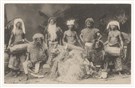
[image from unknown archive]
The legacy of Egypt’s 1952 revolution was one of mobilization but, importantly, of exclusions as well – exclusion of women and of Islamists, for instance. In the wake of the 2011 revolution, the question emerges: Is it possible to conceive an Egyptian nationalism that mobilizes without excluding? The struggle for a pluralistic Egyptian nationalism is, to my mind, the greatest legacy of the January 25th revolution. And one of the greatest tests of the revolution’s success or failure will be how Egyptian nationalism is redefined to accommodate Egypt’s Coptic Christian minority.
In the past, the invocation of the ‘national unity discourse’ has sufficed to accommodate Copts. Advocates of this discourse have ventured so far as to deny the existence of a Coptic minority within Egyptian borders altogether. Within this framework, sectarianism has taken on the guise of an aberrant distraction from the solidarity of the Egyptian people.
Yet, in early March 2011, a Coptic sit-in brought to a halt all traffic in front of the Radio and Television Building in downtown Cairo. The ostensible cause of the protest was the destruction of a church in the Hilwan governorate. I would suggest, though, that the Coptic protests need to be understood as a call for acknowledgment of contemporary Coptic life and culture, of a distinctive Coptic identity.
Indeed, what seems to have eluded partisans of the ‘national unity discourse,’ is that this Coptic identity carries enormous import for various parts of the community. I might add that this has eluded scholarly observers of Egypt abroad, as well. If one judges their importance in contemporary Egypt by the extent to which they attract attention from scholarly observers, one might well conclude that Copts have a negligible impact on Egyptian social, political, or cultural life. There are, for instance, practically no histories of the Coptic community or Coptic social life in the English language. This has made teaching about a vital facet of diversity and pluralism within the Egyptian nation difficult, if not impossible.
Copts appear to attract attention from Western scholars only in so far as they attract attention from Egyptian Islamists, and never for the dynamics of their own community. A case in point: I was delighted by the recent publication of a book whose subtitle reads Non-Muslims and the Egyptian State, convinced that this text would accord serious and sustained attention to the implications of the distinctly Coptic culture I have referenced. Yet, in this book that is explicitly dedicated to non-Muslims and their relations with the Egyptian state, the text is overwhelmingly concerned with Islamist thinkers and their vision of Egyptian citizenship. Coptic conceptions of citizenship are relegated to a chapter at the end entitled ‘Coptic Responses.’ The title of that chapter is highly revealing, for Copts seem only to exist for scholars of Egypt when they respond to Islamists.
Perhaps the greatest testimony to the post-revolutionary Coptic demand for acknowledgment, is how protesters have transformed the phrase ‘Irfaa raasak ya achi, inta Misri’ (‘Raise your head my brother, you are Egyptian’), much in circulation now as a mark of newfound, revolutionary pride in the nation, into ‘Irfaa raasak ya achi, inta Qibti’ (‘Raise your head my brother, you are a Copt’). In much the way that this act of naming held tremendous importance for Egyptians when the words came from Nasser in the 1950s, recasting the formulation as an acknowledgment of Coptic life and community had tremendous importance for Copts as they stood before the Radio and Television Building in March 2011. And much as the Egyptian national community must reckon with this demand for acknowledgment, so too must scholars of Egypt, in both their research and their pedagogy.
“There is no doubt that the new constitution represents a concession to the Moroccan protest movement ... Yet, this should not obscure the fact that the monarch strictly controlled and managed the whole reform process.”click | email | tweet
Jadalicious / جدلشس
Twitter Updates
Latest Entries
View All Entries »- Last Week on Jadaliyya (May 13-19)
- Jadaliyya's Occupation, Intervention, and Law Page Resonates
- Al Jazeera Management Orders Joseph Massad Article Pulled in an Act of Pro-Israel Censorship
- سعادت حسن منتو: قصة قصيرة
- Reports Roundup (May 18)
- Injuries, Arrests and House Raids: The Case of a Bahraini Family
- الليبرالية الفلسطينية أمام القضاء الإسرائيلي
- ما هي النكبة؟
- Academic Freedom and the Middle East: A Handbook for Teaching and Research
- Syria's Inglorious Basterd
- Maghreb Media Roundup (May 17)
- Buckling to Bigotry: The Newseum Dishonors Murdered Palestinian Journalists
- كتب: أطفال الندى
- Statement of the Arab and Middle East Journalists Association in Reference to Newseum Scandal
- New Texts Out Now: Maya Mikdashi, What is Settler Colonialism? and Sherene Seikaly, Return to the Present
- On the Margins Roundup (May)
- On the American Association of University Professors' Opposition to Academic Boycotts
- The Palestinian Museum: An Agent Of Empowerment And Integration For Palestinians
- An Ongoing Displacement: The Forced Exile of the Palestinians
- Syria Media Roundup (May 16)