From the Editors
Jadaliyya Revamps Arabic Section . . . click here
Jadaliyya Launches Arabian Peninsula Page . . . Click here!
الآن . . . القسم العربي بحلة جديدة
The Culture Page Returns . . . . click here
Jadaliyya launches its new Syria page . . . Click here.
Want to find out about new books? Visit our expanding NEWTON page. Click here.
Call for Photos: Become a Contributing Photographer at Jadaliyya
Internship Opportunities at ASI (Jadaliyya, Arab Studies Journal, FAMA). Click here!
The Jadaliyya Egypt Elections Watch page archives! Click here for comprehensive coverage.
Interested in writing a Review for Jadaliyya? Visit our Call for Reviews here.
Kosova, Libya, and the Question of Intervention
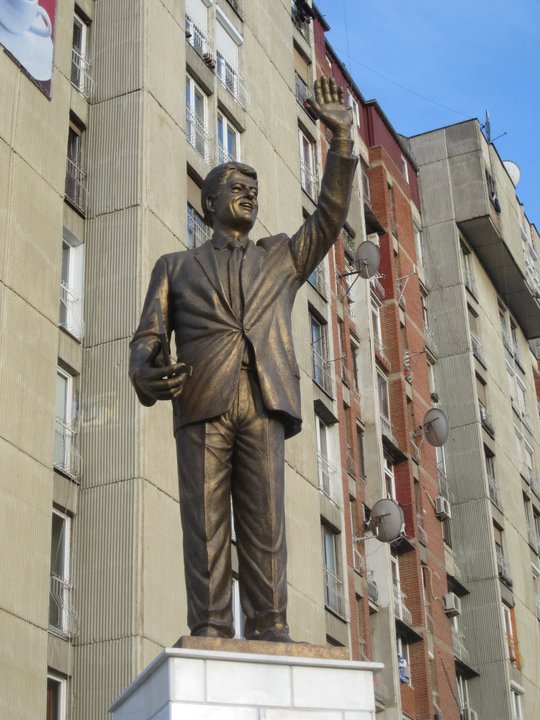
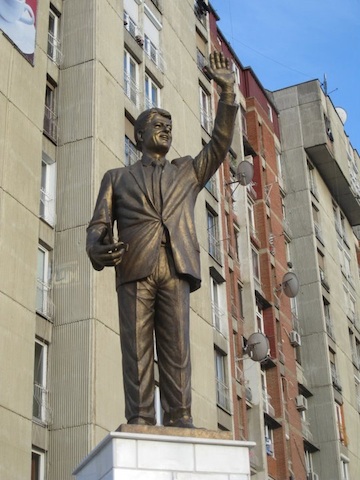
[Public Art in Pristina. Image by Michael Kennedy]
Kosova and Libya are juxtaposed nowadays in suggesting what humanitarian intervention can do. Hashim Thaci, Kosova’s prime minister and former resistance fighter, celebrates what NATO did to defend Kosovars in 1999 when they bombed Serbia and its forces for 78 days to prevent genocide. Few if any Kosovars would decry that intervention, leading some in the newly independent state to find sympathy for airstrikes in Libya. Perhaps that is why Kosova is again in the news, for many across NATO’s capitals wish for a replication of that kind of appreciation in Libya and the Arab world. But it’s not just a question of the strike, it’s the follow through that should be of concern as well.
Kosova has had substantial Western follow through dedicated to both stability and democracy. Although finally declaring independence in 2008, Kosova is still under the jurisdiction of international agencies, most notably EULEX, the European Union’s body dedicated to assuring the rule of law in the territory. With aspirations to join the European Union, Kosova works to fulfill Copenhagen criteria around political and economic regulations. And while Kosova is among the poorest parts of Europe, it also developed such a powerful civil society in the 1990s that it could run its own education and health systems parallel to Serb rule.
Problems remain, of course. Five EU states still do not recognize Kosova’s independence. International travel for Kosovar citizens is notably difficult. Tensions with Serbia and the Serbian minority have declined, but substantial challenges remain, especially in the country’s north where concerns for territorial integrity and access to scarce water supplies underlie ethnic tensions. European and American investment in assuring Serbian/Kosovar negotiations abide, reinforced by the more than 8,000 KFOR soldiers at the US military Camp Bondsteel.
Despite these conditions, or maybe even because of some, Kosova’s democracy suffers. Consider the last couple weeks.
US Ambassador Chris Dell actively aided the parliamentary election of Behgjet Pacolli, the world’s richest Albanian, to become president, despite the fact that his party barely managed to enter the Kosovar parliament in last December’s elections. Pacolli’s wealth was made in Russian construction projects; as Kosova’s head, he could facilitate negotiations with Serbs also tied to Russian cultural and state interests. During my visit to Pristina this week, colleagues told me that regional stability is the priority that drives Western investment in Kosova.
Conspiracy theories abound in Kosova, and not without reason. With only 2 million people, it’s a small country and deals do shape Kosovar history. PM Thaci supported Pacolli in the formation of this new government on February 23, probably knowing that days later EULEX would arrest 9 former Kosova Liberation Army (KLA) fighters on charges of war crimes. With a new stable government, he could risk the alienation of his political base by giving up his brothers to Brussels. Who knows what assurances he enjoyed in making this deal? But he may not have counted on a constitutional crisis partially made in America.
![]()
Broadcast live on television, Kosovars watched the US Ambassador use his smart phone to advise parliamentary political maneuvers to elect Pacolli. His was not only dubious democratic practice but bad advice; on 3/28, Kosova’s constitutional court decreed Pacolli’s election unconstitutional. The rule of law triumphed in that moment against one part of the political elite and their American advisor. Indeed, global civil society came to the aid of independent media when the Ambassador denounced days earlier Kosovar media for broadcasting his private cellphone messages – why shouldn’t Kosovar media, free press believers asked, deny him his privacy in Kosova’s parliament to publicize his role in Kosovar democracy?
We might have seen on that day of constitutional violation the Arab spring move to southeastern Europe. Kosovar NGO leaders debated whether they also should hit the streets protesting this obvious abuse of political power. In the end, they chose to work through expert bodies and informal political channels to reinforce democracy. But others are protesting – why should we give up our comrades in arms to Brussels, KLA veterans challenge? Maybe the West’s airstrikes helped, but these fighters risked all to liberate our country. Who governs Kosovar democracy anyway?
Yes, Libya is not Kosova. Libyan oil produces more wealth than Kosova’s rare metals. Arab solidarity is certainly more stabilizing than enduring worries over a neighbor’s territorial ambitions. But when a democracy’s midwife is foreign military intervention, postwar institutions suffer imperial burdens regardless of motive, and whether democracy’s preconditions abound or lack.
It is right to debate when military intervention is justified, but a sustainable foreign policy can’t be based on answering when bombs and rockets are humanitarian. We need also to ask how sustainable democratic institutions can be built after war if NATO bombs are part of the political landscape. And here, we might not just debate this amongst the interveners. Kosovar civil society has much to teach us, not only for what they have accomplished, but also for how liberators become imperial. And that means Kosova in 2011 is just as important to recognize as Kosova in 1999 when we think about Libya tomorrow.
4 comments for "Kosova, Libya, and the Question of Intervention"
I quite agree with this commet. Kossovo question was biuld by english with nato intervention, no other words can be said after all. Many people died for that and just for two thing: power and money. Misery objects for that nations that would have the proud to be honest...
It is the responsibility of the state to protect its own citizens, but in case of Serbia: a) in Bosnia Serbs committed the four crimes of mass atrocity: genocide, war crimes, ethnic cleansing and crimes against humanity, and as such it was the responsibility of the International Community to act
In case of Kosovo, the sitaution challenged the International Community. The NATO bombing wasnt approved by the Security Council hence can be called to an extent illegal. At the same time countries such as US, Germany France, UK knew who they where dealing with, and could not allow for another Bosnia to happen.
Please note, almost one million refugees were forced out of Kosovo (almost half the population) in fear for their lives.
The NATO campaign was succesful and refugees have returned home. However, we also need to be critical of the campaign. As a connsequence of inadequate protection for Kosovar Serbs, and non Albanian population, 240,000 (UNHCR figures) were forced out of Kosovo by Albanians in a reverse ethnic cleansing.
Showing more or less same politics of genocide like Serbs.
The question for any country were four crimes of mass atrocities are taking place is, can international community ensure there will be no reverse attrcities, and if they take place who will take resonsibility and accountability for them.
to the person writing the first comment. You have no idea what you are saying. Kosovo is not DR Congo. Its most economically disadvantaged area in former YU. Today it has 20% leaving on less then 2 dollars and almost 50% of population bellow 24 years of age. Part of economic crisis was Serbian nepotism and lack of investments in infrastructure. Anyway , even if the NATO campaign was wrong, Serb record of attrocities in Bosnia doesnt help your plight to international community as victims. Even Russia turned their back to you knowing you have gone to far with almost complete rasict regime in kosovo.
I find it funny how people seem to skip the fact that the war in bosnia was a 'war'- which means BOTH the serbs and bosnians were responsible for attempted ethnic cleansing.Theres not only one side that does the killing in a war. Also, its funny how the apparent 'genocide' attemp against the bosnians is portrayed to the media, however 'operation storm'- which was an even larger act of ethnic cleansing than in bosnia was classified as an act of 'revenge' and not genoside. Where is the justice in this?
Also third comment mentionedand lack of investments in infrastructure by serb government. This is not thr truth as Universities were built in Kosovo for for the Albanians IN THEIR OWN LANGUAGE. The Condition in Kosovo had only decreased after US and NATO intervention period.
Infomous
Hot on Facebook
“So what are we seeing in Israel? A farce? A brief spasm over bread? Spoiled whingeing over the price of a flat for the children of the generals? An impossible chimera of joint struggle, the faint historical tracings of the Palestine Communist Party evanescently appearing in the Israeli imaginary?"click me | أنقرني email quote to a friend
From Jadaliyya Reports
Jadalicious / جدلشس
- هشام صفي الدين: الإستبداد والثورة عودة الكواكبي
- The Idiot's Guide to Fighting Dictatorship in Syria While Opposing Military Intervention
- "We Will Not Recognize Criminal Israel," Says Brotherhood Leader
- الأزمة المعيشية الفلسطينية بين الإستهلاك والمديونية الأسرية والأمولة
- Revolutionary Contagion: Morocco and a Plea for Specificity
Twitter Updates
Latest Entries
View All Entries »- Artistic Depictions of Arab Women: An Interview with Artist Lalla Essaydi
- The Andalus Test: Reflections on the Attempt to Publish Arabic Literature in Hebrew
- New Texts Out Now: Past Is Present: Settler Colonialism in Palestine
- Critical Perspectives on EBRD "Transition" Investment Priorities in Egypt (Video)
- Arabian Peninsula Media Roundup (May 15)
- عين على المخيم
- سروة ونكبة...
- فضيحة بوعلام صنصال تدغدغ الوجدان الاسرائيلي
- Haera: Right of Return March (In both Arabic and English)
- Last Week on Jadaliyya (May 7-13)
- Egypt Media Roundup (May 14)
- Shock-and-Awe Nation Building: Iraq's Neo-Liberal Reconstruction
- Saudi Feminism: Between Mama Amreeka and Baba Abdullah
- Sanctions Against Iran: A Duplicitous "Alternative" to War
- Algeria's 10 May 2012 Elections: Preliminary Analysis
- Should Tunisia Pay Ben Ali's Debts?
- Penetrated Opposition and Failure of Consensus in Syria: Interview with Haytham Manna`(Part 4 of 4)
- عن الوضع الحالي في سوريا: مقابلة مع هيثم مناع الجزء الرابع
- ثورة الجسد
- المسألة الكردية في سورية: مقاربة عامة


The claim of "preventing genocide" in Kosovo was NOT proved, and was a mere pretext for NATO imperialist aggression. The so-called victims of Serb genocide were found in MUCH less numbers than declared before bombing and were mostly combatants.
KLA was a terrorist organization but fully supported by NATO
The result of "independence" of Kosovo - under NATO rule - was an ethnic cleansing of Serbs, Roma, Jews and others. KLA also murdered some Kosovo Albanians do not happy with such "independence"
And this is NOT mentioning wholesale traffic in human organs from people murdered for this goal by Kosovo puppet rulers, not traffic in narcotics and humans.
Really, the Kosovo is the best example of what NATO "humanitarian" bombing is about. Of course, this example is virtually NOT known at the West, but I suppose at least here one could read something more accurate than tepid criticism of only part - and not the most ugly - of "new Kosovso".
The huge mineral wealth of Kosovo was a reason for the NATO intervention, but not the only one - the most important was the breaking any resistance to "new world order" in former Yugoslavia.
Now, NATO is playing the same criminal plays in Libya.