This Essential Readings post is written by Laleh Khalili.
[Editors` Note: This is the second in a series of "Essential Readings," in which we ask contributors to choose a list of must-read books, articles, and new media sources on a variety of topics. These are not meant to be comprehensive lists, but rather starting points for readers who want to read more about particular topics.
Laleh Khalili, a senior lecturer in the Politics of the Modern Middle East at the School of Oriental and African Studies and author of Heroes and Martyrs in Palestine: The Politics of National Commemoration provides a list of sources dealing with the topic of counterinsurgency. Some of Khalili`s own writings on counterinsurgency can be found here, here, and here.]
Counterinsurgency is today lauded as the preferred mode of asymmetric warfare in contexts where civilians need to be won over. Because it combines war-fighting with “civic action” (provision of social services) and ethnographic intelligence gathering, counterinsurgents describe it as “armed social work” – or, alternatively, “armed social science.” Critics are not so sanguine and locate the origins of today’s counterinsurgency in past colonial encounters.
The organic intellectuals of US counterinsurgency – ascendant since 2006 – include a significant number of soldier-scholars and military/war studies scholars, who very ably put their case forward. Critical readings of counterinsurgencies, on the other hand, tend to focus on specific aspects or historical moments, and as such, are rich but fragmentary. Comparative studies are rare. Sometimes when the voices of those subjected to counterinsurgency are recorded, the broader political and military praxis is given short shrift. At other times, a focus on the development of the practice and doctrine effaces the experiences of the victims. Indigenous collaborators with the counterinsurgents loom large in the vernacular narratives but are rarely studied. The sources listed below variously remedy these drawbacks.
This collection includes primary sources, a film, academic books, general histories, and a novel. The historical counterinsurgencies highlighted below are those invoked paradigmatically as the progenitors of today’s U.S. counterinsurgency. As the focus of this list is on counterinsurgencies, classics of revolt such as Mao Tse Tung’s On Guerrilla Warfare or Frantz Fanon’s revolutionary writings are excluded.
U.S. Army, FM 3-24: The Counterinsurgency Field Manual (2006)
The ultimate primary source, this doctrine text, written by military officers, scholars, and human rights activists, published online by the Army and again by a university press, is an early articulation of counterinsurgency theory and practice in the new resurgence of this idea. “Chapter 1: Insurgency and Counterinsurgency” lays out the basic premises, and subsequent chapters detail the various aspects in great detail. The manual updates French counterinsurgent David Galula’s Counterinsurgency Warfare: Theory and Practice (Praeger Security International, 2006). For more analytical and comparative studies of counterinsurgencies, and their implications for different branches of the military, the edited volume by Thomas Rid and Thomas Keaney, Understanding Counterinsurgency (Routledge, 2010) is a solid overview, written primarily by practitioners. A “symposium” organized by and published in Perspectives on Politics (June 2008) brings together defense policy analyst Stephen Biddle, political scientists Stathtis Kalyvas and Wendy Brown, and soldier-scholar Douglas Ollivant to provide scholarly critiques of the Manual.
.jpg)
[Image from http://www.army.mil/-images/2007/06/05/5451/]
These brief and revelatory articles, written at the height of decolonisation and the U.S. counterinsurgency war in Vietnam in the 1960s and 1970s, lay bare the architecture of asymmetric warfare by imperial and neo-imperial powers. Ahmad’s surgically precise skewering of “liberal-reformist” counterinsurgency feels as fresh and cutting today as the day it was written, more than forty years ago.
This cogent essay by a scholar of habeas corpus in colonial India traces the origins of today’s counterinsurgency doctrine and practice in past colonial governance and policing practices.
The word “counterinsurgency” only appears a handful of times in this lucid and forceful comparative study of Serbian violence in the Balkans and Israeli violence in Lebanon and Palestine. Nevertheless, the book brilliantly shows the particular political conditions which produce different forms of counterinsurgency violence: unrestrained brutality in the “frontiers” and imperial policing in “ghettos.” Architect Eyal Weizman’s “Walking Through Walls: Soldiers as Architects in the Israeli–Palestinian Conflict” (Radical Philosophy Review, March/April 2006) marvellously dissects the theoretical pretentions of Israeli counterinsurgents whose work culminates in the last instance in the unravelling of the fabric of civilian life in Palestine.
The British counterinsurgency in Malaya is often lauded (not only by today’s counterinsurgents, but also during the Vietnam War) as the model to be emulated. Although long out of print and difficult to find, Short’s exhaustive history is an encyclopaedic resource, even if its “official” status means that it does pull its punches in some instances. Nevertheless, the avalanche of material collected here (and since made unavailable to researchers with the reclassification of the Malaysian archival material) clearly shows the brutal nature of a counterinsurgency often described as a “population-centric” conquest of “hearts and minds.”
[Image from http://www.socialistunity.com/?p=3703]
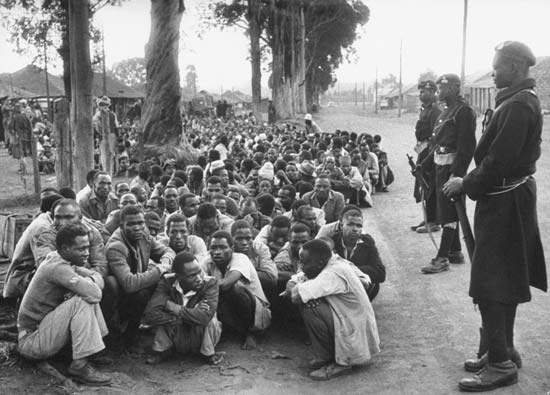
Although in recent years two very substantial histories of the British counterinsurgency in Kenya have been published (David Anderson’s Histories of the Hanged and Caroline Elkins’s Imperial Reckoning) I have chosen Branch’s book because of its focus on the Gikuyu “loyalists” who collaborated with the British overlord and the local settler government. The book is meticulously researched and, given the propensity of great powers to depend on local proxies, its examination of the indigenous allies is of great contemporary interest. The brutal British suppression of the Mau Mau revolt in Kenya also has in Kenya’s greatest living writer, Ngũgĩ wa Thiong’o, an eloquent chronicler. Among Ngũgĩ’s many writings which incorporate that period, A Grain of Wheat (Penguin Classics, 2002 [1967]) affectingly traces the destruction the counterinsurgency wrought in the lives of ordinary Gikuyu villagers.
Perhaps the most influential political film ever is certainly one of the least propagandistic and one of the most aesthetically accomplished and intensely emotionally riveting (the film truly deserves the superlatives!). The film was made by a member of the Italian Communist Party in collaboration with an Algerian FLN commander (who also acts as a version of himself in the film), and has the peculiar distinction of having been used both as a training manual by the Black Panthers and taught as a manual of counterinsurgency in the U.S.’s International Police Academy. It was also screened at the Pentagon after the insurgency had begun in Iraq in 2003. The film, acted with one exception by a nonprofessional cast, unflinchingly shows bombings by FLN militants and devastating scenes of torture and violence by the French military. For those drawn in by the film and curious about the French counterinsurgency in Algeria, the substantial narrative history of the Algerian War of Independence by Alistair Horne, A Savage War of Peace: Algeria, 1954-1962 (New York Review Books 2006 [1977]), though problematic in some respects, still has not been surpassed (at least in English). The great Algerian novelist, Assia Djebar, draws on her own experience and that of other women of the FLN to produce a moving and harrowing portrait of the revolt and the brutal French response in Children of a New World (The Feminist Press, 2005).