In the last decade, Mecca, Islam’s birthplace, has been the target of some of the world’s largest commercial development schemes. Over one hundred buildings are under construction around the Grand Mosque (Masjid al-Ḥarām) and will soon replace the historical, architectural and socioeconomic landscape of this rapidly developing city. Whole neighborhoods have been completely gutted out, their residents displaced to the outskirts of Mecca and other neighboring cities.[i] The once-heroic mountains on which they stood have been reduced to man-made craters, en route to being turned into the next largest shopping mall, hotel, or luxury residential building. Some have already been replaced with skyscrapers that hover over the Grand Mosque, blocking its southwestern access to the sun. Throughout, cranes dot the holy city’s skies, as smog chokes its Mosque and most likely the four million pilgrims who will visit it for hajj this November. Centuries-old fortresses, streets, markets, bookstores, schools, and cafes in this central area of Mecca have been destroyed, no longer there to tell stories of a past that diverges from the one in official memory in Saudi Arabia. This indiscriminate approach to redevelopment projects in the holiest of all Muslim sites reveals the (excessive) powers of petro-capital, private contractors, and Al Saud’s state apparatus, and has had major implications to socioeconomic, religious, political and environmental life.
The Saudi government has marketed the multi-billion dollar overhaul of Mecca, and all the measures it entails, as necessary to accommodate the increasing numbers of Muslim pilgrims and to enhance hajj and umra services. In the same vein, Mecca’s governor Prince Khaled Al Faisal regularly boasts of his government’s plan to bring Mecca into the 21st century, to transform this religious destination into a model city for development and modernization. The goal, we are often told, is to make Mecca the most beautiful city in the world.[ii] Beauty is relative indeed, more so when at the expense of demolishing people’s homes or historical and religious landmarks. But it does not take an architect or urban planning expert to see that something is going terribly wrong in Mecca- aesthetically and structurally. The government and construction companies have mostly invested in Central Mecca,[iii] an area that falls within a two-kilometer radius around the Grand Mosque, completely neglecting the rest of the city. Traffic in Mecca has become more of a test of nerves (and manners); roads look more like jigsaw puzzles; parking spaces are almost impossible to find; air and noise pollution are overwhelming; water and electricity shortages persist in the areas outside of Central Mecca; prices of hotel rooms and rental apartments are exorbitant; and, perhaps most alarmingly, there are no emergency evacuation plans in the new profit-driven, “contractor-style” construction projects, each of which can absorb tens of thousands of people simultaneously. Mecca, it seems, is becoming increasingly more stressful, alienating, and dangerous.
The scramble for commercial land in Central Mecca-which drove prices up more than twenty-fold in the last ten years to an average $70,000 per sqaure meter- has led to severe competition between the different contractor companies, and hence, very little planning coordination. The Mecca Development Authority (MDA), the official governmental body in charge of devising a strategic development plan for Mecca and overseeing all development and urban-planning projects in the city,[iv] has done little so far in improving the reality on the ground. The private contractors, especially the Saudi Binladen Group (SBG), seem to hold most of the decision-making power, if not all. Driven primarily by profit motivations, the contractors in Central Mecca have given minimal consideration to the actual needs of the average pilgrim or visitor, contrary to government claims. All of the new commercial services cater to wealthy pilgrims, from the high-end shops and restaurants in the malls, to hotel rooms that start at $700 per night and apartments that sell for at least $3 million.
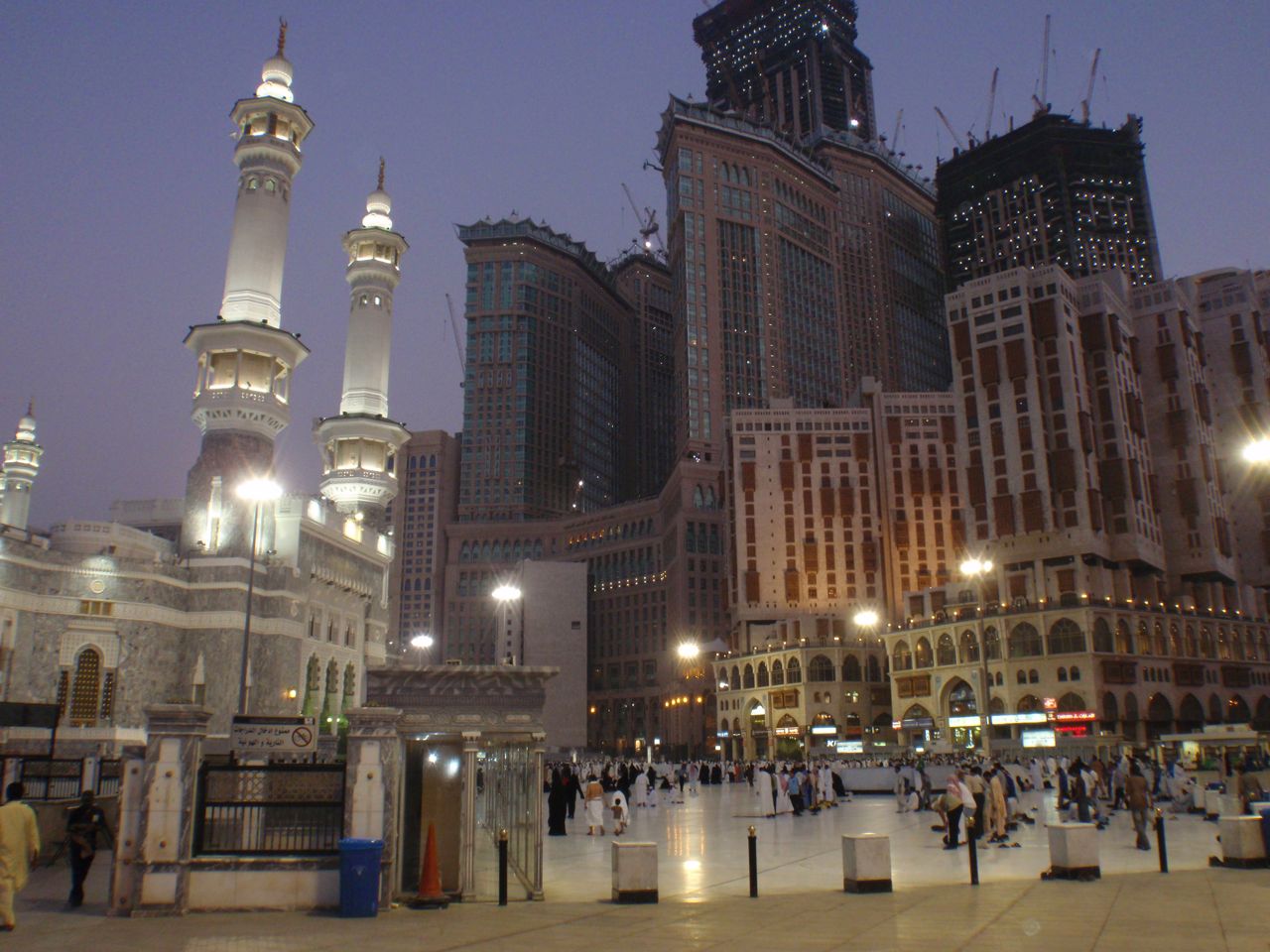
The remaking of Mecca- or rather, of Central Mecca- into the new front for “urban beauty and modernity” has thus far produced a city alien to many of its 1.7 million residents.[v] It has also caused much confusion for the millions of people who visit it each year. The construction projects- which exploit every inch of land in this central, congested area and attempt to maximize the number of rooms, apartments, and restaurants with a direct view of the Grand Mosque- have led to a new kind of spatial chaos that is oppressive at best. Most Saudi critics of the current development projects in Mecca express similar feelings of alienation and loss. As I arrive in Mecca, I am indeed overwhelmed and disoriented with all the transformations that have taken place since my last visit years ago. The 18th century Ottoman Ajyad Fortress, a Meccan landmark that once protected the Grand Mosque from invaders, was no longer there. The whole mountain it was located on was blown up and flattened overnight,[vi] to make space for the current Abraj Al Bait towers, part of the King Abdul Aziz Endowment for the Two Holy Mosques (see photos). The complex stretches over an area of 16 million ft², the largest in the world, and with one of its seven towers over 1,970 ft high, it is one of the tallest buildings in the world. This tower also lodges the largest clock in the world, which can be seen from 16 miles away. The three billion dollar endowment project includes several 5-star hotels, luxury residential towers, a shopping mall, a prayer area with a 4000-person capacity, and a large parking space. It will also house the Saudi King’s private Mecca quarters, currently located in a royal compound east of the complex.
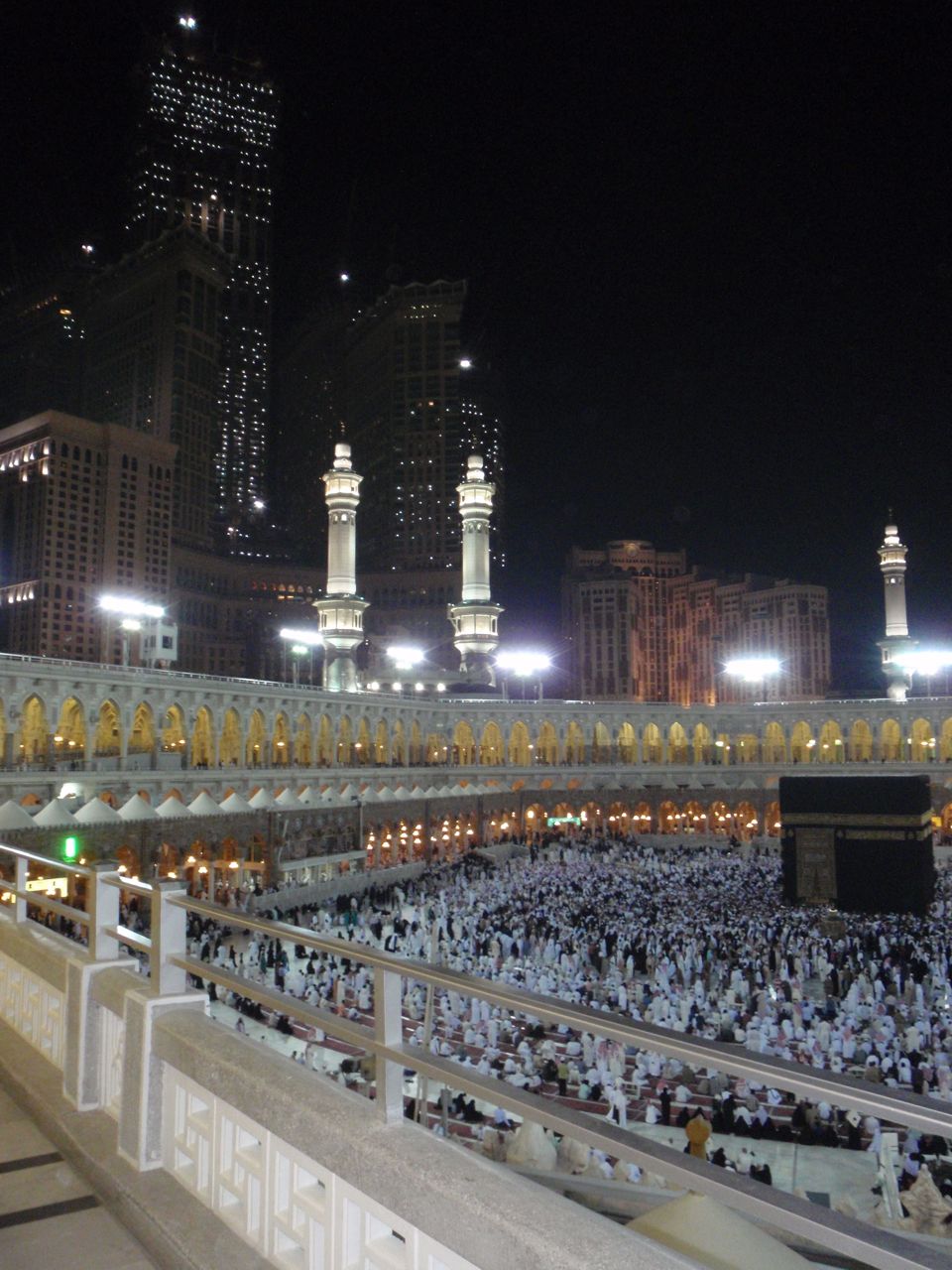
The Abraj Al Bait towers, which will accommodate and service 60,000 people when it is completed in 2012, is one of many development projects in Mecca that does not have an emergency evacuation plan. In 2008, nine floors of one of its towers, Hajar, caught fire. No casualties were reported in this or the other two fires that took place there that same year. But as one of the firefighters working on putting off the first fire later told me, “Thank God no one was injured. We had no idea what to do, no emergency plan or emergency training. And if this happens during hajj, it will be a disaster.” Many of the urban planners I spoke with expressed similar safety concerns about this and other projects in the area. Some of them even provided the government and the MDA with comprehensive safety and urban planning recommendations, free of charge, but none of their advice was heeded. The MDA claims that it is requiring each development site to adopt an emergency evacuation plan that abides by the strictest international codes, but that is yet to be seen.
Abraj Al Bait is one of the largest commercial construction ventures in the world. It was privately funded by the project’s contractor, the Saudi Binladen Group (SBG). Although SBG will continue to manage the project, all profits will go to the King Abdulaziz Endowment for the next 25 years. Profits will be used to maintain the complex itself and other religious sites in Mecca and Medina. However, SBG will have rights to the majority of the profits after the 25-year period expires. SBG- the contractor company for many of the development projects in Mecca- has a special relationship with the Al Saud ruling family, one that has transitioned smoothly since the days of King Abdulaziz Ibn Saud, but remains ambiguous and overlooked. The prominent sons of the founders of both the Saudi state and the construction company are in an interlocked, mutually trusting relationship where both sides are aware of the red lines, and know not to cross them. This is one of the factors that have informed the vision of modernity that permeates the urban plans and cultural policies for Mecca, and which reveal a new sort of urban globality (linked to petro-modern accumulation, which is both excessive and spectacular) based on Islamic universality to which Mecca is central.
I will elaborate on the relationship between corporate interests, the religious establishment, and state power as it is further played out in Mecca in Part II of this post. I will also bring in to the discussion the expansion works of the Grand Mosque and three other development projects that surround it: Al Shamiyya Project; Jabal Omar Project; and Ajyad Hospital. Here I will also discuss the original property owners of land in Central Mecca and the residential neighborhoods outside of it.
In Part III, I will discuss the different travel and accommodation options that Hajj pilgrims have, and how the new development projects have influenced religious practice and the experience of hajj. Here, I will include the role of the official religious establishment in the development process in Mecca.
Part IV will be about historical, archeological, and architectural transformations in Mecca; the varied responses (and lack thereof) within Saudi Arabia and other Muslim countries and the attendant discourse on modernity and progress; and some of the political and environmental consequences to development in Mecca.
[iii] The government has also invested in other Al Masha’er al Muqaddassa sites, such as Arafat, Muzdalifa and Mina, major destinations for hajj rituals, located several kilometers outside Central Mecca. The most notable projects are the Jamarat Bridge and the $ 1.8 billion Al Masha’er al Muqaddassa Monorail, which links it to Central Mecca, and is expected to start serving pilgrims in November 2010 at a 35% capacity. Ticket prices are currently being renegotiated after official and popular criticism and protestation of the expensive initial prices.
[iv] http://aawsat.com/details.asp?section=43&article=551693&issueno=11363. The logo of the MDA until a year ago was an image of two giant bulldozers that meet at the mouths in a “V” shape, with the Kaaba behind them in the background. The MDA is currently working on a new logo.
[v] This is compounded by the fact that Mecca’s residents, many of whom were displaced or forced to sell their land, and have endured this state of construction mania for over a decade, have yet to benefit from improvements in infrastructural services.
[vi] Rumors of the imminent destruction of Ajyad caused many of Mecca’s residents, Saudi and non-Saudi Muslim archeologists, historians, and architects, as well as the Turkish government and many of its people to criticize the Saudi Arabian government and protest the move to demolish the fortress. In response, the Saudi Binladen Group blocked off the site at night, and destroyed it within 24 hours.