One year has passed since Mohammed Bouazizi set himself ablaze in Sidi Bouzid. His act had inspired the revolutions throughout the region, most of which have subsequently been rolled back by military authorities, co-opted by religious conservatives, and overtaken by bitter violence. But in Sidi Bouzid on Saturday, the one-year anniversary of Bouazizi’s self-immolation, residents were able to finally demonstrate their joy and pride at the magnitude of the events their native son unleashed. A building-sized tableau of Bouazizi’s beatific face was unfurled over an advertisement for a national telecom company. The sign read: “Revolution of Freedom and Dignity.”
“Dignity” is an important word for a town that long lacked a voice in Tunisia’s political, cultural, and ideological landscape. Many in Tunisia’s more prosperous cities describe Sidi Bouzid, located in Tunisia’s impoverished interior, as provincially religious. But while the black-and-white banners of Hizb-ut-Tahrir—the Salafist party that remains banned in Tunisia—were present in abundance, women were as likely as not to wear the Islamic head covering, the hijab. The town could hardly be described as an epicenter of Tunisia’s newfound Islamism. Neither does the mostly agricultural town aspire to join Tunisia’s secular Francophile elite. While foreigners in the capital will be welcomed with fluent French, here, a majority of young people speak better English, as if the disconnect between the town and the rest of the country left them yearning to reach out to a wider world.
“If the Tunisians said no to Ben Ali, we can say no to this government,” said Hamedi Khalifi, a 19-year-old engineering student, in immaculate English. The theme of a “second revolution” was recurrent, but most residents were not ready just yet for another uprising. They were instead thrilled at the presence of government figures and foreign media in a city that has become a symbol of neglect and isolation. Interim president Moncef Marzouki’s arrival was met with jubilation and cheers of “Yahya Marzouki” [Long Live Marzouki] from a crowd of over ten thousand. Eager spectators scrambled up onto trees for a better view, taking down the limb of one of them as Marzouki passed.
Indeed, though Marzouki’s Congress for the Republic party took just one of eight Constituent Assembly seats in Sidi Bouzid’s electoral district, support for the president himself is strong. After all, residents consider his hometown of Grombalia as part of “the south,” a blanket term for Tunisia’s disadvantaged regions that have long had next to no representation among the country’s political class. “We have some faith in Moncef Marzouki. He’s from a humble family. His purpose is to help the weak,” said Rabah Rabihi, a sixty-five-year-old man who carried a serrated olive knife and described himself as “a worker, one hundred percent.”
Marzouki’s speech lasted just a few minutes, however, and as crowds slowly dispersed, doubt returned.
“We don’t see any change here,” said Hisham Laifi, a twenty-four-year-old fruit and vegetable vendor who was a childhood friend of Mohamed Bouazizi and who used to travel with him to the central market to stock up on produce. Laifi’s attitude, along with many in the town, combined skepticism with a nearly ecstatic pride. “I can’t describe this day; I feel like I’ve entered paradise,” he said, adding, “We don’t celebrate for Marzouki, or for Ennahda, or anyone else; we celebrate for ourselves.”
While joy resounded along Avenue Habib Bourguiba, small businessmen and vendors along Sidi Bouzid’s quieter side streets were mostly unimpressed by the festivities. “We are against the elections. [The politicians] are people who promise great programs but do nothing. It’s only promises,” said Tareq Neji with stoic resignation. Neji, who owns and runs a small agricultural chemicals shop, explained how his friends selling fruit and vegetables in stands across the street no longer have to suffer police harassment or pay the constant fines police levied to supplement their meager salaries. Yet, he said, such vendors are now victims of theft and harassment from the town’s homeless people, and their pocketbooks are hurt from an overall decrease in demand. Neji held a fatalistic view of the economic prospects of his hometown, saying the region had been “a triangle of poverty since ancient times.”
While the police have stopped their day-to-day extortion of the town’s most economically vulnerable, skilled employment still seems to be dominated by a cabal of well-connected functionaries. Jawida Mahmoudi, a twenty-six-year-old woman who used to be a technical director for the local water authority, described how she and her highly educated colleagues worked under a group of unqualified supervisors who took advantage of their position to siphon funds into their pockets. She expressed disappointment at the shallowness of change since the revolution. “It wasn’t Ben Ali alone who created this problem. There are a lot of men who participated,” said Mahmoudi.
As the sun set and crowds thinned, revelers were met by a visitor who rekindled their enthusiasm. Ammar Bouazizi, the cousin of Sidi Bouzid’s hero, was surrounded by friends, family and well-wishers who erupted again in elation. A small man lost in the folds of a spacious black coat, he spoke little, apparently overcome with emotion. When he did speak, however, it was without equivocation: “Mohamed Bouazizi started the revolution, and the youth of Tunisia completed it.” [Images by Mischa Benoit-Lavelle.]
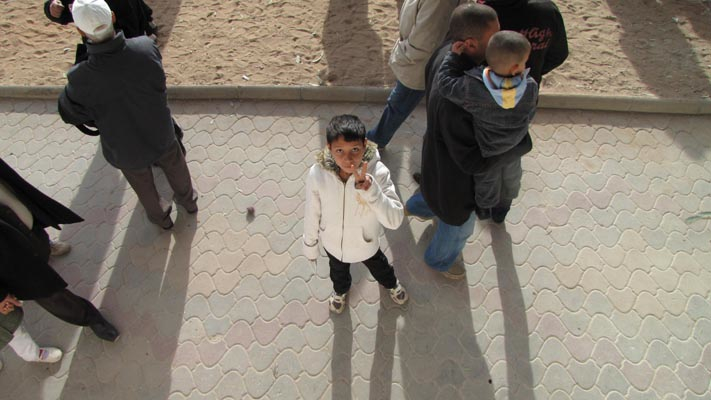
A boy in Sidi Bouzid
.jpg)
.jpg)