From the Editors
Jadaliyya Launches DARS Page: Daily Acts of Resistance and Subversion
Tadween Publishing Blog is here! Check it out
Jadaliyya's first book is now available! Click here.
Want to find out about new books? Visit our expanding NEWTON page. Click here.
Interested in writing a Review for Jadaliyya? Visit our Call for Reviews here.
الآن . . . القسم العربي بحلة جديدة
Jadaliyya Launches Photography Page (click here!)
Call for Photos: Become a Contributing Photographer at Jadaliyya
Why Mubarak is Out
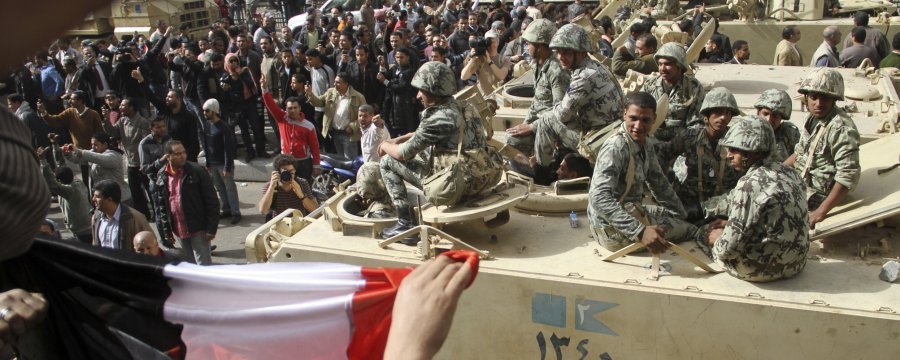
[Image from Lefteris Pitarakis / AP Photo]
The “March of Millions” in Cairo marks the spectacular emergence of a new political society in Egypt. This uprising brings together a new coalition of forces, uniting reconfigured elements of the security state with prominent business people, internationalist leaders, and relatively new (or newly reconfigured ) mass movements of youth, labor, women’s and religious groups. President Hosni Mubarak lost his political power on Friday, 28 January. On that night the Egyptian military let Mubarak’s ruling party headquarters burn down and ordered the police brigades attacking protesters to return to their barracks. When the evening call to prayer rang out and no one heeded Mubarak’s curfew order, it was clear that the old president been reduced to a phantom authority. In order to understand where Egypt is going, and what shape democracy might take there, we need to set the extraordinarily successful popular mobilizations into their military, economic and social context. What other forces were behind this sudden fall of Mubarak from power? And how will this transitional military-centered government get along with this millions-strong protest movement?
Many international media commentators – and some academic and political analysts – are having a hard time understanding the complexity of forces driving and responding to these momentous events. This confusion is driven by the binary “good guys versus bad guys” lenses most use to view this uprising. Such perspectives obscure more than they illuminate. There are three prominent binary models out there and each one carries its own baggage: (1) People versus Dictatorship: This perspective leads to liberal naïveté and confusion about the active role of military and elites in this uprising. (2) Seculars versus Islamists: This model leads to a 1980s-style call for “stability” and Islamophobic fears about the containment of the supposedly extremist “Arab street.” Or, (3) Old Guard versus Frustrated Youth: This lens imposes a 1960s-style romance on the protests but cannot begin to explain the structural and institutional dynamics driving the uprising, nor account for the key roles played by many 70-year-old Nasser-era figures.
This article is now featured in Jadaliyya's edited volume entitled Dawn of the Arab Uprisings: End of An Old Order? (Pluto Press, 2012). The volume documents the first six months of the Arab uprisings, explaining the backgrounds and trajectories of these popular movements. It also archives the range of responses that emanated from activists, scholars, and analysts as they sought to make sense of the rapidly unfolding events. Click here to access the full article by ordering your copy of Dawn of the Arab Uprisings from Amazon, or use the link below to purchase from the publisher.

59 comments for "Why Mubarak is Out "
Really great to see you guys publishing such informative thoughtful work!
very useful, thanks.
is there any possible alignment of oppositional factions/forces that could support a revolutionary seizure of power from the current government?
also, based on the social/class/institutional alignments you discuss, what could happen this week, say, if masses of protesters try to seize the State TV building or the Presidential Palace?
mubarek is defiant, with US backing and coordination. what might happen now?
Time: February 5, 2011 13:00 Union Square, NewYork. A demonstration for continued support of the Egyptian people After Egyptians went down to the roads in the day of rage to express the tragic situation that our beloved country has reached and as usual the security did not allow them to practice what is their right in expressing and strike security forces has fired tear gas and cold water to break up the strike. That strike made by thousands in scenes brought tears to the eyes
Thank you so much for this, Amar! I will need a lot more time to digest all the information you give us here, but the article is incredibly helpful to understand the mechanisms of the unrest of the past few days. I am going to share your article with all my friends!
Fantástica análise da situação no Egito. Muito obrigado, Paul, por esclarecer tão bem eventos tão complexos e importantes. É raro de se ler algo com tanta nuance hoje em dia!
Thank you so much, this is the most helpful piece I've read about the uprising. I find it easier to rejoice in the events now that I see them in a more nuanced light.
As an American who left home to study abroad in France, I learned at an early age to question my assumptions and to gather information, as much information as possible, before forming opinions. I am now in my mid-40's and live in Rome, where I have perhhaps become too complacent and sit too comfortably in my chair of "enlightened" middle age. Thank you Mr Amar for waking me up.
Thanks for this! After having just read yet another article stating that technology has given Egyptians a voice and is leading to democracy, it's so refreshing to read this insightful analysis of the diversity of players in Egypt who are contributing to (and might potentially obstruct) political change.
Great analysis, 'beyond the bianries'! really blitzes conventional commentary/journalism by exposing the way it works. The history-to-today update on UN-based but US-independent internationalism is a real contribution - I've never seen that picked up before. The URL has gone round the 'school' here.
Muito obrigada por esclarazer a complexidade da situacao. E a primeira vez que vejo uma argumentacaotao clara contra as dicotomias que geralmente aparezem na midia
superb essay. it really brings out the capillaries of power in the Egyptian state. more, more. more on the gamal and the neo-liberal clique. who are they?
Well done Bravo! Biggest problem facing the middle East is Israel's support of the west--Egpht has to contend with greedy western countries to control the M.E. supplies.That is why Israel was created and funded. Even if Mubarack leaves--next president will be MOSSAD assissinated--just like Israel's stooge Mubarack as VP during Sadat--killed the President--lot's of leads also--to the assiassination of Nasser. CIA/MOSSAD/MI5-6 are very dangerous---no future anti-west Egphtian President will live long--Egpht is dealing with very mean greedy western forces--namely USA and side kick Israel.One suggestion for Arabs---side with Iran :^/
FINALLY, a piece that clarifies all the police versus army dimensions that are obviously central but clearly not well understood!
Brilliant, many thanks.
Thanks for this brilliant analysis in terms of local actors but what about external and foreign ones. Egypt is a major element in the geopolitics of world powers, especially Europe and the US, towards the region. Enlightening us on this dimension of the situation in egypt would complete the picture on how the situation evolves.
USA is doing too little too late and always to join the winner. The only thing USA can say now is GET OUT MUBARAK otherwise USA lost all moral values and should never speak about democracy. Mubarak's Regime pays homeless thugs, criminals, policemen who are hungry a very little money to protect corruption in elections and harm educated patriot citizens as his last chance to maintain his severely shaken hold on power..He is truly a criminal and should be hanged now.. Mubarak’ leaving Egypt is not enough anymore. The Most AMAZING video on the internet Egypt jan25 http://www.youtube.com/watch?v=ThvBJMzmSZI MUST SEE!!!Egypt Revolution 2011 Demonstrators Vs police Fighting http://www.youtube.com/watch?v=dBtYLBQPRGQ
Cool stuff, Amar, deep, deeply informed, so much beyond the simplified images in most mass-media. Thanks, I will pass on anything you write.
Brilliant, pithy, what else can I say ...
dear Amar. i am linking your article in Blogs i like to read. and forwarding to friends and family. well done.
Best analysis to date of the 21st Century's most significant revolution. Many tnanks for sharing such high quality work.
Thanks for bringing such clarity and focus to this very important issue. I've forwarded the link far and wide.
As an African and socialist from Kenya, I must say I was quite impressed by your lucid and incisive analysis of the Eqyptian situation. Kudos!
Dear Paul, Many thanks, I concur with previous comments (at least those not using your analysis to distort it with a view to settling accounts with their perceived enemies). One thing though: clearly, you have written this piece with a view to countering usual Western "fast-food" analyses. Good, and thank you for that. Now what about the other pieces of the puzzle? What about the nationwide structured Muslim brotherhood? I agree with you that, thanks to the combination of grievances, and thanks to the chain of past and present key events (Algeria's war of 90s, 9/11, Afghanistan, Iraq, the current extreme-right regime in Israel...), religious movements cannot claim to take ownership of these beautiful and natural jasmine-flavoured "winds of change". Yet, isn't your (and my) inclination not to see (not to want?) an Islamic hijacking of the regime change, driving you halfway in your very detailed analysis? A number of essential actors have been examined, as well as their motivations... What about another monumental piece: an 80-year old movement which is soon to be legalised (and whose influence stretches anyway through all the institutions and groups you've mentioned)? And its satellites? My take is that it will take its share of the power puzzle... one proportionate to the vacuum of power, or to the degree of coheion/rivalries that will characterise the future, structured shape of this secular movement. My hope is that it wil not be enough to promote a rampant legalisation of religious authoritarianism, as has been seen elsewhere (women barred from exercising their rights or from performing their duties, street "lords" deciding what is right and what is wrong according to their reading of the Book - in other words: according to their self-perceived interests)...
As you can see my concern is not about international and regional relations: other countries, including Israel, will have to adjust to what the New Egypt will perceive as its national interests. What I am concerned about, is the possibility, for yound and old Egyptians, to achieve their goals in a secular society. There should be no less than the following goal: that even in the slums of Cairo, or in villages of upper Egypt, there be a new sense of achievable goals, without interference from any criminal or religious maffia. ANd that is only possible thanks to a fair and firm, non aligned, justice system. All these remarks, once again, are just of complementary nature, not contradicting your enlightening analysis. Merci and choukren, once again.
Brilhante ensaio que nos permite ver a complexidade da revolução egipícia, que se desenrola ante nossos olhos, sob o registro do espetáculo na mídia global. Obrigado ao Professor Amar por nos ajudar a entender o fascinante e dramático momento. No Brasil, agora fica claro como toda política externa é "ideológica" e "interessada", não apenas a do Governo Lula, mas, principalmente, a dos U.S.
extremely helpful, thank you!
Thanks for providing detailed background information....All very helpful in our trying to understand the implications for what's happening in Egypt and the region. It certainly serves as valuable replacement for the vacuum that is the 'color commentary' .....purporting to be 'analysis' ... being fed to the world by the airheads ..from the likes of Fox News and others these days.
A truly outstanding piece. It fills in so much of the background and provides an extraordinarily succinct context for the events. I feel ten times more intelligent on the Egypt crisis than I did ten minutes ago. Thank you.
Good play-by-play in-depth and factual analysis, though I would quibble that Mubarak's team is not off the field yet. The praetorian regime initiated by the Free Officers Movement will persist and various factions in the Army will coalesce, I believe, and your 'national capitalists' may have carried the day by ousting the crony crew with Mubarak's assent. In that case, a new alignment with much more of a democratic character could EVENTUALLY emerge, but I think Obama's jumping up and down calling for a transition just this minute and make it snappy is simply a sophomoric self-defeating misreading of the situation.
Dear Paul, Many thanks, I concur with previous comments (at least those not using your analysis to distort it with a view to settling accounts with their perceived enemies). One thing though: clearly, you have written this piece with a view to countering usual Western "fast-food" analyses. Good, and thank you for that. Now what about the other pieces of the puzzle? What about the nationwide structured Muslim brotherhood? I agree with you that, thanks to the combination of grievances, and thanks to the chain of past and present key events (Algeria's war of 90s, 9/11, Afghanistan, Iraq, the current extreme-right regime in Israel...), religious movements cannot claim to take ownership of these beautiful and natural jasmine-flavoured "winds of change". Yet, isn't your (and my) inclination not to see (not to want?) an Islamic hijacking of the regime change, driving you halfway in your very detailed analysis? A number of essential actors have been examined, as well as their motivations... What about another monumental piece: an 80-year old movement which is soon to be legalised (and whose influence stretches anyway through all the institutions and groups you've mentioned)? And its satellites? My take is that it will take its share of the power puzzle... one proportionate to the vacuum of power, or to the degree of coheion/rivalries that will characterise the future, structured shape of this secular movement. My hope is that it wil not be enough to promote a rampant legalisation of religious authoritarianism, as has been seen elsewhere (women barred from exercising their rights or from performing their duties, street "lords" deciding what is right and what is wrong according to their reading of the Book - in other words: according to their self-perceived interests)...
As you can see my concern is not about international and regional relations: other countries, including Israel, will have to adjust to what the New Egypt will perceive as its national interests. What I am concerned about, is the possibility, for yound and old Egyptians, to achieve their goals in a secular society. There should be no less than the following goal: that even in the slums of Cairo, or in villages of upper Egypt, there be a new sense of achievable goals, without interference from any criminal or religious maffia. ANd that is only possible thanks to a fair and firm, non aligned, justice system. All these remarks, once again, are just of complementary nature, not contradicting your enlightening analysis. Merci and choukren, once again.
Mubarak is out of power by defcto and on power by dejure.
Thank you for your cogent article which is the most enlightened perspective that I have read to date.
Thanks, Amar. This really is must-reading.
Thank you Amar. You article brings forth the complexities of the Egyptian social and political situation beyond the classical binarism of secular/religious, East/West. You deftly connect the current events to the larger modern social and economic Egyptian history.
Thank you. All these days I have started to follow Egypts uprise I have been frustrated by all shallow analysis like those you critisize in your article.
I have searched for something like this to understand the dynamics of the revolution and the country in itself.
To me the story of the thugs are heartbreaking. Large income gaps and people left without any prospects what so ever will always turn violent.
Thank you for reminding me of that extreme social inequalities always are the roots to injustice and hence to violence. Thank you for helping me understand understand the background.
And thank you for sharing so much hope.
Thank you all for these fascinating, supportive and provocative comments. I hope to engage your questions in the next days. I will be appearing on television Saturday morning (Feb 5th) on Democracy Now, 11am-1pm EST, 8-10am PST, if you would like to learn more. View at www.democracynow.org
Very Powerful Stuff. Very enlightening. Thank You.
http://www.youtube.com/watch?v=V1Lyc-IPYnY
an urdu translation of this article is here http://issuu.com/ispakistan/docs/mubarakout_paulamar?viewMode=presentation&mode=embed
An old Berber saying goes like this: "There no field that does have a thorn." Amar's analysis may a thorn for many in the main steam media field but it is is a beautiful rose for all of those seeking deep understanding rather than sound bites.
A pleasure to read. Thank you.
AC
Thank you very much for a well-written and thoughtful article.
I have one question about what you wrote here: "Egyptians have a long history for investing in and supporting international law, humanitarian norms and human rights."
I've never heard that anywhere, nor did I experience it there. At what point in history have Egyptians been at the forefront of human rights exactly?
I've been waiting for an article like this one. Al-Jazeera is pretty good for news (and did publish this piece, actually) but by and large the Western media contains much rubbish and cliche. Thank you, Paul Amar!
Great analysis. Thanks.
Thanks for a brilliant analysis.
Mr. Amar, thank you for this enlightened and in-depth analysis. I only wish such scholarship could appear in the main stream media in the US (New York TImes, LA Times, Wall Street Journal, etc.) And even more importantly, I hope that Mr. Obama and Mrs. Clinton will read it and digest it. I will fax it on to the White House and cross my fingers.
I first came across this article in a translation published in the Frankfurter Allgemeine Zeitung (FAZ). I was impressed by the depth of analysis, providing much more than the frantic reports of "special correspondents" hastily dispatched into crisis zones. The only thing I thought was missing is the role Muslim Brotherhood is, will be, playing in Egyptian politics...
I just read your article in the Frankfurter Allgemeine and felt really enlightened. Thank you for providing us with such a singular piece of background information. The other day, participating in a demonstration in Berlin in support of the Egyptian protesters,.I read the caption "Human rights instead of Western Rights!". It made me feel deeply ashamed of the European (and US) manoevring in favour of the status quo. Is international politics turning the legitimate claims of the Egyptian people upside down?
A soldier in Cairo kissing a civilian. Who has seen that in his lifetime? I have no words. Mubarak should see that. He will not beleive his eyes. Thomas
It may interest you to have more information (besides Wikipedia) about Frank Wisner Sr, the father of the american diplomat currently in Egypt :
a) in the recent book of John Loftus
introduction to the OPC :
http://www.scribd.com/doc/47963038/America-s-Nazi-Secret-Loftus-OPC-CIA
apparitions of Frank G. Wisner Sr :
http://www.scribd.com/doc/47870340/Frank-G-Wisner-Sr http://www.scribd.com/doc/48153091/Frank-G-Wisner-Sr-2 http://www.scribd.com/doc/48153091/Frank-G-Wisner-Sr-3
b) in the book of Ian Johnson :
http://www.scribd.com/doc/48154012/Frank-G-Wisner-Sr-Book-of-Ian-Johnson
Extremely illuminating. I just linked (and excerpted) at Obsidian Wings.
very meticulously writte....mubarak you really stink!!!
Does anyone know anything about what groups specifically Amar's referring to when he writes about "...rural and worker social movements. The latter group critiques the universalism of UN and NGO secular discourses.."?
Sounds like distributism, in a way.
Thank you for this great analysis, very helpful!!
Excellent. I think it's just about time to take labour and ownership issues out of the realm of economics and into the realm of morality.
So glad I ragged about our American press and media in a public way on FaceBook, because a friend sent me your comprehensive article, setting forth the complexities in Egypt. Thank you for this informative article.
This is (or should be) going straight onto readings lists for Middle East Politics and Democratisation courses! You've done us all a real service: these are exactly the sorts of categories that should be introduced in the analysis (not just for Egypt).
Thanks for the great summary of the questions not answered anywhere else! And thanks too to Juan Cole for his everyday best!
Great analysis that is sorely missing in other publications. However, I found your analysis or the military a little wanting. There are two sets of groups in the military that exerted their influence on the event, but I'm not sure you describe them very well. You say the pro-Mubarak group is the air force and the presidential guard and then an unamed other group. I think the split here is between older and younger officers. The older officers benefitted greatly from Mubarak's regime. They owed their careers to him personally and as such very loyal to him. On the other hand there were younger officers across the board who found Gamal and the other capitalists around him to be abhorent and by moving against Mubarak they cut Gamal's power indefinitely. They guys were not able to acquire new wealth; they were blocked by Gamal and his cronies and toppling Mubarak assured that. They were also putting pressure on their seniors who in turned feared a mutiny if they did not act against Mubarak.
Also factual errors: 1- Tantawi is not the chief of staff of the armed forces but rather the defense minister. 2- the air force was NOT strafing the population. They were merely flying over.
This is such a great resource that you are providing and you give it away for free. I love seeing websites that understand the value of providing a quality resource for free. It’s the old what goes around comes around routine.
If you prefer, email your comments to info@jadaliyya.com.
Hot on Facebook
Yet, the majority of young people I talked to, regardless of class or gender, revealed a sophisticated political perspective and a keen interest in participation. They talked the language of human rights, responsibilities, good governance and bad governance.click | email | tweet
From Jadaliyya Reports
Jadalicious / جدلشس
Twitter Updates
Latest Entries
View All Entries »- Maghreb Media Roundup (May 24)
- أوهام ليبرالية
- Tadween Roundup: News and Analysis from the Publishing/Academic World
- Syria Media Roundup (May 23)
- Asfari Institute Inaugural Conference: New Spaces of Civil Society Activism in the Arab World (Beirut, 23-24 May)
- Women's Rights in the Egyptian Constitution: (Neo)Liberalism's Family Values
- مسخ الذاكرة
- New Texts Out Now: Louise Cainkar, Global Arab World Migrations and Diasporas
- Arabian Peninsula Media Roundup (May 21)
- إعادة الحساب الدائمة: إساءة فهم سوريا بعد سنتين
- From al-Araqib to Susiya: Forced Displacement of Palestinians on Both Sides of the Green Line
- إعجام
- كارل ماركس واليسار في لبنان
- Picturing Algeria
- Egypt Media Roundup (May 20)
- Last Week on Jadaliyya (May 13-19)
- Jadaliyya's Occupation, Intervention, and Law Page Resonates
- Al Jazeera Management Orders Joseph Massad Article Pulled in an Act of Pro-Israel Censorship
- سعادت حسن منتو: قصة قصيرة
- Reports Roundup (May 18)


Women's Rights in the Egyptian Constitution: (Neo)Liberalism's Family Values
New Texts Out Now: Louise Cainkar, Global Arab World Migrations and Diasporas


.jpg)
enlightening and thought provoking I am so pleased you have weighed in on this topic