[The following report was issued by the United Nations Country Team in the occupied Palestinian territory in August 2012.]
Gaza in 2020: A Liveable Place?
Summary
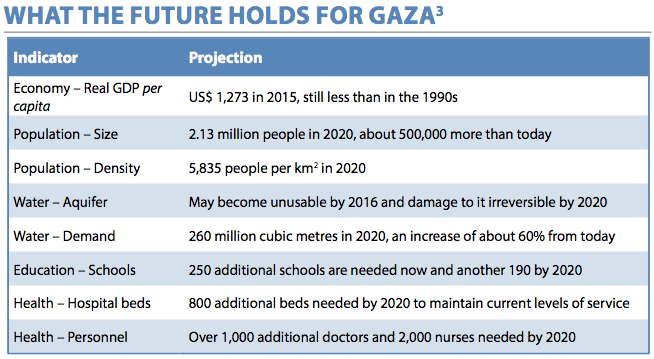
By the year 2020, the population of Gaza will increase to around 2.1 million, from an estimated 1.6 million people today. The substantial population growth rate will thus add some 500,000 people to a living area which is restricted and already heavily urbanized. Fundamental infrastructure in electricity, water and sanitation, and municipal and social services, is struggling to keep pace with the needs of the growing population. By 2020, electricity provision will need to double to meet demand, damage to the coastal aquifer will be irreversible without immediate remedial action, and hundreds of new schools and expanded health services will be needed for an overwhelmingly young population. Tens of thousands of housing units are needed today.
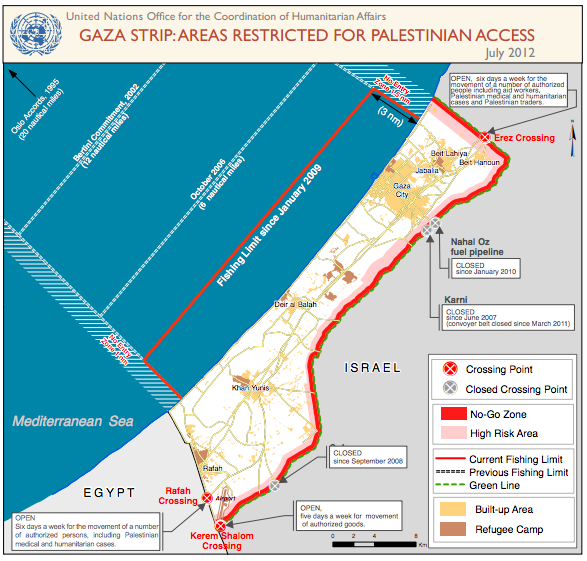
Gaza is an urban economy, heavily reliant on intensive trade, communication and movement of people. The area has been essentially isolated since 2005, meaning that, in the longer term, its economy is fundamentally unviable under present circumstances. Gaza is currently kept alive through external funding and the illegal tunnel economy.
The people of Gaza remain worse off than they were in the 1990s, despite increases in real gross domestic product (GDP) per capita over the past three years. Unemployment is high and affects women and youth in particular. Gaza’s GDP per capita is expected to grow only modestly in the coming years, making it ever more difficult for Gazans to secure a decent living. The challenges will only become more acute, particularly if the current political status quo continues. Even if the political situation were to improve dramatically over the next years, the issues identified in this study would still need to be addressed as a matter of urgency.
While recognizing recent progress, demographic pressure and the deterioration of Gazan infrastructure demand durable and broad-based economic growth based on trade of goods and services. It will be essential to ensure the provision of basic infrastructure (particularly water/sanitation and electricity) and improved social services (particularly health and education). As a heavily urbanized environment with little room for further growth, Gaza needs to be open and accessible to the world. The viability of a future Palestinian state depends on a proper connection between the West Bank and Gaza, providing access to the Mediterranean for the entire occupied Palestinian territory.
This document focuses on a range of the most important issues affecting the daily lives of the people in Gaza, which will only intensify in the coming years – even more so should the political situation (the divide between Gaza and the West Bank, the occupation and closure, and continued violent conflict) not improve. These challenges are described in the six-monthly UN report to the Ad hoc Liaison Committee, and more routinely in the UN’s monthly briefing to the Security Council. In short, an end to the blockade of the Gaza Strip in the context of Security Council resolution 1860, and Gaza’s recovery and long-term economic development remain fundamental objectives of the United Nations.
[Click here to download the full report.]