[”A Profile from the Archives“ is a new series published by Jadaliyya in both Arabic and English in cooperation with the Lebanese newspaper, Assafir. These profiles will feature iconic figures who left indelible marks in the politics and culture of the Middle East and North Africa.]
Name: Ahmad
Known as: Al-Khatib
Father: Muhammad
Mother: Wadhha Al-Khbaizi
Date of birth: 1926
Nationality: Kuwaiti
Specialization: Degree in Medicine
Category: Politician
Profession: Doctor- Politician
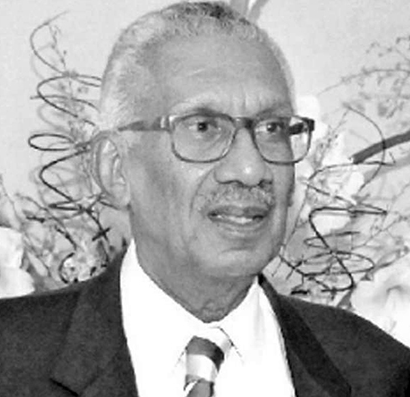
Ahmad Muhammad Al-Khatib
- Kuwaiti
- Born in Kuwait in 1926.
- Married and has three sons.
- He started his primary studies in Al-Mubarakiyah School when he was seven years old. He moved later to Al-Anjari School, which applied the old teaching system of Al-Katatib, and learned Quran, basic writing and arithmetic. He joined Al-Ahmadiyah School when he was in his second primary grade, then moved to Al-Mubarakiyah School to finish high school.
- He left Kuwait for Beirut in 1942 to continue his studies in the American University in Beirut. He graduated from medical school as a surgeon in 1952. In Beirut, he met George Habash and Wadee Haddad from Palestine and Hani Al-Hindi from Syria. The four established, alongside other friends like Saleh Shibil and Hamid Al-Juburi, the movement of “Al-Qawmeyeen Al-Arab” or “The Arab Nationalists” in 1951 under the influence of the ideas of Qustantin Zuraiq from Damascus.
- He participated in the 1952 students’ demonstrations to protest the American intervention in the Middle East. Clashes took place in these demonstrations in Beirut and he was fired from the university, along with a Palestinian colleague of his from AUB. But students’ demonstrations forced the Lebanese government to interfere to retract the decision to fire him.
- He was one of the founders of the Nationalist Cultural Club in Kuwait in 1951.
- He earned a diploma from London in tropical diseases in 1954.
- He returned in 1954 to Kuwait and worked in the American hospital until 1957, when he resigned to work in his own clinic.
- He accompanied Jasim Al-Qatami in a visit to Iraq in 1958 heading a youth delegation to congratulate Abdul Kareem Qasim and Abdul Salam Arif for toppling the monarchy. He said in a speech before them: “We are sure that you will unite soon with the United Arab Republic (referring to Syria and Egypt).”
- He was Vice President of the Founding Assembly, which approved the Kuwaiti constitution after independence in 1962.
- He was elected a member in the first parliament in Kuwait in 1963, where he starred as one of the callers for reform and full democracy. This bothered the government and a decision was made to exclude him from the second, third, and fifth parliaments.
- On 7 December 1965, he resigned, along with eight other MPs, from the parliament to protest the approval of a number of laws restricting public freedoms.
- He lost the parliamentary elections in 1967.
- He won the elections of 1971 and 1975, but he lost in 1981.
- On 29 February 1985, after parliamentary terms were frozen for four years, parliamentary elections were held and he won a parliamentary seat and returned to the parliament, but an Amiri edict dissolved the parliament due to disputes between the Amir and the parliament.
- On 8 May 1990, Kuwaiti security forces stormed his guest house (diwaniya) and arrested him, along with twenty other former members of parliament, while they were having a meeting to call for resuming the parliamentary term. He was released on 12 May.
- He was elected as a member in the Kuwaiti parliament in October 1992.
- He published a memoir entitled “Kuwait: From Emirate to State.”
Positions
- In response to a question about the direct and indirect reasons that drove authorities to abort democracy, he answered: the main reason is the role that some high officials played in the collapse of the stock market (Al-Manakh) in 1982. (Al-Wafd, 30 October 1986).
- True democracy needs an environment of public freedoms; freedom of press, freedom to establish organizations and freedom of political parties are the basis to establish any democratic council. (Al-Jaraed, 25 December 1989).
- Kuwait ensures its own safety by playing the role of the security factor in the region. (Al-Hayat, 1 July 1999).
- To ban the talk about arrangements in the ruling family is an aggression against Kuwait’s existence and history. (Assafir, 27 November 2001).
- He warned that Kuwait is headed toward a state of isolation more severe than the fall of Saddam Hussein. (Al-Qabas, 21 November 2003).
- He said that “our government is providing aid to dictatorships which is turning the people of these countries against Kuwait.” (Al-Siyasa, 11 March 2003).
[This article was translated from the Arabic by Ali Adeeb Alnaemi. Click here for the Arabic text.]