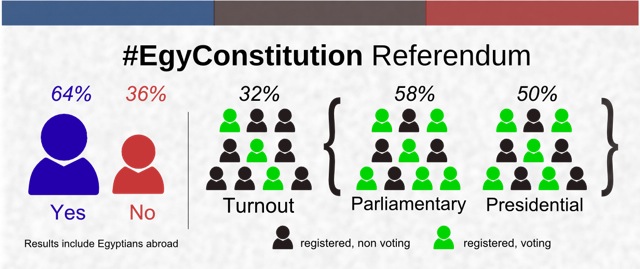
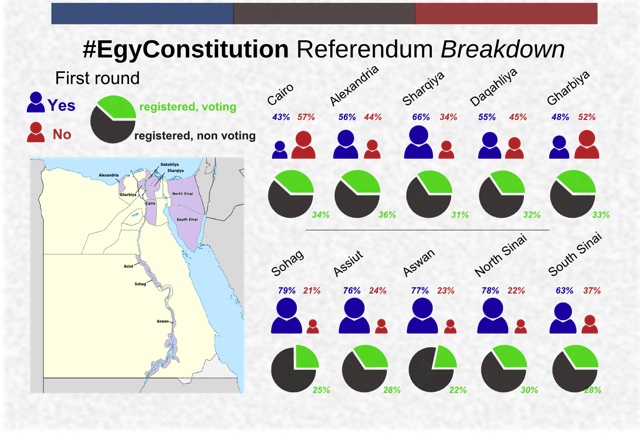
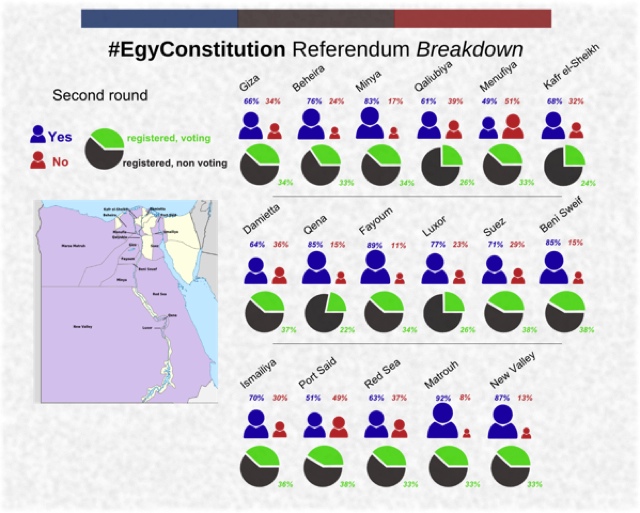
Based on numbers reported by Egyptian media outlets, below is a summary of the constitutional referendum vote results broken down by governorate.
What do these numbers tell us?
- In two stages of voting, average turnout across governorates was 30%, with Egyptians abroad participation being the most notable outlier with a 41% turnout rate.
- The only three governorates where the majority of voters elected to reject the draft constitution are Cairo, Gharbiyya, and Menofia.
What do these numbers not tell us?
- Given that the vast majority of eligible voters (68% or 33,855,564) did not participate in the referendum, we can neither conclude that the majority of the eligible voting population supports the constitution, nor can we conclude that a majority rejects it.
- Only 16,232,035 or 32% of eligible voters have reportedly cast a vote. It is, therefore, misleading to claim that the silence of the other 68% is reflective of support for one position or another.
What conclusions are impossible to draw from these numbers?
- The reasons behind the low turnout are many, not mutually exclusive, and unclear. Thus far, there has been no empirical evaluation of the possible links between voter abstention and lack of motivation, or the restriction that a voter can only vote in her assigned polling station—as opposed to the 19 March 2011 referendum, when Egyptians were allowed to vote wherever they pleased. It is unclear whether this restriction was enforced, and whether it was consistently respected.
- Attempting to establish relationships between governorate-level voting results and various demographic and social indicators, such as literacy rate, is misleading, because eligible voters in a given governorate may include individuals who reside in different governorates and whose demographics are not captured by governorate-level indicators. For instance, claiming that predominantly rural governorates support the constitution can be misleading if it turns out that registered voters in these supposedly rural regions include a large number of well-educated youth working in nearby urban centers.
- Commentators in social media have examined every possible correlation between [name your favorite social or demographic indicator] and governorate level voting outcomes. While drowning in interesting and seemingly revealing scatterplots and tables, it is easy to lose track of the fact that correlation is not causation. For example, given the data under consideration, the courageous inferences that commentators have been making with regards to the role of the rural/urban divide or illiteracy rates in driving voting behavior across governorates are anything but justified.
Constitutional Referendum Results Broken down by Governorate
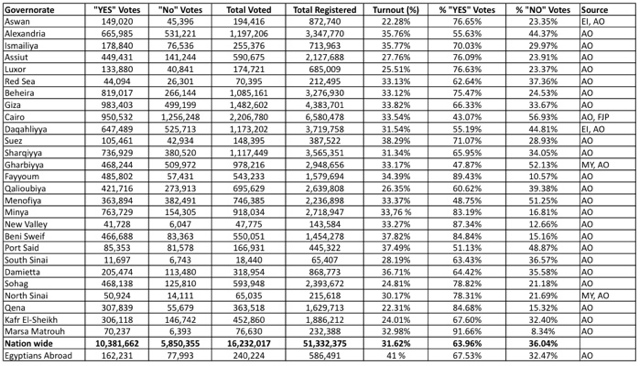
Notes: AO: Ahram Online; EI: Egypt Independent; FJP: Freedom and Justice Party; MY: Al-Masry Al-Youm