Aomar Boum, The Last Rekkas: Chronicles of a Foot Courier in Southern Morocco (Casablanca: Langages du Sud, 2024).
Jadaliyya (J): What made you write this book?
Aomar Boum (AB): In the mid-1990s, I conducted an ethnographic study of the internationally celebrated Tissint Amazigh folk dance in southeastern Morocco, examining the politics of folklore as communities navigated the contours of local identity and national tourism. With written sources on the region limited mainly to colonial-era texts like Charles De Foucauld’s Reconnaissance au Maroc, I turned to oral history, beginning with interviews with my father, Faraji, one of the last elders to come of age under early French colonial rule. In the process, I discovered that Faraji’s great-grandfather had grown up in the pre-Saharan oasis of Tissint.
This genealogical link redirected my research afterward. Lacking written records about the oases of the Bani region, I began gathering oral histories during visits to my native village, Lamhamid. What started as two hours of recordings on folk dance became an archive of over eighty hours of testimony covering genealogy, tribal warfare, famine, drought, trade, ethnic relations, Jewish-Muslim histories, and slavery. Despite the archive’s richness, I rarely revisited it, preoccupied with tenure-track demands and producing scholarship deemed legible within the academy. Writing about family especially in collaboration with my child was not considered professionally viable.
In 2018, as Faraji showed signs of dementia, I began contemplating a biography. Though I was not ready to begin, I found myself drawn back to his stories. In November 2023, Faraji passed away in Lamhamid at the age of 110, at the foot of the Bani mountains. A few weeks later, my thirteen-year-old daughter, Majdouline Boum-Mendoza, and I began drafting a tribute to him. Just eight months earlier, my brother Mohammed had died of silicosis, after years of digging wells and inhaling dust. Majdouline and I had co-written and illustrated a memorial piece for him.
What started as a short tribute for Faraji quickly grew into a forty-page manuscript within a week. I decided to publish it as an illustrated book centered on generational memory, structured around Faraji’s life as a rekkas, a foot courier delivering letters across the pre-Saharan region in the 1930s and 1940s. The book evolved into a three-generational conversation, Faraji, myself, and Majdouline, on history, memory, and the present.
I finished the manuscript in early March; by the end of that month, Majdouline had illustrated every chapter. In May 2024, The Last Rekkas was published in English, Arabic, and French in Casablanca, and presented at the Rabat Book Fair. It is a collection of short texts across twenty-four chapters, framed by an introduction, a foreword by Driss El Yazami, and a concluding section written by Majdouline.
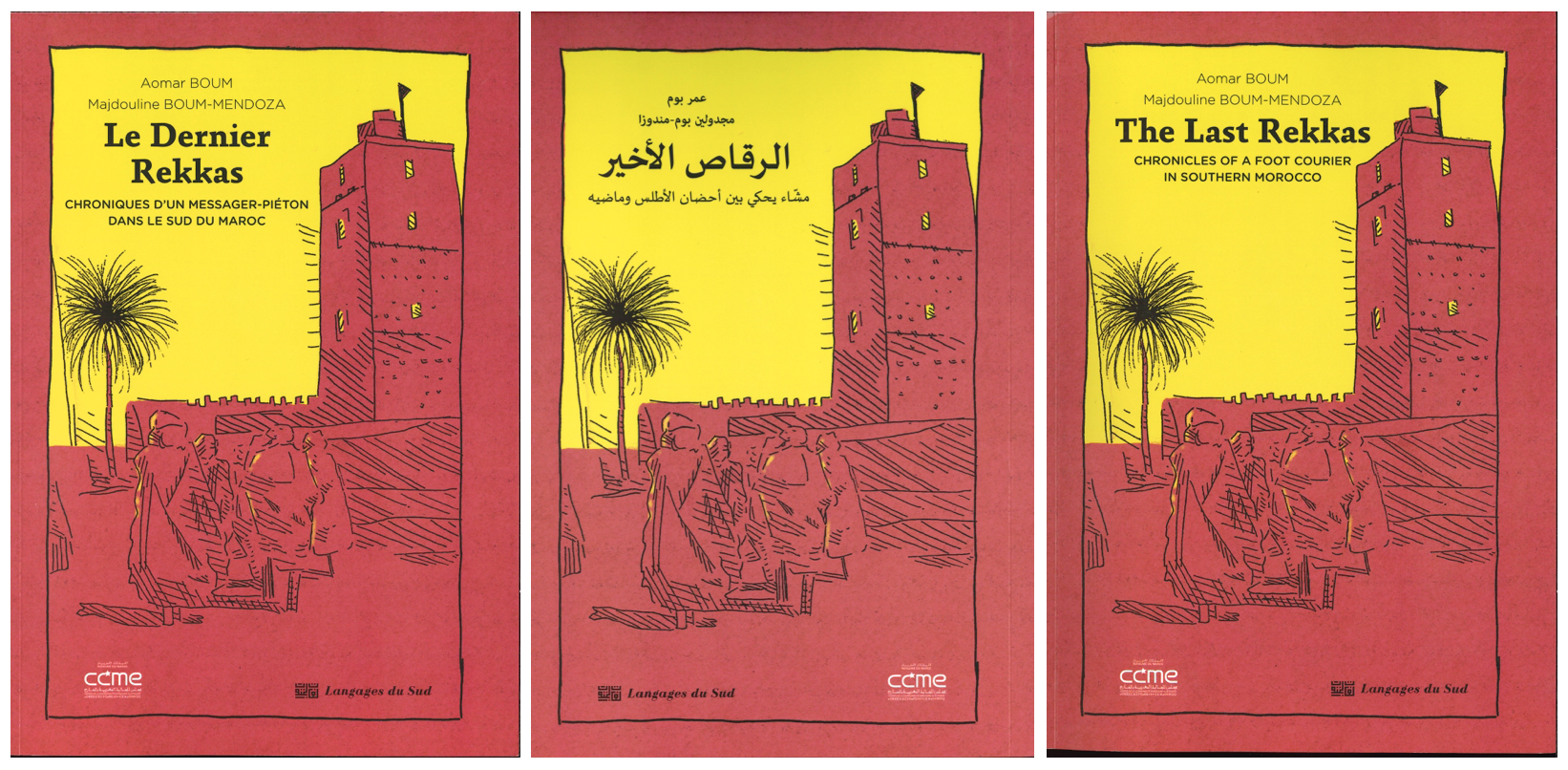
Fig. The Last Rekkas in English, Arabic, and French
J: What particular topics, issues, and literatures does the book address?
AB: In his book Min Afwāhi al-Jihāl (From the Mouths of Men), Moroccan historian al-Mukhtar al-Susi urges historians to document their own family histories. If historians are recognized for recording the lives of kings, ministers, and presidents, he argues, they are surely as deserving of credit for chronicling those closest to them. What justification, he asks, could there be for dismissing family biographies, which offer vital insight into lived experience? Their absence would leave a gap no archive could fill.
The Last Rekkas begins from this premise. It is a historical anthropologist’s reconstruction of regional memory through my father’s recollections. The book is both a family biography and a localized account of Moroccan history, narrated from the vantage of an ordinary villager. Alongside my daughter Majdouline, we adopt Faraji’s ethnographic voice to tell a story long overlooked. Through his eyes, we trace a narrative that remains attuned to the rhythms of Tata while engaging broader national and global currents. In this way, The Last Rekkas offers world history as seen through the perspective of an illiterate foot courier.
For over twenty years, Faraji traveled on foot between the political and tribal centers of Foum Zguid, Tissint, Tazenakht, Ouarzazate, Telouet, and sometimes Tindouf. He crossed a vast terrain spanning the High Atlas, the Anti-Atlas, and the Sahara. Unlike imperial couriers employed by the Makhzan (government), Faraji lacked state protection. Rekkas were known for their perseverance and trustworthiness, forming a close-knit society where the profession was passed from father to son. Some were paid by delivery speed, but many—particularly in the southwest under El Glaoui rule—were unpaid, compelled into the role through corvée labor. Relying on endurance, they faced mortal risk from wild animals, bandits, freezing mountain passes, swollen rivers, and long stretches without food or water.
By the early twentieth century, trains, telegrams, cars, and buses had begun to displace rekkas in major cities. Yet the profession persisted in remote regions where French colonial forces struggled to establish infrastructure south of the High Atlas. It was here that Faraji, under tribal orders, delivered messages as far as Telouet, a fifty-hour walk ascending over two thousand meters. Depending on conditions, each journey could take four to six days.
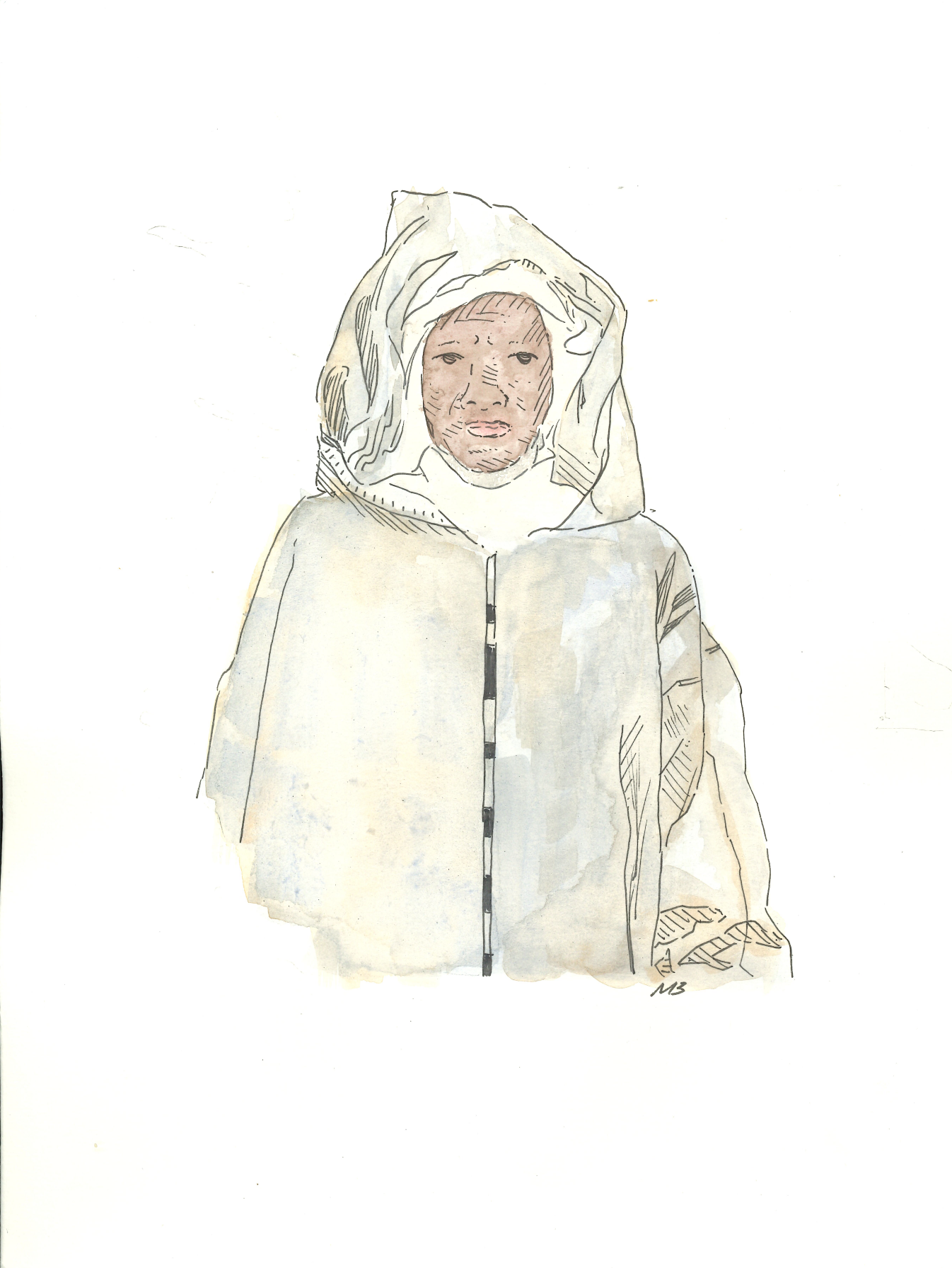
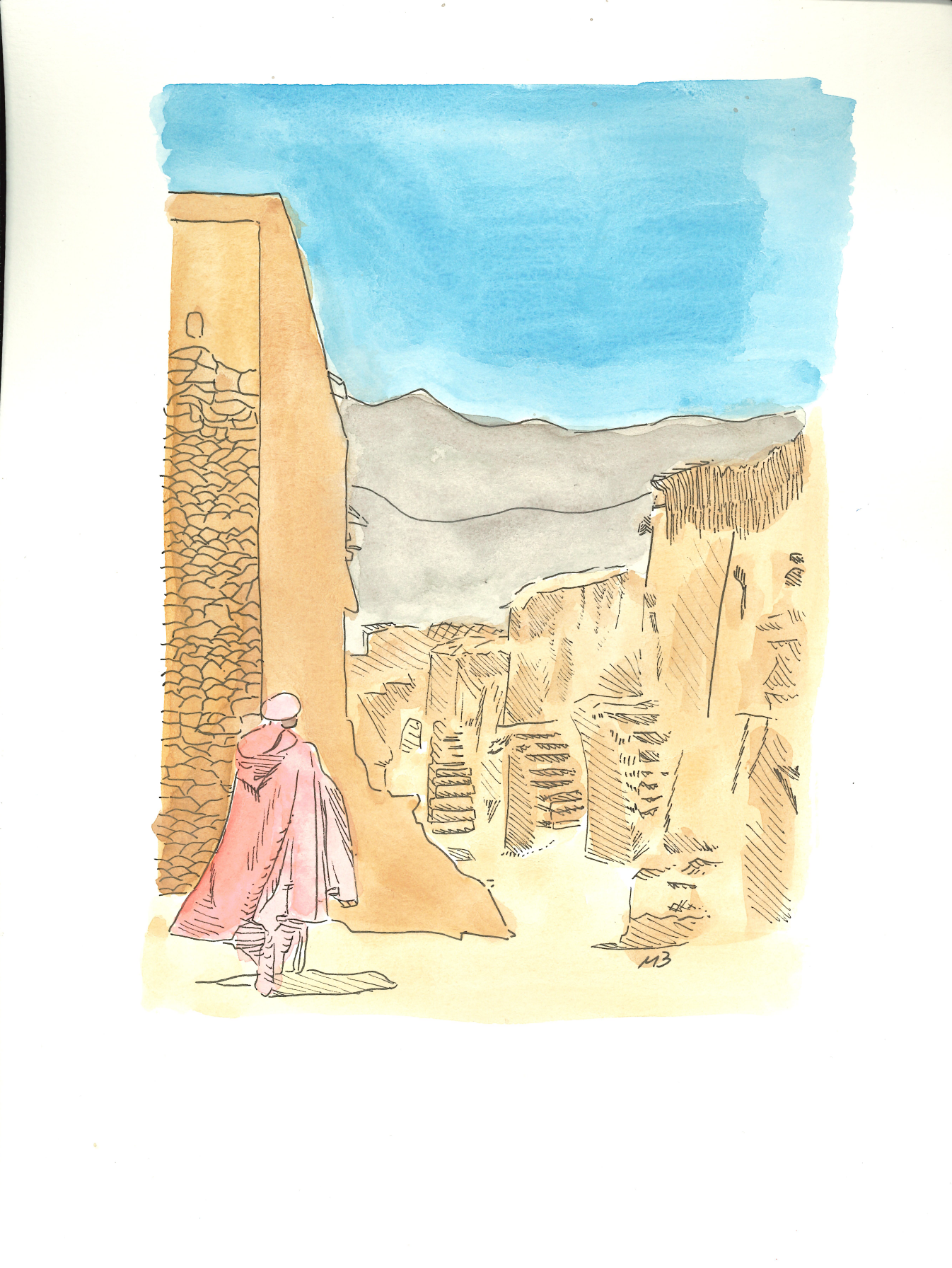
Fig. Faraji portrait, copyright Majdouline Boum-Mendoza
Fig. Faraji during one his trips to Telouet the center of the Glaoua, copyright Majdouline Boum-Mendoza
J: How does this book connect to and/or depart from your previous work?
AB: A central concern of my research is intergenerational memory and its entanglement with local and global historical transformations. This book continues that inquiry, offering a narrative from the margins by a historically marginalized subject. The thread linking this project to my previous work is a sustained focus on histories narrated from the periphery. Where it diverges is in method: I turn to illustration and comics as alternative modes of ethnographic expression. Multimodality, I argue, is not simply an aesthetic choice but a necessary historiographical intervention; one that reimagines ethnographic practice for the present. The visual dimension broadens the work’s reach, inviting readers beyond academia, including K-12 educators. By merging graphic form with biography, this project speaks across generations and social locations. The artistic contributions of Majdouline, my child, support public engagement while reinforcing the book’s core purpose: to trace the contours of social, economic, and environmental change in a Saharan community in southeastern Morocco.
J: Who do you hope will read this book, and what sort of impact would you like it to have?
AB: The Last Rekkas is an exercise in generational transmission between a grandfather, a son, and a daughter. It is not only a project of family storytelling but also an immigrant father’s attempt to sustain his daughter’s connection to extended kin in the Moroccan bled. The illustrated format was essential to engage a younger generation attuned to visual culture. I hope other anthropologists begin to turn the ethnographic gaze inward, informing their scholarship by showing who they are and where they come from. In June 2024, The Last Rekkas was showcased at the Mairie de Paris, where Majdouline and I spoke publicly about what it meant to tell Faraji’s story. Presenting The Last Rekkas in the emblematic building of French colonial authority was a moment of difficult recognition. Faraji had worked as a rekkas for the French military office of Georges Spillmann in Ouarzazate, who also assigned him to accompany Jean Besancenot during his ethnographic survey of southern Morocco. To speak about Faraji in the very halls where De Foucauld, Spillmann, and Besancenot once passed through and where orders conscripting my father, Senegalese tirailleurs, and Moroccan goumiers into forced labor were signed was both painful and celebratory. Hearing my daughter’s voice and my father’s name echo through those corridors was profoundly moving. In that seat of colonial power, Faraji’s labor and life were finally acknowledged.
J: What other projects are you working on now?
AB: As I continue developing my scholarship on ethnic and religious minorities in the Middle East and North Africa, I am engaged in several anthropological and historical projects that extend the work of The Last Rekkas and my graphic novel with Nadjib Berber, Undesirables. I advocate for a graphic novel form and historiographic practice that respond to shifting readerships without discarding the scholarly traditions built over decades. My current work, Inside the Margin, includes a series of comics that reframe the margins as generative centers, foregrounding uncommon narratives that reshape our understanding of world history. Inside the Margin is both a conceptual framework and a narrative practice that elevates the voices of ordinary individuals through the comic panel. It offers a mode of writing that highlights the lived resilience of those affected by local and global encounters. This artistic and historical approach situates marginal narratives within the genres of graphic novels, comics, and bande dessinée, underscoring their centrality to global history. Rather than seeking inclusion within hegemonic frameworks, however, Inside the Margin asserts its own space, grounded in its own logic and stakes.
J: Describe the process of writing this book with your child.
AB: This was not my first collaboration with Majdouline, and it certainly won’t be the last. She has illustrated several published articles and books for me and others, deepening our father-daughter bond through shared work in art and writing. This collaboration is meaningful to me not only as a father, but also because of my educational training in Middle Eastern studies. As a student at the University of Arizona, I had the privilege of working with my mentor, Michael Bonine, co-leading several Fulbright-Hays programs for K-12 teachers. From those experiences, I came to appreciate the importance of making scholarship accessible to broader publics, especially K-12 educators. As both father and teacher, I have encouraged Majdouline to develop and share her artistic skills to the fullest. Each summer, we traveled to the village, where she encountered oasis life in ways that shaped her visual sensibility. Her drawing style, intricate sketches, and refined use of watercolor beautifully convey the history and evolving environments of southern Morocco. Her work reflects an intimate familiarity with these spaces and their inhabitants, including her grandfather, whom she visited regularly until his passing in November 2023. The decision to illustrate the text was also shaped by my postcolonial perspective on colonial writing. Her illustrations drawn from memory and personal encounters with Morocco form a response to the tradition of French artists who illustrated books for European audiences. In contrast, Majdouline’s work reclaims visual narrative from within: grounded in lived experience, family memory, and a deep connection to the oasis.
Excerpts from the book
4. THE ROOTS OF LIFE IN LAMHAMID (pages 31 to 32)
In 1931, as the French army assumed control of the Anti-Atlas region, General Spillman designated Foum Zguid as a regional administrative and military hub. Positioned strategically atop a hill at the pinnacle of a mountain pass in the Bani region, the initial structure overlooked the arid Foum Zguid River. The name, Foum Zguid, translates to the “mouth of Zguid river” in English. Meandering through the Anti-Atlas Mountain ranges, the river and its tributaries zigzag past Kasbahs and Ksour. Previously named Foum lhanch, signifying "mouth of the snake," the French opted for this location for military and civilian construction due to its elevated vantage point, ensuring the security of their troops and the modest garrison. Its elevated position facilitated monitoring of the traffic between towns upstream, en route to Marrakesh and Tafilalt, as well as the pre-Saharan area leading to Oued Draa.
Five kilometers north of Foum Zguid lies Lamhamid Ksar, nestled on a hill at the foothills of the Bani Mountains along the right bank of the dry Foum Zguid river. Lamhamid, the birthplace of Faraji, was once a fortified village encircled by a protective rampart with a few gates that closed at night to keep bandits out. The ksar was built using tamped earth, clay bricks, and stone, demanding regular maintenance, especially during the summer and before the onset of the rainy season.
The houses were inhabited by extended families, with sons continuing to reside with their parents and sometimes grandparents even after marriage. Each dwelling featured a central courtyard (rahba) and internal staircases leading to the rooms of nuclear families in the first floor. Under the stairs, a small dark room was used as a sheep pen. A few families owned a cow. Ceilings were covered with beams of palm wood. Homes of wealthy residents including the shaykh were generally whitewashed and sometimes decorated.
The ksar also housed a communal storehouse or granary called agadir, historically used to store agricultural products and crops during times of famine or extended tribal warfare, overseen by a guardian elected by the community.
While Lamhamid’s population predominantly spoke Moroccan Arabic, Tashalhit, the indigenous language, was also prevalent. Engaging in subsistence farming, farmers cultivated seasonal crops in the palmeraie, irrigating their plots through a sophisticated water-sharing system known as khettara. Lamhamid boasted one of the densest palmeraies in the Foum Zguid valley. Faraji reminisced about moving through the canopy, from one palm tree top to another, during the harvest season, in the 1930’s.
[…]
9. EMPTINESS AND HOSTILE LANDSCAPES (page 61)
In the early decades of the twentieth century, the Anti-Atlas was a dangerous region to travel even with armed escorts, tribal defense and religious protection of saintly brotherhoods. Travelers were robbed and occasionally murdered. There were few people on the road. The paths between Tazenakht and Foum Zguid were a dangerous trip largely because they were not under the full control of Pasha Glaoui until the French occupation of Foum Zguid in 1931.
In every trip outside Lamhamid, Faraji was aware that he could be killed anytime and anywhere in this thoroughfare. Travelling mostly alone with no protection he encountered snakes, scorpions, wild dogs, wolves, and sometimes bandits and thieves. He had a small sword (Koumia) and a long sickle (tamskart). Between Amazigh and Arab ksour and farming lands, Faraji faced long walking hours of empty landscape, barren and dry in summer and muddy and snowy in winter.
There was no nezala between Foum Zguid and Tazenakht. These were resting stations controlled and secured by families linked to the Makhzan and central government. In the north between Casablanca and Tangier, sherifian rekkas were safer because of their ability to rely on the safety networks of nezala for overnights and during the days for rest. They were less vulnerable to attacks by thieves.
[…]
15. FROM TRAIL TO ROAD (pages 90 to 91)
In 1883, Charles de Foucauld conveyed the inherent challenges of traversing Morocco in his writing, stating that the country lacked conventional roads. Instead, a complex network of trails intertwined, forming intricate labyrinths where navigation proved difficult unless one possessed an intimate familiarity with the terrain. This insight served as a focal point in de Foucauld’s work, Reconnaissance au Maroc, 1883-1884, where he extensively discussed the insecurity of existing roads and the hardships associated with travel on foot, by donkeys, mules, or in the company of camel caravans.
Throughout his exploration of Morocco, de Foucauld observed that its roads were mainly used by burden-bearing mules and donkeys, guided by local peasants transporting various goods such as cloth, grain, or produce baskets. The first paved road between Tazenakht and Foum Zguid was finally completed one century later in the late 1980s. Before that it could take a day to drive between Lamhamid and Tazenakht, where the paved road started and ended. Faraji trekked these winding roads before the French capitalists and military in collaboration with El Glaoui used indigenous labor and turned them into roads taken mostly by trucks.
Until that time, there had been little use for these roads because people, including Faraji, travelled on foot or by donkey, mule, camel and sometimes horses. Trucks and later private cars made it to Lamhamid, allowing foreigners to get to the villages of the Foum Zguid river. Some stopped for tea at the only hotel in Foum Zguid.
Before the days of dirt roads, Faraji was one of the few people aware of the existence of a world beyond Lamhamid. As local nobility owned their own trucks, Faraji was no longer one of the few villagers who saw the outside world. With roads, trucks drove fast and regularly through the Anti-Atlas valley, and Faraji was no longer needed to deliver a mail because the “machine” could do it.
[…]
18. THE SCOURGE OF HUNGER (pages 104 to 105)
Years of hunger came and went, marked by the ominous cycle of awaiting the rainfall that often eluded farmers. Drought relentlessly destroyed what families cultivated for the season, paving the way for famine. Locusts descended, becoming the sustenance for a desperate people. When locusts proved insufficient, the populace resorted to consuming what remained of dry dates and grass, seasoned only with salt. Amidst these harsh conditions, occasional outbreaks of deadly cholera and other diseases compounded the misery, claiming the lives of children and the elderly.
In Faraji's recollections, the onset of famine often coincided with prolonged droughts. Rain was not merely a blessing but a lifeline and a source of peace with neighboring tribes. The unpredictable nature of rain prompted families to safeguard their agricultural savings, consisting mainly of dry dates, carrots, parsnips, barley, and corn. At times, extensive droughts affected large regions of the south, compelling communities to migrate in search of sustenance. However, these migrations were not without challenges, as locals resisted the influx, leading to conflicts and wars.
Faraji vividly recounted a pre-World War II era marked by a severe food shortage caused by a multi-year drought. The yield of dates was notably low, and a subsequent disease outbreak resulted in numerous deaths throughout the Anti-Atlas region. As the ordeal persisted, families were driven to extremes, resorting to hunting lizards, wolves, and various wild animals for survival, even in defiance of Islamic restrictions. Meanwhile, the unequal distribution of food shares by the Makhzan, controlled by tribal lords and local nobility, further exacerbated the suffering of the local population.
[…]
22. DEAD PALMERAIE (page 125)
For centuries, in Lamhamid, the subsistence economy had been centered around palm trees. Over time, Faraji predicted a significant shift: when the leaves of the palm-trees dried, villagers would migrate north, not returning as rekkas, but settling in cities as new laborers. As he neared the end of his life, Faraji's prophecy unfolded. Families, in their pursuit of cultivating profitable henna and later thirsty watermelon, pumped water excessively, causing the oasis wells to dry up and the palm trees to wither away.
Despite facing intermittent years of drought, Faraji knew how to immerse himself in the biodiversity of Lamhamid during his young age and even celebrate it. Local villagers diversified their agricultural practices, growing cereals, vegetables, and fruits. In addition, they engaged in the labor-intensive cultivation of henna, raising a modest income.
Faraji became witness to the evolving landscape, from the flourishing palm-tree-based economy to the challenges of overexploitation leading to a shift in agricultural focus of the villagers. Today, wells and springs have dried up throughout Lamhamid. The palm-trees have withered, prompting villagers to migrate to urban centers such as Agadir and Casablanca where many work in public baths as kessals.