Lucy McNair and Yahya Laayouni, eds., Amazigh Cinema: An Introduction to North African Indigenous Film (University of Regina Press, 2025).
Jadaliyya (J): What made you edit this book?
Lucy McNair and Yahya Laayouni (LM & YL): This edited collection arose as a natural outgrowth of the yearly New York Forum of Amazigh Film (NYFAF), which was founded by contributor Dr Habiba Boumlik and which we have co-curated since 2015-2017. Since then, NYFAF has invited filmmakers, actors, and scholars to LaGuardia Community College and the Laguardia Performing Arts Center in the Borough of Queens, New York to screen and discuss a wide range of shorts, documentaries, and feature films that in some way express what it means to be Amazigh both in the past and today. Over the years, we found that little was known about North African Indigenous film among Anglophone viewers and scholars, and no book-length analysis had been published in English. As we developed the book project, we saw a need to position Amazigh cinema in relation to other Indigenous cinemas around the world and to promote recognition of Amazigh film narratives as part of global Indigenous art. We were thrilled to be invited by contributor Sheila Petty to present the manuscript to the University of Regina Press in Canada, which accepted it as the first edition in a new series, Indigenous Voices in World Arts and Cultural Expressions. Coming from the United States and from Morocco and trained in critical writing and translation, and gender and film studies, respectively, we also wished to collaborate on this project together and complete it for the tenth anniversary of NYFAF. We are happy to say we succeeded in meeting our goals.
J: What particular topics, issues, and literatures does the book address’?
LM & YL: The book is an edited collection of essays by an international group of experts on North African Indigenous expression and media, whom we were lucky to invite to NYFAF over the years, and with whom we share a common interest and key concerns. Our collection, which offers the first English-language analysis of Amazigh cinema for North American and global readers, takes note of a growing archive of underexamined Amazigh-related films. As co-editors, we provide a critical introduction to this archive’s historical, cultural, and linguistic contexts across the space of the Tamazgha and diasporic communities. Some chapters trace broad links between oral performance, amateur video, and feature films, offering theoretical frameworks. They contrast Amazigh production with national and global cinemas and evaluate the reception of what contributors alternately call “Amazigh-Speaking Cinema,” “Amazigh-YouTubea,” or “Amazigh cinematographic space.” Examining how cinematic art plays a role in preserving Amazigh language and shaping contemporary Amazigh identity or Amazighity, including gender identity, they also show how these films give witness to a long history of repression and exclusion as well as creative resiliency. Other chapters focus on specific documentary and feature films, interrogating the art of specific filmmakers who portray the pressures of contemporary life on rural and immigrant women, men, and children, and the role of Amazigh identity in larger national or international contexts. These films often examine both the pull of nostalgia and the necessity for change, using the camera to translate oral culture into contemporary narratives and (re)establish a sense of presence and continuity. Casting a broad net, the collection as a whole resists folkloristic and polemical hierarchies, arguing that Amazigh cinema can but does not have to be filmed in Tamazight or in North Africa, and often engages multiple spectatorships. The book hopes to highlight the collective and varied use of visual media by these filmmakers, who are crafting new narratives of Amazigh life and opening a space for all audiences to witness Indigenous lives and their compelling strategies of survival and celebration.
J: How does this book connect to and/or depart from your previous work?
LM & YL: As stated above, we come to this project from different areas of scholarly and creative focus. Lucy is a translator, and her scholarship has focused on the topic of traumatic memory in North African Francophone literature. Yahya is a gender studies and film studies expert. Having met in our work on NYFAF, we were intent to fill a gap and produce the first book in English about Amazigh cinema. This collection builds on the work of contributor Dr Daniela Merolla, who edited a collection in French (2019), and of the scholar Frédérique Devaux Yahi who published an important earlier analysis of Algerian Amazigh cinema (2016). In addition to the annual gatherings of NYFAF, we have attended national and international conferences, most importantly the 2016 conference Transnational Moroccan Cinema, organized by Drs Florence Martin, Will Higby, and Jamal Bahmad. These forums allowed us to shape an interdisciplinary, transnational conversation that focuses on audio-visual self-representation and does not bow to traditional and often repressive cultural and linguistic parameters. Our project extends this conversation to global Indigenous expression. It is thus the first collection of critical articles in English on an emergent transnational film production that articulates and creatively inscribes Indigenous North African identity, historical memory, linguistic resilience, and contemporary perspectives on local, national, and global levels.
J: Who do you hope will read this book, and what sort of impact would you like it to have?
LM & YL: As stated above, this book project emerges from a long-term effort to organize a film festival devoted to our subject. We have developed contacts with scholars, filmmakers, producers, and actors who are eager to understand this emergent art form. We thus aim to reach a diverse audience of viewers and readers who are interested in the global conversation around Amazigh cinema that a collected edition in English from a North American press can offer. Within an academic readership, this project will appeal to a variety of disciplinary fields: Indigenous studies, Indigenous cinema studies, world cinema studies, Francophone studies, North African studies, and contemporary film studies.
J: What other projects are you working on now?
YL: I am currently working on two projects; one is a co-authored chapter with Dr Habiba Boumlik on Amazigh media censorship in Morocco. This chapter addresses yet another issue that has not received much attention, and we hope to cover some aspects of it. I am also working on another chapter on the films of Nabil Ayouch as part of a collection that specifically addresses his work.
LM: Also with our colleague Dr Habiba Boumlik, I just co-published a chapter on NYFAF for the collection African Film Festivals and Transnational Flows of Living Cultural Heritage, edited by Sheila Petty (Palgrave, June 2025). I am currently revising an article submitted to the Journal of Amazigh Studies on Moroccan filmmaker Sanae Akroud’s wonderful film Myopia, which offers a rich semiotic field to explore a contemporary experience of the Tamazgha, and am drafting a paper for a conference in Fez in December on the role and visual translation of poetry in Amazigh film.
J: What did you learn by writing this book?
LM & YL: This is the first collection either of us has edited. It is also the first book in English on this subject and positions Amazigh cinema in a global context. We are deeply grateful for the contributors who generously devoted their time and effort to write and revise compelling chapters on a range of interests and issues connected to Amazigh-inflected filmmaking. We are also grateful to the committed work of the editorial team at the University of Regina Press. Their expertise guided us each step along the way, and their sincere interest and enthusiasm for Amazigh cinema and the identities and experiences expressed through it, grounded in the Press’s long-term commitment to editing books on Indigenous life in North America, were consistent resources. We learned that not everyone agrees on what constitutes an Amazigh film or even believes there is or should be an Amazigh cinema. We nevertheless saw reason to proceed and focus on an underexplored, emergent artform that inspires artists and audience members. We are also aware that the book is a beginning. We look forward to reading articles, chapters, and books that further examine representations of Amazigh life brought to the big screen. We are eager to see, for example, an analysis of the problematics and politics of language in Amazigh cinema or the evolution of how filmmakers capture Amazigh notions of space and time through cinematography and editing.
The following excerpt from our book is from the beginning of our introduction, which provides an historical and theoretical framework for understanding Amazighity or Amazigh culture and identity. Subsequent sections address specific contexts found in or connected to Amazigh-related films such as Arabism, Indigenous cinema, and the issue of language. We encourage you to start here and continue reading if you are able to acquire or borrow the full collection.
Excerpt from the book (from the Introduction, pages 7 to 11)
Ancient Modes, Modern Means: An Introduction to Contemporary Amazigh Cinema
by Lucy R. McNair and Yahya Laayouni
In director Nabil Ayouch’s 2017 film Razzia, a dramatic tableau of modern, multifaith Morocco, the first scene is set in a remote village. Isolated in the mountains without electricity or roads, the rural folk labour and love under harsh conditions. Among them is a smart, tender school-teacher who transmits his knowledge of the natural environment and local lore to eager village kids in their maternal language. The teacher, deftly played by the Moroccan actor Amine Ennaji, receives a visit from a school superintendent and is forced to make a choice: obey the Arabic-only rule of the Moroccan state and keep his job or refuse to play a role in a persistent and pernicious erasure of Indigenous culture and lose his livelihood. A subject of discrimination in a postcolonial state, the teacher takes to the road. Later in the film, after years have passed, we see him as a silhouette in an urban setting, silenced by dislocation, discrimination, and poverty, facing a wave of rampaging inner-city youth. In Ayouch’s layered critique of the Moroccan state and its failed Arabization policy, the tragic rupture in the transmission of Indigenous heritage frames the country’s postcolonial misfortunes.
The divide between Indigenous and mainstream, rural and urban Morocco leads to a counterexample in Sanaa Akroud’s 2020 feature film Myopia. We meet Fatem, an illiterate, pregnant rural mother played by Akroud herself, who walks on narrow paths up snow-covered mountains in the High Atlas. We read vulnerability and mettle in her face as she holds her small daughter and asks a mule-travelling merchant for a letter from her migrant husband. And we feel her fateful arousal to courage when she hears about the broken glasses of the local imam, the only person in the village who can read. Leaving her daughter behind and taking the arduous journey upon herself to find an optician, she hitchhikes to the city. There, already aligned with her perspective, we accompany her along a relentless urban gauntlet: shop assistants who cannot comprehend rural monolingualism, police officers who smell a conspiracy, and journalists who jockey for an exclusive from a woman they see as a martyr. All of them exhibit forms of cultural myopia when confronted with the repressed heritage alive in Fatem.
Both film characters are Amazigh, or Imazighen in plural, signifying “free people” in their mother language, which is generally referred to as Tamazight. Replacing the term "Berber" Amazigh is the contemporary name Indigenous inhabitants of the Tamazgha (or native homelands across North Africa) call themselves and the name they are now increasingly referred to by media representatives and national institutions. Though some scholars, especially in the francophone zone, still employ the terms Berber or Berber/Amazigh to conserve research traditions, we embrace this act of self-naming and seek to understand its cultural expression because we believe it holds important insights for the region and the world.
Globally, Indigenous self-representation has gained relevance in public debate and in visual media as issues of linguistics, cultural and gender diversity, migration, and environmental sustainability have moved to the forefront. In North Africa, through the openings created by long-term activism and recent political realignments, the ancient and contemporary modes of life of Indigenous groups have found new means of expression. Across the Tamazgha, from the Canary Islands across North and Northwest Africa to the Siwa Oasis in Egypt, they have increased their visibility by fusing a long tradition of oral storytelling and musical performance with a home-grown education in visual media. As scholars have documented, amateur and semi-professional audio recordings and videos began to circulate in the early 1990s, developing into popular Amazigh tv dramas and captivating musical and dramatic recordings that flourished for home, diasporic, and world audience consumption. Of most relevance to us, out of this marriage of traditional modes and modern tools, a substantial production of professional documentary and feature film has also emerged since the mid-1990s. Belonging both to the history of North African national cinemas and contemporary transnational genres, Amazigh cinema–film production by and about Indigenous North African subjects—has turned a local experience of cultural existence and resistance into a vehicle for transnational Amazigh memories and visual imaginations.
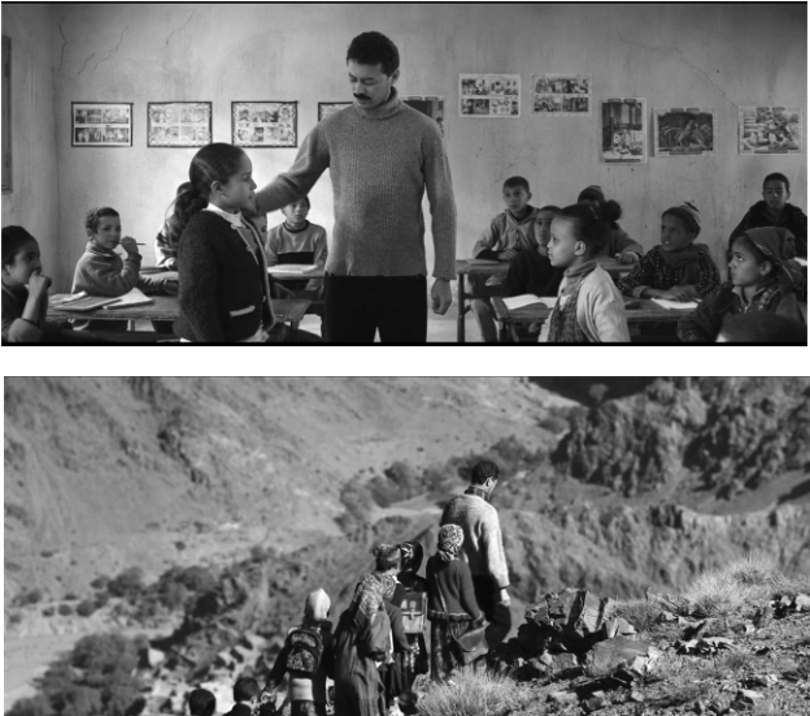
Razzia, dir. Nabil Ayouch, 2017
Casting a broad net on what constitutes an Amazigh film, this collection offers the first English-language analysis of this varied cinematic production for North American and global readers by placing the works within their historical and cultural contexts and introducing and defining key terms. Theorizing the historical and cultural links between a body of amateur video, documentaries, shorts, and feature films, this collection seeks to link and contrast Amazigh film production with individual national cinemas and established cinematic genres by examining how cinema plays a role in preserving and transmitting "Amazighity," a contemporary cultural concept linking language, lands, and peoples that emerged and coalesced around a history of colonial and postcolonial repression and exclusion and the global phenomena of Indigenous representational sovereignty. As a collaborative scholarly outgrowth of the yearly New York Forum of Amazigh Film (nyfaf), a pedagogically oriented film festival that has sought to celebrate Amazigh visual expression while avoiding folklorization and ideological divisions, the volume considers all videos and films produced across the Tamazgha and diaspora that are by and about Imazighen. Arguing that this growing archive deserves critical attention, the collection gives witness to its reception and the evolution of its name, which contributors call alternately “Amazigh-Speaking Cinema,” “Amazigh YouTubea,” or “Amazigh cinematographic space,” breaking from the use of the term "Berber." From systemic repression to gradual official recognition to an active role in film production and contemporary culture, the status and place of Amazighity can thus be examined through this body of cinematic work, which grew symbiotically with Amazigh cultural movements and North African cinematic production and varies from one country, generation, and filmmaker to another, shaped by national political pressures, the experience of diaspora, and unequal access to production technologies and distribution networks. Through the eyes of their protagonists and cinematographers, these shorts, documentaries, and feature films have come to shed an unflinching light on the fault lines in contemporary political and social systems, interrogating the nostalgic pull of ideologies of resistance that repress native knowledge and the necessity for adaptation and an opening of social fields. As its creators employ the camera lens and editorial craft to track and align audiences with an Indigenous sense of presence and continuity, Amazigh cinema allows for a new dialogic rapport with a world facing multiple threats—the continued ignorance of colonial history, the ravages of climate change, and the uprooting and loss of a sense of belonging and home through mass migration.
Offering a theoretical framework, the present volume thus shows how Amazigh cinema belongs to a larger Indigenous “counterpublic address” focusing on socially and aesthetically constructed acts of memory work, transmission, and confrontation. To apply Nancy Fraser’s understanding of counterpublics, Indigenous cinema offers “parallel discursive arenas where members of subordinated social groups invent and circulate counter-discourses, which in turn permit them to formulate oppositional interpretations of their identities, interests, and needs” and aim at resisting nationalistic and hegemonic forces. Fraser stresses that these new spaces are not necessarily bias free and can lead to antidemocratic and competitive claims. By recentering and often decolonizing visual media, however, Amazigh filmmakers are collectively shaping Amazigh memory or “survivance,” a term used by the Anishinaabe scholar and writer Gerald Vizenor to describe the act of taking control over “historical representations of erasure.” This act can choose to resist binary thinking and the common antagonisms between land-based or national identities, a common strength of the Indigenous, transnational worldview. Often portraying how individuals overcome a sense of social atrophy in the face of traumatic memory and collective crisis, the creative space of this Indigenous art form is relevant to spectators far and wide as we collectively seek strategies for the twenty-first century.