Teaching Palestine Today: Session 4-
On "Western Values"
Featuring:
Ussama Makdisi
Craig Mokhiber
Mouin Rabbani
Lana Tatour
Discussants:
Ghassan Hage
Adam Horowitz
Moderator:
Bassam Haddad
Friday, 03 October, 2025
3:00PM EST | 10:00PM Gaza
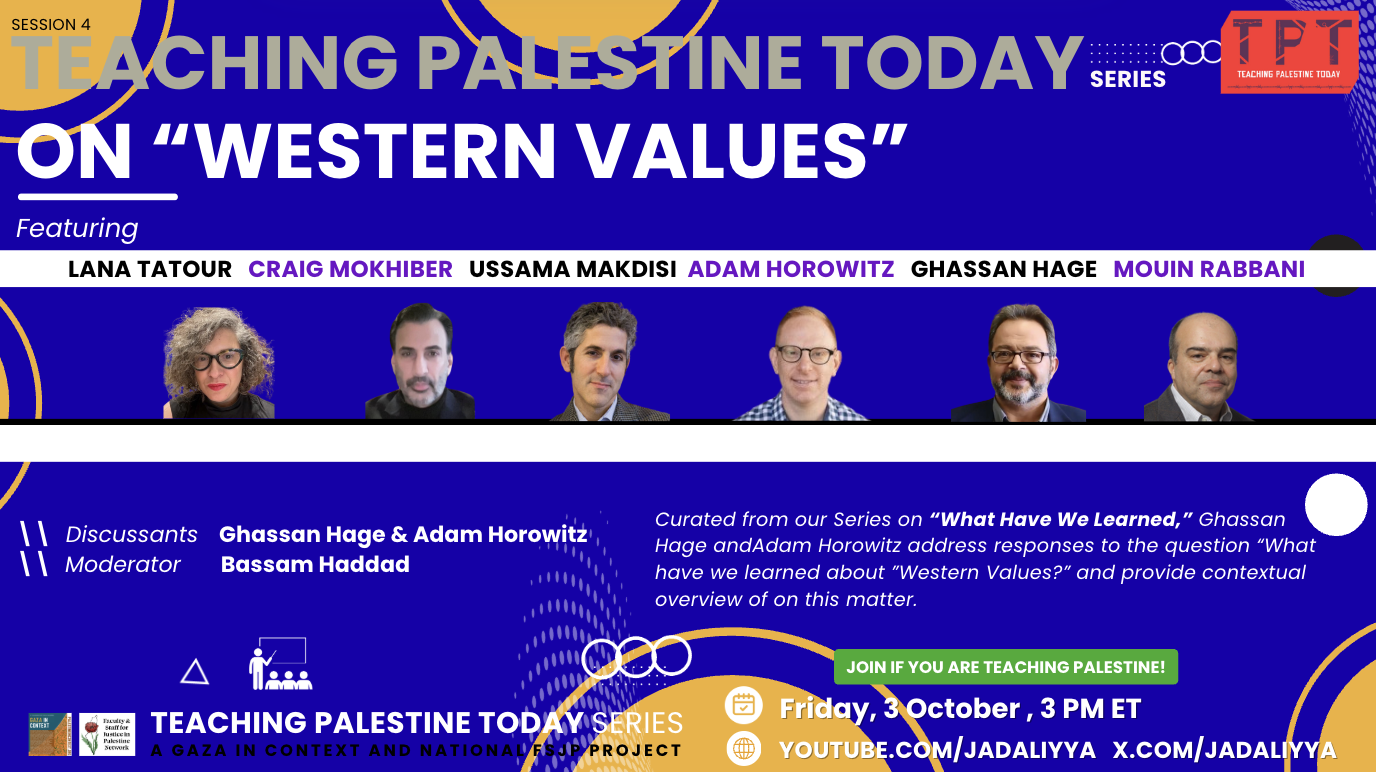
Join our fourth session of the Pedagogic Series “Teaching Palestine Today". This session addresses “Western Values,” curated from our speakers’ responses to the question “What have we learned about “Western Values” in the past year+?” Featuring Lana Tatour, Ussama Makdisi, Adam Horowitz, Craig Mokhiber, Mouin Rabbani, and Ghassan Hage. Our discussants are Ghassan Hage and Adam Horowitz, with Bassam Haddad as moderator
This series is organized by the Gaza in Context Project and National Faculty and Staff for Justice in Palestine, with more than 140 chapters nationwide.
Featuring
Lana Tatour is a Lecturer in Development at the School of Social Sciences, UNSW Sydney. She works on settler colonialism, indigeneity, race, citizenship, human rights, and the Middle East with a focus on Palestine and Israel. Prior to joining the School of Social Sciences, she was a Postdoctoral Fellow at the Center for Palestine Studies at Columbia University, and held visiting fellowships at the Palestinian-American Research Center, the Australian Human Rights Centre, UNSW Faculty of Law and UNSW School of Social Sciences. She is on the board of The Australian Journal of Human Rights. She is currently working on her manuscript: Ambivalent Resistance: Palestinians in Israel and the Liberal Politics of Settler Colonialism and Human Rights, and on an edited volume together with Dr Ronit Lentin on Race and the Question of Palestine.
Craig Mokhiber is an international human rights lawyer and former senior United Nations Official. He left the UN in October of 2023, penning a widely read letter that warned of genocide in Gaza, criticized the international response and called for a new approach to Palestine and Israel based on equality, human rights and international law. He has spent four decades in the international human rights movement, including more than thirty years at the United Nations. He is the former Director of the New York Office of the UN High Commissioner for Human Rights, held senior UN positions in Geneva, New York and in the field, and undertook human rights missions to dozens of countries across Africa, Asia, the Middle East, Eastern Europe and Latin America. He has served as the UN’s Senior Human Rights Advisor in Palestine, and in Afghanistan, led the team of human rights specialists attached to the High Level Mission on Darfur, headed the Rule of Law and Democracy Unit, and served as Chief of the Economic and Social Issues Section, and Chief of the Development and Economic and Social Issues Branch at OHCHR Headquarters. He was for five years the Chairman of the UN Task Force for Action Two (a global initiative to advance national human rights protection systems), and later Chaired the UN Democracy Fund consultative group, the UN Working Group on Leadership, and the UN Consultative Group on Inequalities, and the Steering Committee of the UN Human Rights Mainstreaming Fund.
Ussama Makdisi is Professor of History and the first holder of the Arab-American Educational Foundation Chair of Arab Studies at Rice University. For AY 2019-2020, Professor Makdisi is a Visiting Professor at the University of California at Berkeley in the Department of History. In 2012-2013, Makdisi was an invited Resident Fellow at the Wissenschaftskolleg zu Berlin (Institute for Advanced Study). In April 2009, the Carnegie Corporation named Makdisi a 2009 Carnegie Scholar as part of its effort to promote original scholarship regarding Muslim societies and communities, both in the United States and abroad. Makdisi was awarded the Berlin Prize and was a Fellow at the American Academy of Berlin. His latest book is Age of Coexistence: The Ecumenical Frame and the Making of the Modern Arab World (UC Press, 2019). His previous books include Faith Misplaced: the Broken Promise of U.S.-Arab Relations, 1820-2001 (Public Affairs, 2010), the thrice-awarded Artillery of Heaven: American Missionaries and the Failed Conversion of the Middle East (Cornell UP, 2008), The Culture of Sectarianism: Community, History, and Violence in Nineteenth-Century Ottoman Lebanon (UC Press, 2000) and the co-edited Memory and Violence in the Middle East and North Africa (Indiana UP, 2006). He has published widely on Ottoman and Arab history as well as on US-Arab relations and US missionary work in the Middle East.
Adam Horowitz is the Executive Editor of Mondoweiss.net, an independent website covering news, politics, and debate around Palestine. Adam was the co-editor of The Goldstone Report: The Legacy of the Landmark Investigation of the Gaza Conflict (2011, Bold Type Books) with Lizzy Ratner and Philip Weiss and has been active in Jewish anti-Zionist movements for the last two decades.
Ghassan Hage is professor of anthropology at the University of Melbourne. He has held several visiting professorships across the world including at the American University of Beirut, at the University of Paris, The University of Copenhagen, the University of Keio in Tokyo, and Harvard. He was recently a visiting professor at the Max Planck Institute of Social Anthropology in Germany but his professorship was terminated because of his critiques of Zionism. He works in the fields of theoretical anthropology, the anthropology of nationalism, multiculturalism and racism, and the anthropology of migration. He is the author of several works including Alter-Politics: Critical Anthropology and the Radical Imagination (2015) and Is Racism an environmental threat? (2017), Decay 2020), The Diasporic Condition: Ethnographic Explorations of the Lebanese in the World (2021), The Racial Politics of Australian Multiculturalism (2023). His most recent work Pierre Bourdieu's Political Economy of Being is forthcoming with Duke University Press in 2025.
Mouin Rabbani has published and commented widely on Palestinian affairs, the Israeli-Palestinian conflict, and the contemporary Middle East. He was previously Senior Analyst Middle East and Special Advisor on Israel-Palestine with the International Crisis Group, and head of political affairs with the Office of the United Nations Special Envoy for Syria. He is Co-Editor of Jadaliyya Ezine.
Bassam Haddad is Founding Director of the Middle East and Islamic Studies Program and Associate Professor at the Schar School of Policy and Government at George Mason University. He is the author of Business Networks in Syria: The Political Economy of Authoritarian Resilience (Stanford University Press, 2011) and co-editor of A Critical Political Economy of the Middle East (Stanford University Press, 2021). Bassam is Co-Founder/Editor of Jadaliyya Ezine and Executive Director of the Arab Studies Institute. He serves as Founding Editor of the Arab Studies Journal and the Knowledge Production Project. He is co-producer/director of the award-winning documentary film, About Baghdad, and director of the acclaimed series Arabs and Terrorism. Bassam is Executive Producer of Status Podcast Channel and Director of the Middle East Studies Pedagogy Initiative (MESPI). He received MESA's Jere L. Bacharach Service Award in 2017 for his service to the profession. Currently, Bassam is working on his second Syria book titled Understanding The Syrian Tragedy: Regime, Opposition, Outsiders (forthcoming, Stanford University Press).