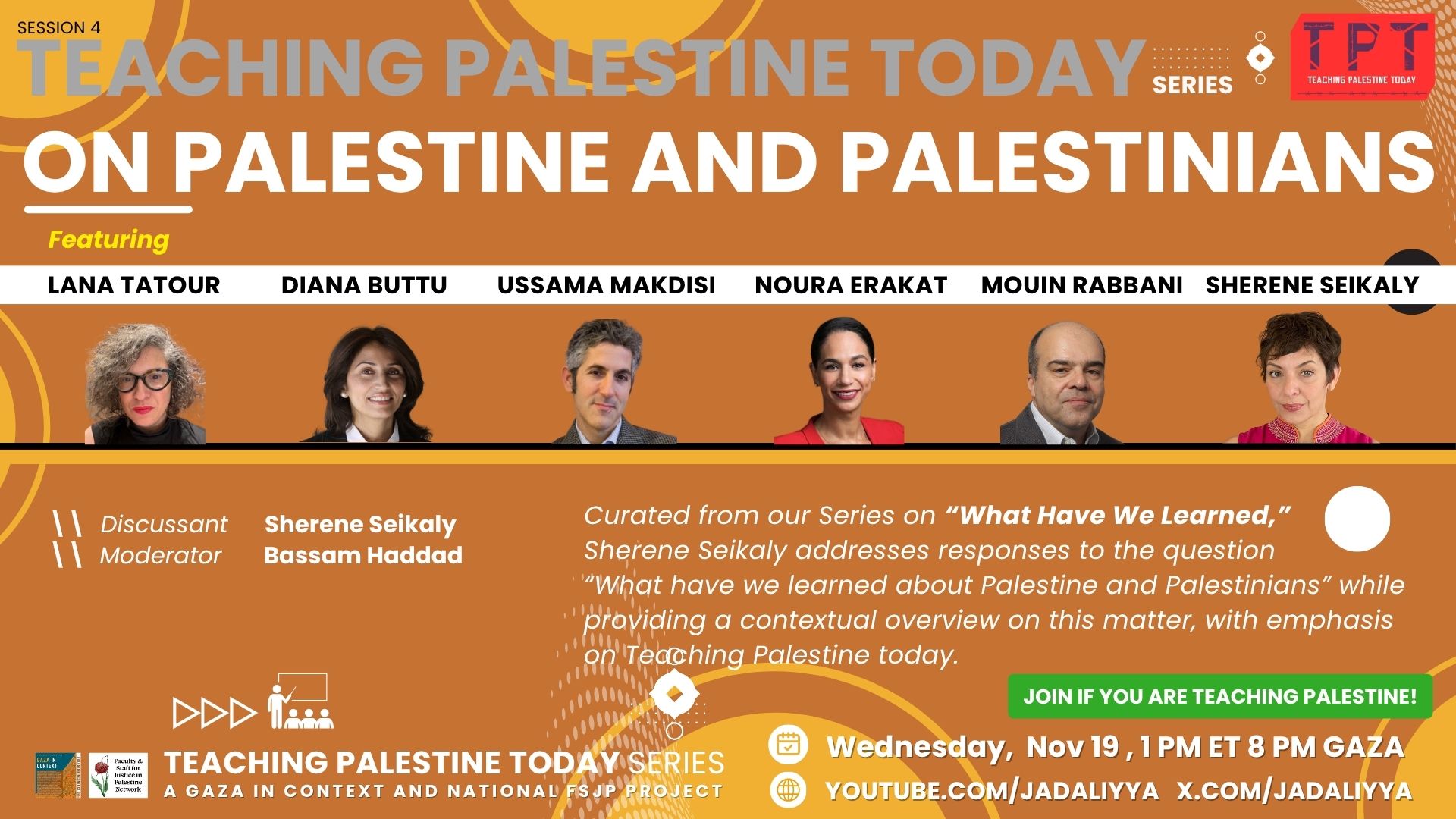
Teaching Palestine Today: Session 4-
On Palestine and the Palestinians
Featuring:
Lana Tatour
Diana Buttu
Ussama Makdisi
Noura Erakat
Mouin Rabbani
Discussant:
Sherene Seikaly
Moderator:
Bassam Haddad
Wednesday, 19 November, 2025
1:00PM EST | 8:00PM Gaza
Join us for an extra special session of the Pedagogic Series “Teaching Palestine Today". Curated from our Series on “What Have We Learned,” Sherene Seikaly addresses responses to the question “What have we learned about Palestine and Palestinians” while providing a contextual overview on this matter, with emphasis on Teaching Palestine today. ” Featuring Lana Tatour, Diana Buttu, Ussama Makdisi, Noura Erakat, and Mouin Rabbani. Our discussant is Sherene Seikaly, with Bassam Haddad as moderator
This series is organized by the Gaza in Context Project and National Faculty and Staff for Justice in Palestine, with more than 140 chapters nationwide.
Featuring
Lana Tatour is a Lecturer in Development at the School of Social Sciences, UNSW Sydney. She works on settler colonialism, indigeneity, race, citizenship, human rights, and the Middle East with a focus on Palestine and Israel. Prior to joining the School of Social Sciences, she was a Postdoctoral Fellow at the Center for Palestine Studies at Columbia University, and held visiting fellowships at the Palestinian-American Research Center, the Australian Human Rights Centre, UNSW Faculty of Law and UNSW School of Social Sciences. She is on the board of The Australian Journal of Human Rights. She is currently working on her manuscript: Ambivalent Resistance: Palestinians in Israel and the Liberal Politics of Settler Colonialism and Human Rights, and on an edited volume together with Dr Ronit Lentin on Race and the Question of Palestine.
Diana Buttu is a Palestinian-Canadian lawyer and analyst based in Haifa and Communications Director to the Institute for Middle East Understanding. Diana previously worked as a legal advisor the Palestinian negotiating team. Diana was one of the lawyers who challenged the legality of Israel’s apartheid wall before the International Court of Justice.
Ussama Makdisi is Professor of History and the first holder of the Arab-American Educational Foundation Chair of Arab Studies at Rice University. For AY 2019-2020, Professor Makdisi is a Visiting Professor at the University of California at Berkeley in the Department of History. In 2012-2013, Makdisi was an invited Resident Fellow at the Wissenschaftskolleg zu Berlin (Institute for Advanced Study). In April 2009, the Carnegie Corporation named Makdisi a 2009 Carnegie Scholar as part of its effort to promote original scholarship regarding Muslim societies and communities, both in the United States and abroad. Makdisi was awarded the Berlin Prize and was a Fellow at the American Academy of Berlin. His latest book is Age of Coexistence: The Ecumenical Frame and the Making of the Modern Arab World (UC Press, 2019). His previous books include Faith Misplaced: the Broken Promise of U.S.-Arab Relations, 1820-2001 (Public Affairs, 2010), the thrice-awarded Artillery of Heaven: American Missionaries and the Failed Conversion of the Middle East (Cornell UP, 2008), The Culture of Sectarianism: Community, History, and Violence in Nineteenth-Century Ottoman Lebanon (UC Press, 2000) and the co-edited Memory and Violence in the Middle East and North Africa (Indiana UP, 2006). He has published widely on Ottoman and Arab history as well as on US-Arab relations and US missionary work in the Middle East.
Noura Erakat is a Professor of Africana Studies and the Program of Criminal Justice at Rutgers University, New Brunswick. Noura is the author of Justice for Some: Law and the Question of Palestine (Stanford University Press, 2019), which received the Palestine Book Award and the Bronze Medal for the Independent Publishers Book Award in Current Events/Foreign Affairs. She is co-founding editor of Jadaliyya and an editorial board member of the Journal of Palestine Studies as well as Human Geography. She is a co-founding board member of the DC Palestinian Film and Arts Festival. She has served as Legal Counsel for a Congressional Subcommittee in the US House of Representatives, as Legal Advocate for the Badil Resource Center for Palestinian Refugee and Residency Rights, and as national organizer of the US Campaign to End the Israeli Occupation. Noura has also produced video documentaries, including "Gaza In Context" and "Black Palestinian Solidarity.” Her writings have appeared in The Washington Post, The New York Times, the Los Angeles Review of Books, The Nation, Al Jazeera, and the Boston Review. She is a frequent commentator on CBS News, CNN, MSNBC, CBS, Fox News, the BBC, and NPR, among others. She completed non-resident fellowship of the Religious Literacy Project at Harvard Divinity School in 2021. In 2022, she was selected as a Freedom Fellow by the Marguerite Casey Foundation.
Mouin Rabbani has published and commented widely on Palestinian affairs, the Israeli-Palestinian conflict, and the contemporary Middle East. He was previously Senior Analyst Middle East and Special Advisor on Israel-Palestine with the International Crisis Group, and head of political affairs with the Office of the United Nations Special Envoy for Syria. He is Co-Editor of Jadaliyya Ezine.
Sherene Seikaly is Associate Professor of History at the University of California, Santa Barbara. She held the Qatar Postdoctoral Fellowship at Georgetown University and the Europe in the Middle East Postdoctoral Fellowship at the Wissenschaftskolleg zu Berlin. Seikaly was Director of the Middle East Studies Center at the American University in Cairo (2012-2014), where she was awarded an Excellence in Teaching Award in 2014. Seikaly's Men of Capital: Scarcity and Economy in Mandate Palestine (Stanford University Press, 2016) explores how Palestinian capitalists and British colonial officials used economy to shape territory, nationalism, the home, and the body. Her forthcoming book, From Baltimore to Beirut: On the Question of Palestine focuses on a Palestinian man who was at once a colonial officer and a colonized subject, an enslaver and a refugee. His trajectory from nineteenth century mobility across Baltimore and Sudan to twentieth century immobility in Lebanon places the question of Palestine in a global history of race, capital, slavery, and dispossession. Seikaly is the recipient of the National Endowment for the Humanities Research Fellowship, the Distinguished Teaching Award from the Academic Senate, the University of California, Santa Barbara; the Harold J. Plous Award at UCSB; and the UC President’s Faculty Research Fellowship. She currently serves as co-editor of Journal of Palestine Studies and co-founder and co-editor of Jadaliyya.
Bassam Haddad is Founding Director of the Middle East and Islamic Studies Program and Associate Professor at the Schar School of Policy and Government at George Mason University. He is the author of Business Networks in Syria: The Political Economy of Authoritarian Resilience (Stanford University Press, 2011) and co-editor of A Critical Political Economy of the Middle East (Stanford University Press, 2021). Bassam is Co-Founder/Editor of Jadaliyya Ezine and Executive Director of the Arab Studies Institute. He serves as Founding Editor of the Arab Studies Journal and the Knowledge Production Project. He is co-producer/director of the award-winning documentary film, About Baghdad, and director of the acclaimed series Arabs and Terrorism. Bassam is Executive Producer of Status Podcast Channel and Director of the Middle East Studies Pedagogy Initiative (MESPI). He received MESA's Jere L. Bacharach Service Award in 2017 for his service to the profession. Currently, Bassam is working on his second Syria book titled Understanding The Syrian Tragedy: Regime, Opposition, Outsiders (forthcoming, Stanford University Press).