[This is the Editor's Note and Table of Contents for the Arab Studies Journal Fall 2025 issue, which is now available for purchase. Click here to subscribe to Arab Studies Journal.]
ARAB STUDIES JOURNAL
VOL. XXXIII, No. 1–2
Editors’ Note
In this issue, we are proud to publish a diverse collection of peer-reviewed articles that represent new directions in the critical interdisciplinary study of the Middle East and North Africa. In her article, “Writing Africa for Africans: Du Bois, Egyptian Africanists, and the Encyclopedia Africana Project Between Dreams and Disruptions,” May Kosba traces the historical evolution of W. E. B. Du Bois’s vision for a pan-African encyclopedia through his and his family’s interactions with Egyptian Africanists. She contrasts Du Bois’s own evolving vision for this project with that of Henry Louis Gates and Kwame Anthony Appiah, who claimed Du Bois’s legacy for their encyclopedia project decades later. In her article, “Crime and Dystopia in Three Egyptian Novels: Dissecting Cityscapes and the Body as a Terrain for Political Critique,” Dalia Said Mostafa situates recent Egyptian dystopian crime fiction in its postrevolutionary political context. Examining recent works by Ahmed Khaled Tawfiq, Basma ‘Abdel ‘Aziz, and Nael Eltoukhy, Mostafa evokes how each author explores the bodily experience of dystopic oppression as a means to grapple with a counterrevolutionary present.
The final two articles provide powerful ethnographic and political-economic studies of agricultural labor in the occupied West Bank. They are products of two workshops on critical labor studies in the Middle East and North Africa convened by Rima Majed at the American University of Beirut in 2022. We are grateful to Rima Majed and Elizabeth Saleh for coordinating these submissions and providing significant editorial insight towards their completion. In “Tobacco Cultivation in the West Bank Between Economic Survival and Settler-Colonial Constraints,” Kholoud Al-Ajarma, D. A. Jaber, and Jawida Mansour explore how Palestinian tobacco workers negotiate Israeli settler colonialism’s effects at each stage of production, from cultivation to manufacturing, shipping, and marketing. Highlighting women’s centrality to this commodity chain, the authors provide trenchant insights into the overlapping power structures that make the tobacco trade a vital lifeline that sustains Palestinian farming communities. Fairouz Salem studies the agricultural system of the occupied West Bank through the case study of Furush Beit Dajan in her contribution, “Palestinian Farmers’ Resilience Against the Settler Colonial-Capitalist Production of Vulnerability in the Jordan Valley.” In contradistinction to international institutions’ conception of vulnerability as a product of a finite and specific risks, Salem identifies the settler-colonial and capitalist structures that consistently generate vulnerability and inform Palestinians’ tactics for resilience.
This issue also features an urgently relevant essays section produced by the Middle East Studies Association (MESA) Global Academy. Founded in 2019, the MESA Global Academy supports scholars from the MENA who face persecution in their home countries. In conjunction with the Graduate Center, City University of New York, the MESA Global Academy awards competitive scholarships to enable researchers to contribute to interdisciplinary knowledge production projects at North American universities. Diana B. Greenwald introduces the essays, which Ceren Abi and the MESA Global Academy Committee coordinated. The two contributors, Dina Hadad and Nadia Al-Sakkaf, grapple with the present period of spectacular and devastating transformation in the MENA. Both ground our understanding of profound geopolitical shifts in Middle Eastern communities’ concrete experiences of warfare and fractured governance. The issue concludes with a reviews section that explores a multidisciplinary selection of recent works on political ecology, commodity history, popular culture, and resistance.
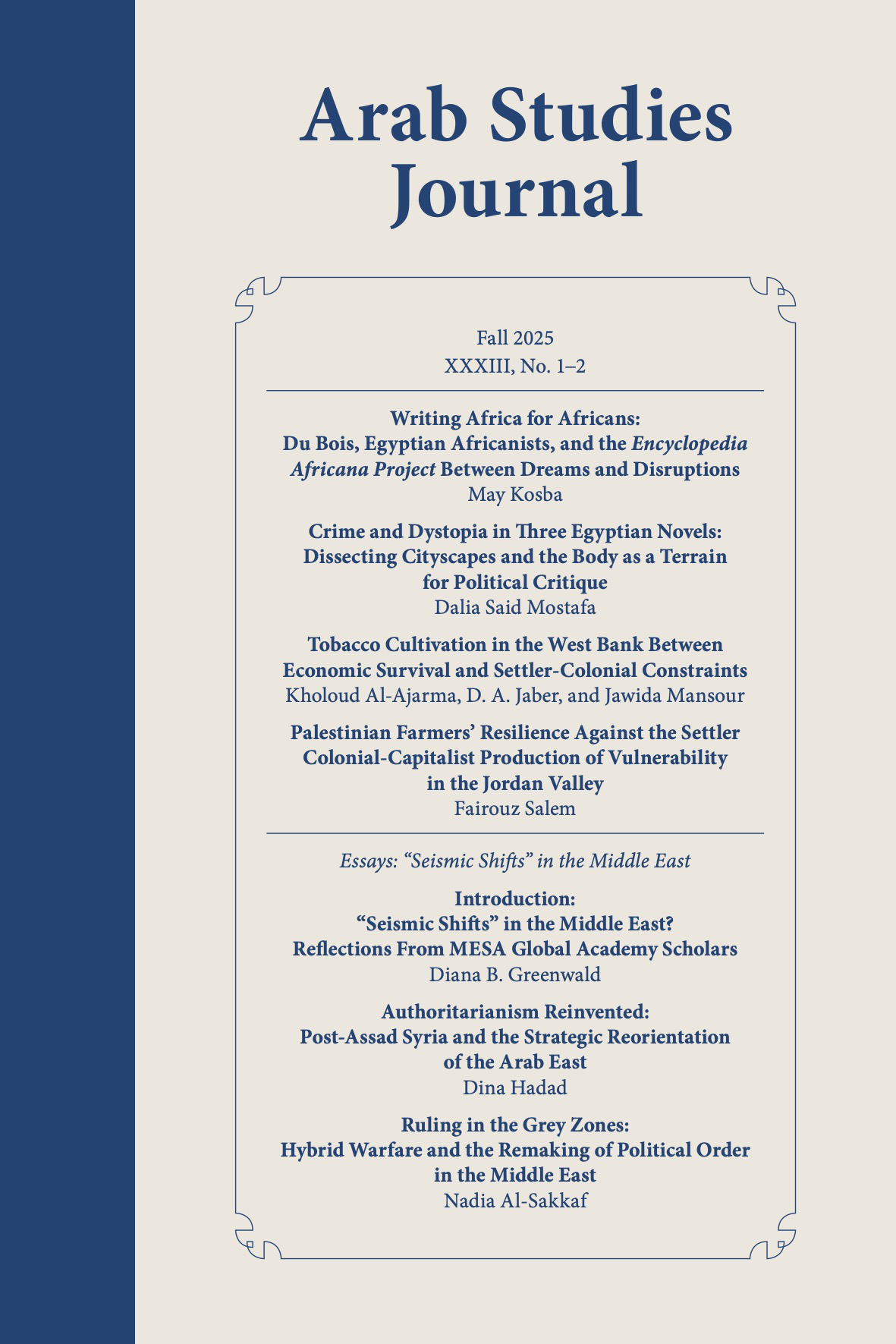
Table of Contents
ARTICLES
Writing Africa for Africans: Du Bois, Egyptian Africanists, and the Encyclopedia Africana Project Between Dreams and Disruptions
May Kosba
Crime and Dystopia in Three Egyptian Novels: Dissecting Cityscapes and the Body as a Terrain for Political Critique
Dalia Said Mostafa
Tobacco Cultivation in the West Bank Between Economic Survival and Settler-Colonial Constraints
Kholoud Al-Ajarma, D. A. Jaber, and Jawida Mansour
Palestinian Farmers’ Resilience Against the Settler Colonial-Capitalist Production of Vulnerability in the Jordan Valley
Fairouz Salem
ESSAYS: “Seismic Shifts” in the Middle East
Introduction: “Seismic Shifts” in the Middle East? Reflections From MESA Global Academy Scholars
Diana B. Greenwald
Authoritarianism Reinvented: Post-Assad Syria and the Strategic Reorientation of the Arab East
Dina Hadad
Ruling in the Grey Zones: Hybrid Warfare and the Remaking of Political Order in the Middle East
Nadia Al-Sakkaf
REVIEWS
The Political Ecology of Violence: Peasants and Pastoralists in the Last Ottoman Century
By Zozan Pehlivan
Reviewed by Deren Ertas
The Untold Story of the Golan Heights: Occupation, Colonization, and Jawlani Resistance
Edited by Muna Dajani, Munir Fakher Eldin, and Michael Mason
Reviewed by Gary Fields
Egypt’s Beer: Stella, Identity, and the Modern State
By Omar D. Foda
Reviewed by Kaleb Herman Adney
The Arab Nahda as Popular Entertainment: Mass Culture and Modernity in the Middle East
Edited by Hala Auji, Raphael Cormack, and Alaaeldin Mahmoud
Reviewed by Adéla Provazníková
A Landscape of War: Ecologies of Resistance and Survival in South Lebanon
By Munira Khayyat
Reviewed by Susann Kassem