In Defense of Academic Freedom Session 11
The Frontlines of Educator Resistance
Featuring:
Heather Ferguson
Karim Mattar
Sherena Razek
Moderators:
Bassam Haddad
Organized by DC, Maryland, & Virginia Faculty for Academic Freedom and Gaza in Conrtext Collaborative Project; Cosponsored by MESA Task Force on Civil and Human Rights, MESA's Committee on Academic Freedom, Faculty for Justice in Palestine Network (140+ chapters nationally)
The assault on academic freedom is intensifying on University campuses. This series takes note of cases of defamation, intimidation, and suspension that faculty are being subjected to in the United States and beyond. We aim to raise awareness regarding the conditions and pretenses under which such violations occur.
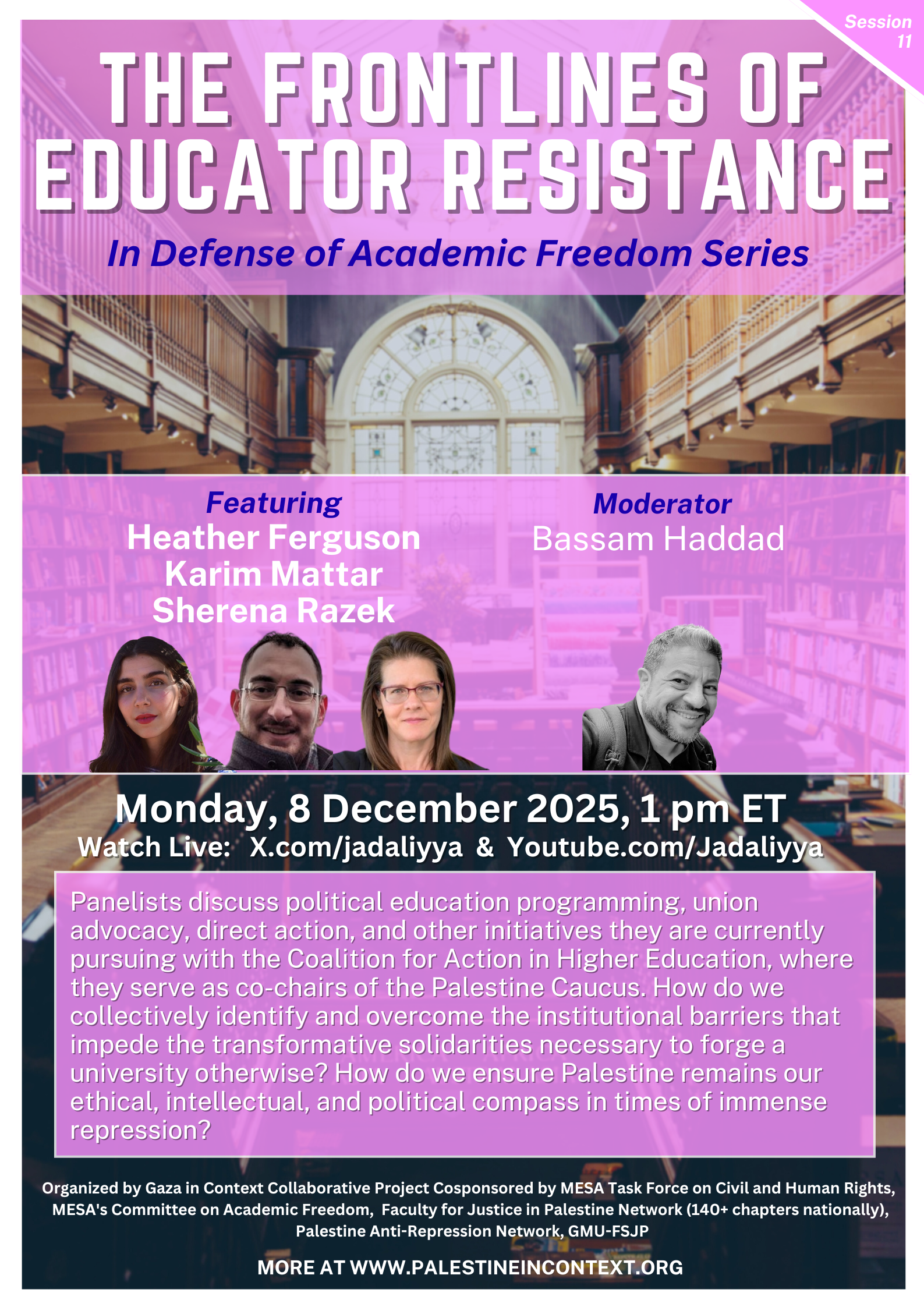
In this session, panelists discuss political education programming, union advocacy, direct action, and other initiatives they are currently pursuing with the Coalition for Action in Higher Education, where they serve as co-chairs of the Palestine Caucus. How do we collectively identify and overcome the institutional barriers that impede the transformative solidarities necessary to forge a university otherwise? How do we ensure Palestine remains our ethical, intellectual, and political compass in times of immense repression?
Join academics, activists, and educators to discuss how we organize workers across positions in higher education and K-12 in advance of the school year to push back against the repression at our institutions. We will discuss a variety of tactics, including leveraging internal processes with the support of unions, legal avenues, public pressure campaigns, and boycotts.
This event is Co-Sponsored by the Gaza in Context Collaborative Project
Featuring
Heather Ferguson is an early modern Ottoman historian specializing in comparative strategies for managing difference and dissent in imperial and post-imperial contexts. Recently her energies have focused on building coalitions of organizers both inside and outside the academy and developing collaborative mechanisms to transform knowledge production into crucibles for liberatory futures.
Karim Mattar is an Associate Professor of English at the University of Colorado at Boulder. A descendant of survivors of the Palestinian Nakba of 1948, he works at the intersection of Palestine studies, the humanities, and higher education. He is currently at work on two book projects. The Ethics of Affiliation: Palestine and the Future of Humanism seeks to develop a curriculum and a public pedagogy of truth and reconciliation in historic Palestine, focusing on the areas of education, culture, public institutions, civil society, and law. Writing the Catastrophe: Trauma and Responsibility Across Generations interweaves personal experience, family history, cultural critique, and political analysis to tell a multigenerational, transcontinental story of responsibility to Palestine, with a special emphasis on American higher education during the genocide. Also a dedicated community organizer, Karim works at the local, state, and national levels to enhance public awareness and understanding of Palestinian literature, history, and politics and to advocate for the liberation of Palestine. Karim received his D.Phil. in English at the University of Oxford in 2013, and writes and teaches more broadly on comparative Middle Eastern literatures and cultures, the history of the novel, media and technology, and critical theory.
Sherena Razek is a diasporic Palestinian feminist educator, scholar, activist, and labor organizer. Currently, she is a President’s and Andrew W. Mellon Postdoctoral Fellow in the Department of Gender Studies at the University of California Los Angeles. She holds a PhD from the Department of Modern Culture and Media at Brown University where she was the President of the Graduate Labor Organization and co-founder of the Palestine Solidarity Caucus. She will begin as Assistant Professor in Women’s, Gender, and Sexuality Studies at UMass Boston this coming fall. Her research focuses on Palestinian visual culture, anti-imperialist struggle, and decolonial feminist ecologies. Her first book project is currently titled “Nakba Ecologies: On Elemental Intifada in Colonized Palestine.” It offers a grounded intervention in the emergent field of elemental media studies, by tethering the classical elements of water, fire, earth and air to their specific valences in Palestinian film, photography, performance, ecopoetics, and counter archives. Her curatorial work has addressed the politics and aesthetics of surveillance, oceanic degradation, and the militarization and materialization of nation-state borders between the Global North and the Global South. Her writing appears in The Journal of Palestine Studies, InVisible Culture, and Social Text.
Bassam Haddad is Founding Director of the Middle East and Islamic Studies Program and Associate Professor at the Schar School of Policy and Government at George Mason University. He is the author of Business Networks in Syria: The Political Economy of Authoritarian Resilience (Stanford University Press, 2011) and co-editor of A Critical Political Economy of the Middle East (Stanford University Press, 2021). Bassam is Co-Founder/Editor of Jadaliyya Ezine and Executive Director of the Arab Studies Institute. He serves as Founding Editor of the Arab Studies Journal and the Knowledge Production Project. He is co-producer/director of the award-winning documentary film, About Baghdad, and director of the acclaimed series Arabs and Terrorism. Bassam is Executive Producer of Status Podcast Channel and Director of the Middle East Studies Pedagogy Initiative (MESPI). He received MESA's Jere L. Bacharach Service Award in 2017 for his service to the profession. Currently, Bassam is working on his second Syria book titled Understanding The Syrian Calamity: Regime, Opposition, Outsiders (forthcoming, Stanford University Press).