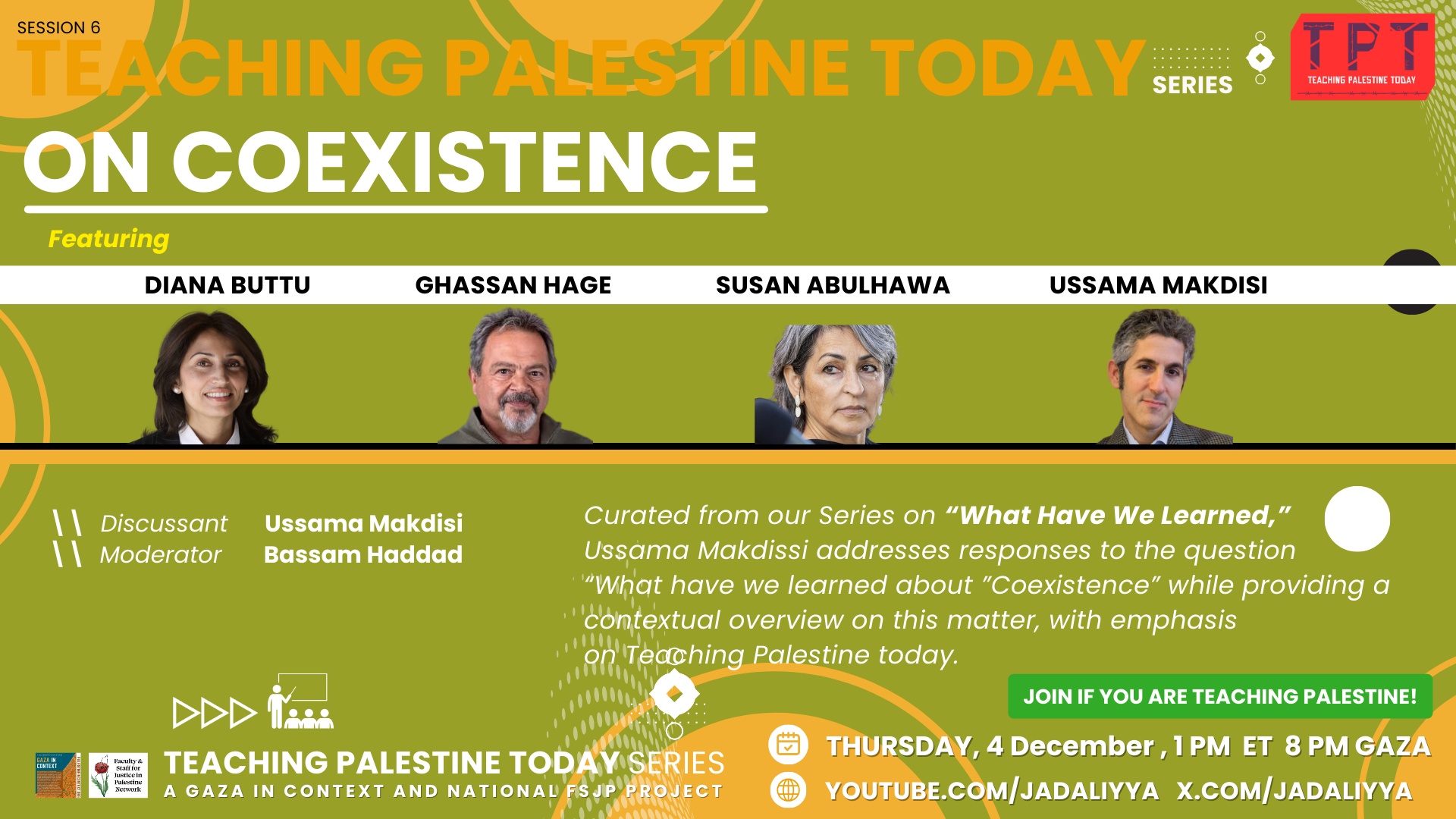
Teaching Palestine Today: Session 5
On Coexistence
Featuring:
Diana Buttu
Ghassan Hage
Susan Abulhawa
Discussant:
Ussama Makdisi
Moderator:
Bassam Haddad
Curated from our Series on “What Have We Learned,” Ussama Makdissi addresses responses to the question “What have we learned about ”Coexistence” while providing a contextual overview on this matter, with emphasis on Teaching Palestine today.
This series is organized by the Gaza in Context Project and National Faculty and Staff for Justice in Palestine, with more than 140 chapters nationwide.
Featuring
Diana Buttu is a Palestinian-Canadian lawyer and analyst based in Haifa and Communications Director to the Institute for Middle East Understanding. Diana previously worked as a legal advisor the Palestinian negotiating team. Diana was one of the lawyers who challenged the legality of Israel’s apartheid wall before the International Court of Justice.
Susan Abulhawa is a novelist, poet, essayist, scientist, mother, and activist. Her debut novel Mornings in Jenin(Bloomsbury, 2010), translated into 30 languages and was an international bestseller. Her second novel is The Blue Between Sky and Water (2015), and her third, Against the Loveless World (2020). She is also the author of a poetry collection, My Voice Sought The Wind (2013), a political commentator, and an advocate for animal rights and liberation.
Ghassan Hage is professor of anthropology at the University of Melbourne. He has held several visiting professorships across the world including at the American University of Beirut, at the University of Paris, The University of Copenhagen, the University of Keio in Tokyo, and Harvard. He was a visiting professor at the Max Planck Institute of Social Anthropology in Germany but his professorship was terminated because of his critiques of Zionism.
Ussama Makdisi (Discussant) is Professor of History and the first holder of the Arab-American Educational Foundation Chair of Arab Studies at Rice University. For AY 2019-2020, Professor Makdisi is a Visiting Professor at the University of California at Berkeley in the Department of History. In 2012-2013, Makdisi was an invited Resident Fellow at the Wissenschaftskolleg zu Berlin (Institute for Advanced Study). In April 2009, the Carnegie Corporation named Makdisi a 2009 Carnegie Scholar as part of its effort to promote original scholarship regarding Muslim societies and communities, both in the United States and abroad. Makdisi was awarded the Berlin Prize and was a Fellow at the American Academy of Berlin. His latest book is Age of Coexistence: The Ecumenical Frame and the Making of the Modern Arab World (UC Press, 2019). His previous books include Faith Misplaced: the Broken Promise of U.S.-Arab Relations, 1820-2001 (Public Affairs, 2010), the thrice-awarded Artillery of Heaven: American Missionaries and the Failed Conversion of the Middle East (Cornell UP, 2008), The Culture of Sectarianism: Community, History, and Violence in Nineteenth-Century Ottoman Lebanon (UC Press, 2000) and the co-edited Memory and Violence in the Middle East and North Africa (Indiana UP, 2006). He has published widely on Ottoman and Arab history as well as on US-Arab relations and US missionary work in the Middle East.
Bassam Haddad (Moderator) is Founding Director of the Middle East and Islamic Studies Program and Associate Professor at the Schar School of Policy and Government at George Mason University. He is the author of Business Networks in Syria: The Political Economy of Authoritarian Resilience (Stanford University Press, 2011) and co-editor of A Critical Political Economy of the Middle East (Stanford University Press, 2021). Bassam is Co-Founder/Editor of Jadaliyya Ezine and Executive Director of the Arab Studies Institute. He serves as Founding Editor of the Arab Studies Journal and the Knowledge Production Project. He is co-producer/director of the award-winning documentary film, About Baghdad, and director of the acclaimed series Arabs and Terrorism. Bassam is Executive Producer of Status Podcast Channel and Director of the Middle East Studies Pedagogy Initiative (MESPI). He received MESA's Jere L. Bacharach Service Award in 2017 for his service to the profession. Currently, Bassam is working on his second Syria book titled Understanding The Syrian Tragedy: Regime, Opposition, Outsiders (forthcoming, Stanford University Press).