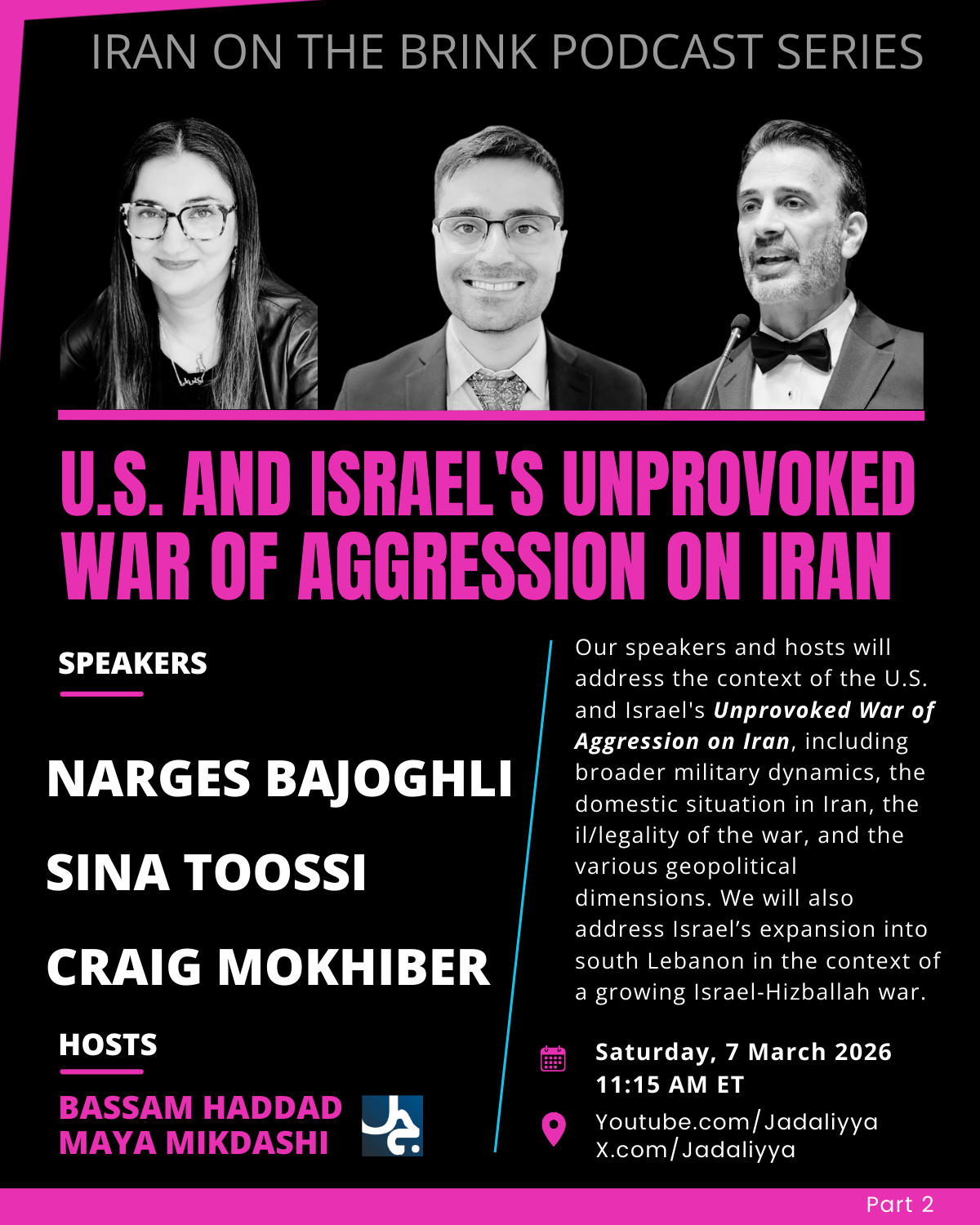
Iran on the Brink Podcast Series
U.S. and Israel's Unprovoked War of Aggression on Iran
Speakers
Narges Bajoghli
Sina Toossi
Craig Mokhiber
Hosts
Bassam Haddad
Maya Mikdashi
In this conversation, our speakers and hosts will address the context of the U.S. and Israel's Unprovoked War of Aggression on Iran, including broader military dynamics, the domestic situation in Iran, the il/legality of the war, and the various geopolitical dimensions. We will also address Israel’s expansion into South Lebanon in the context of a growing Israel-Hizballah war.
Featuring
Narges Bajoghli is a writer, scholar, and public intellectual whose work explores the intersections of revolutions, media, and war in global politics. She is an Associate Professor of Anthropology and Middle East Studies at Johns Hopkins University’s School of Advanced International Studies (SAIS), where she co-directs the Rethinking Iran Initiative and leads Parallax: The Human Stories Lab—a space for ethnographic research, storytelling, and multimedia engagement. Her first book, Iran Reframed: Anxieties of Power in the Islamic Republic (Stanford University Press), received the Margaret Mead Book Award and other honors. Her second book, How Sanctions Work in Iran, offers a rare, on-the-ground analysis of the social and economic impacts of sanctions.
Sina Toossi is a Senior Non-resident Fellow at the Center for International policy. His work focuses on producing research and analysis on U.S.-Iran relations, U.S. foreign policy towards the Middle East, and nuclear policy issues. His writings have appeared in Foreign Affairs, Foreign Policy, and USA Today, among other outlets. He holds an MA in international affairs from American University’s School of International Service, with a regional concentration on the Middle East.
Craig Mokhiber is an international human rights lawyer and former senior United Nations Official. He left the UN in October of 2023, penning a widely read letter that warned of genocide in Gaza, criticized the international response and called for a new approach to Palestine and Israel based on equality, human rights and international law. He has spent four decades in the international human rights movement, including more than thirty years at the United Nations. He is the former Director of the New York Office of the UN High Commissioner for Human Rights, held senior UN positions in Geneva, New York and in the field, and undertook human rights missions to dozens of countries across Africa, Asia, the Middle East, Eastern Europe and Latin America.
Bassam Haddad is Founding Director of the Middle East and Islamic Studies Program and Associate Professor at the Schar School of Policy and Government at George Mason University. He is the author of Business Networks in Syria: The Political Economy of Authoritarian Resilience (Stanford University Press, 2011) and co-editor of A Critical Political Economy of the Middle East (Stanford University Press, 2021). Bassam is Co-Founder/Editor of Jadaliyya Ezine and Executive Director of the Arab Studies Institute. He serves as Founding Editor of the Arab Studies Journal and the Knowledge Production Project. He is co-producer/director of the award-winning documentary film, About Baghdad, and director of the acclaimed series Arabs and Terrorism. Bassam serves on the Board of the Arab Council for the Social Sciences and is Executive Producer of Status Audio Magazine and Director of the Middle East Studies Pedagogy Initiative (MESPI). He received MESA's Jere L. Bacharach Service Award in 2017 for his service to the profession. Currently, Bassam is working on his second Syria book titled Understanding the Syrian Calamity: Regime, Opposition, Outsiders (forthcoming, Stanford University Press).
Maya Mikdashi is an Associate Professor in the Department of Women’s, Gender, and Sexuality Studies at Rutgers University. Her first book Sextarianism: Sovereignty, Secularism and the State in Lebanon (Stanford University Press, 2022) theorizes the relationships between sexual difference and political difference, the religious and the secular, and law, bureaucracy, and biopower. Her writing is grounded in ethnographic and archival research, and has been translated into Arabic, Turkish, French, Spanish, and German. Maya has been published in several peer-reviewed journals, including the International Journal of Middle East Studies, Gay and Lesbian Quarterly, Transgender Studies Quarterly, Comparative Studies of South Asia, Africa, and the Middle East,the Journal of Palestine Studies, and the American Indian Culture and Research Journal. She has also been published in peer-reviewed edited volumes and in public-facing venues. She is a co-founding editor of Jadaliyya.