Iran on the Brink Podcast Series
Comparative Wars, Political Economy, and Infrastructure
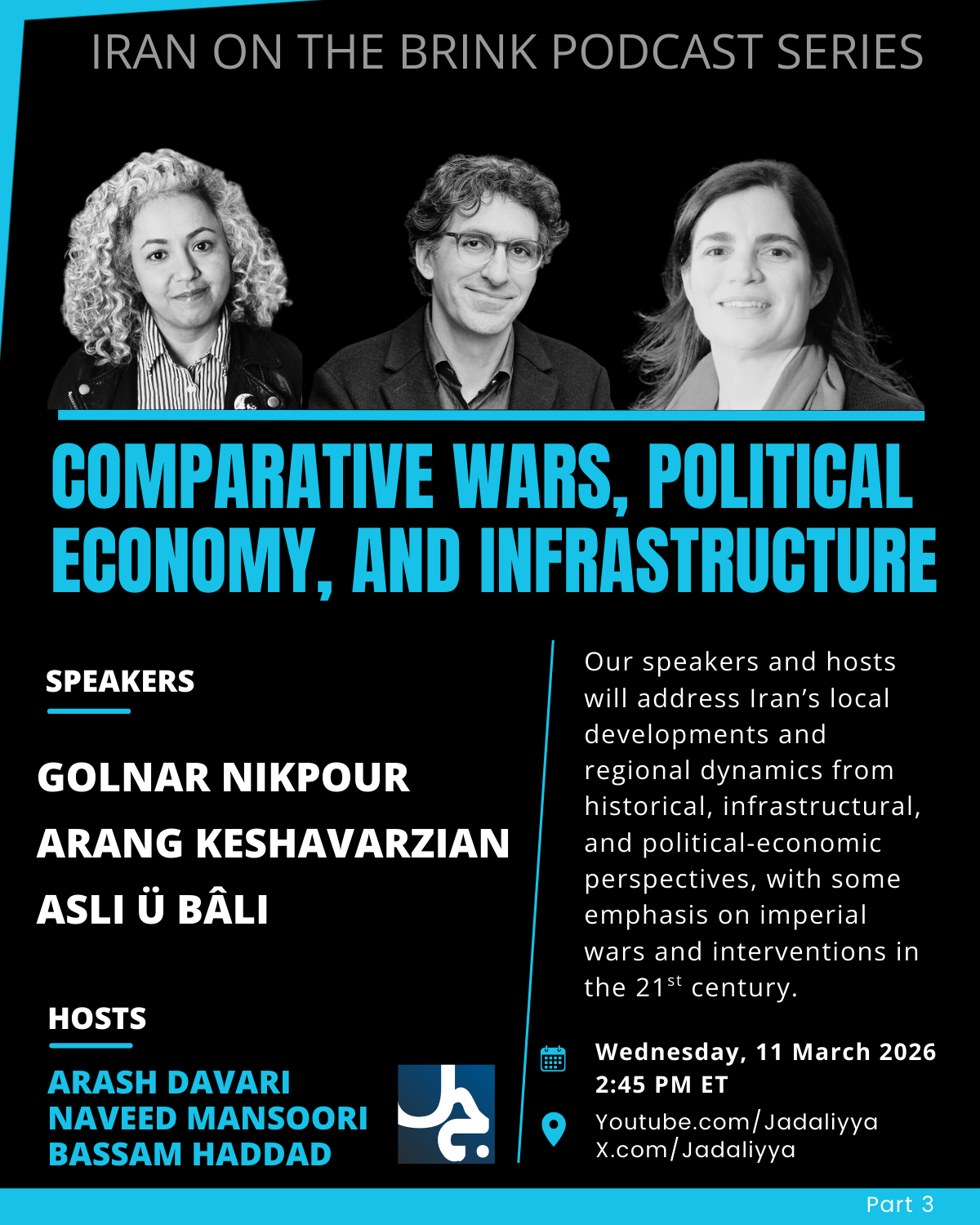
Speakers
Golnar Nikpour
Arang Keshavarzian
Asli Bali
Hosts
Arash Davari
Naveed Mansoori
Bassam Haddad
In this conversation, our speakers and hosts will address Iran’s local developments and regional dynamics from historical, infrastructural, and political-economic perspectives, with some emphasis on imperial wars and interventions in the 21st century.
Featuring
Golnar Nikpour is an Assistant Professor of History at Dartmouth College. Her research has been supported by the Social Science Research Council, the A.W. Mellon Foundation, and the Whiting Foundation, and her writing has appeared in Comparative Studies of South Asia, Africa and the Middle East; Humanity: An International Journal of Human Rights, Humanitarianism, and Development; Iranian Studies; The International Journal of Middle East Studies; The Canadian Journal of History; The New York Times, Jadaliyya; and Tehran Bureau. Since 2019, Nikpour has served on the editorial collective of the journal Radical History Review, and she also serves on the editorial board of the Radical Histories of the Middle East book series by Oneworld Press. Her first book, entitled The Incarcerated Modern: Prisons and Public Life in Iran, is out with Stanford University Press.
Aslı Ü. Bâli is Howard M. Holtzmann Professor of Law at Yale Law School. Prior to joining Yale, she was Professor of Law at UCLA, founding faculty director of the Promise Institute for Human Rights and director of the UCLA Center for Near Eastern Studies. Her teaching and research focus on public international law — particularly human rights law — and comparative constitutional law, with a focus on the Middle East. She is Past President and National Board Member of the Middle East Studies Association of North America.
Arang Keshavarzian is Professor of Middle Eastern and Islamic Studies at New York University. He is the author of Bazaar and State in Iran: The Politics of the Tehran Marketplace (Cambridge UP, 2007) and co-editor, with Ali Mirsepassi, of Global 1979: Geographies and Histories of the Iranian Revolution (Cambridge UP, 2021). His most recent book, Making Space for the Gulf: Histories of Regionalism and the Middle East (Stanford UP, 2024) and his most recent essay was published in the New York Review of Books this week and titled, “Iran Transformed.”
Arash Davari is Assistant Professor in the Department of Politics at Whitman College. His research and teaching interests include modern political theory; history and theory; aesthetics and politics; and political economy, state formation and social change in the Middle East. his writings have appeared in Comparative Studies of South Asia, Africa and the Middle East, Political Theory, and The International Journal of Middle East Studies. He co-founded B|ta’arof magazine.
Naveed Mansoori is a political theorist and a Postdoctoral Research Fellow in the Center for Iran and Persian Gulf Studies at Princeton University. His areas of research include histories and theories of media and mediation, anti- and de-colonial history and theory, critical theory, Iranian Studies, and Middle East Studies. He is a political theorist interested in histories and theories of media and mediation, anti- and de-colonial history and theory, and critical theory. He received his PhD in political science from the University of California-Los Angeles. His current book project, The End of Prophecy: Mediations of Political Myth in Contemporary Iran, offers a rethinking of the public sphere with focus on the role media has played in social movements before and after the 1979 Revolution in Iran
Bassam Haddad is Founding Director of the Middle East and Islamic Studies Program and Associate Professor at the Schar School of Policy and Government at George Mason University. He is the author of Business Networks in Syria: The Political Economy of Authoritarian Resilience (Stanford University Press, 2011) and co-editor of A Critical Political Economy of the Middle East (Stanford University Press, 2021). Bassam is Co-Founder/Editor of Jadaliyya Ezine and Executive Director of the Arab Studies Institute. He serves as Founding Editor of the Arab Studies Journal and the Knowledge Production Project. He is co-producer/director of the award-winning documentary film, About Baghdad, and director of the acclaimed series Arabs and Terrorism. Bassam is Executive Producer of Status Podcast Channel and Director of the Middle East Studies Pedagogy Initiative (MESPI). He received MESA's Jere L. Bacharach Service Award in 2017 for his service to the profession. Currently, Bassam is working on his second Syria book titled Understanding The Syrian Calamity: Regime, Opposition, Outsiders (forthcoming, Stanford University Press).