In January 2026, through an internal promotion, Reuters' promotion of Rami Ayyub as its Jerusalem bureau chief came into effect. Previously, he worked as a breaking news editor based in Washington, DC. After October 2023, Ayyub served as the interim editor for coverage of Israel and Gaza. You can find additional information about him on his LinkedIn profile.
So far, Reuters has made no public statement about the appointment. When Reuters named Stephen Farrell to the same role in 2017, it issued a press release. More recently, Reuters PR updated regarding their international climate correspondent appointment on February 24, 2026 on X: where you can track other significant appointments at Reuters.
The author reached out to Rami Ayyub and Heather Carpenter, a senior director of communications, on February 25th to verify if Ayyub is the first Palestinian to hold this position in the news agency's 175-year history and other questions related to the story. The article will be updated if Reuters responds.
The appointment is newsworthy—not only because Ayyub is Palestinian, but also because it arrives amidst the ongoing genocide in Gaza, Palestine and well-documented genocide denialism by the mainstream media. Reuters claims to be the world's largest multimedia news provider, reaching billions of people every day. Its framing of events directly shapes public opinion on a global scale. In 2025, the author reported that Reuters journalists internally accused the newswire of pro-Israel bias for UK-based Declassified. Similar whistleblower accounts have emerged about The New York Times, the BBC, Human Rights Watch, and the Committee to Protect Journalists. More recently, in March, Poynter reported that multiple Reuters journalists raised concerns about the company’s contracts with the Department of Homeland Security and the potential use of its databases by ICE in immigration raids.
The author spoke with a journalist at a leading news outlet covering the Middle East with over two decades of experience. They said on the request for anonymity, “We were also discussing a story on Rami Ayyub’s appointment—he is the first Palestinian to hold this position, which marks a significant shift at Reuters, where journalists who have worked at Israeli Defense are a norm. Rami Ayyub is, by most accounts, one of the better journalists covering Palestine at Reuters.”
On one hand, Zionist institutions have flagged Ayyub’s work as biased and on the other, Reuters itself reports on Palestine from Israel’s perspective. This contradiction—given the agency’s reputation for impartiality—places Ayyub’s work in a position that makes it impossible for any form of critique from the mainstream media or crowdfunded independent media—for them, this development is not "newsworthy."
A Historic Appointment in a Deadly Moment
On February 23, 2026, Israel's Defense Minister Israel Katz signed a military order designating five Palestinian media platforms in occupied East Jerusalem as "terrorist" organizations. A week before that, Al Jazeera reported that Palestinian journalist Ali al-Samoudi—one of those present when Al Jazeera's Shireen Abu Akleh was fatally shot by an Israeli sniper in Jenin in May 2022 — has been imprisoned by Israel for nearly a year and is now at risk of dying, according to the Palestinian Journalists Syndicate.
It goes without saying, but it must be said, Reuters has placed Rami Ayyub at one of the most dangerous bureaus in journalism. It shows Ayyub’s commitment to Reuters and the profession of journalism.
Since October 7, 2023, Israel has escalated its crimes against humanity—extending its ceaseless Nakba since 1948 into what Al Jazeera has documented as the world's first live-streamed genocide—killing over 72,000 people in Gaza. As the peer-reviewed medical journal The Lancet has established, indirect deaths in one-sided conflicts range from three to fifteen times the number of direct deaths, suggesting US-backed Israel may have killed 288,000 or more people in Gaza.
According to Gaza's Government Media Office, at least 260 media workers have been killed by Israel since October 2023. A study by the Watson Institute for International and Public Affairs at Brown University found that this conflict is the most fatal for journalists in recorded history. In North America and Europe alone, the National Writers Union recorded 44 cases of retaliation affecting over a hundred media professionals between October 7, 2023 and February 2024 — disproportionately targeting those of Middle Eastern or North African descent, or those who identify as Muslim.
Reuters Headlines Cannot Be Corrected
In August 2025, an Israeli-targeted airstrike on a tent near Shifa Hospital in Gaza City killed Anas Al-Sharif, 28 — a member of the Pulitzer Prize-winning Reuters team—along with four Al Jazeera journalists and one assistant. Reuters broke the story with the headline "Israel kills Al Jazeera journalist it says was a Hamas leader." After social media backlash, the news agency quietly changed it. Prior to this in 2024, Reuters had reported the killing of Al Jazeera journalist Ismail Al-Ghoul with the headline "Israel kills an Al Jazeera journalist and says, without evidence, he was a Hamas operative"—without issuing a note about its correction. This was reported by Berlin-based James Mackenzie and edited by Americas Day Editor Daniel Wallis and London-based Day Editor Jon Boyle.
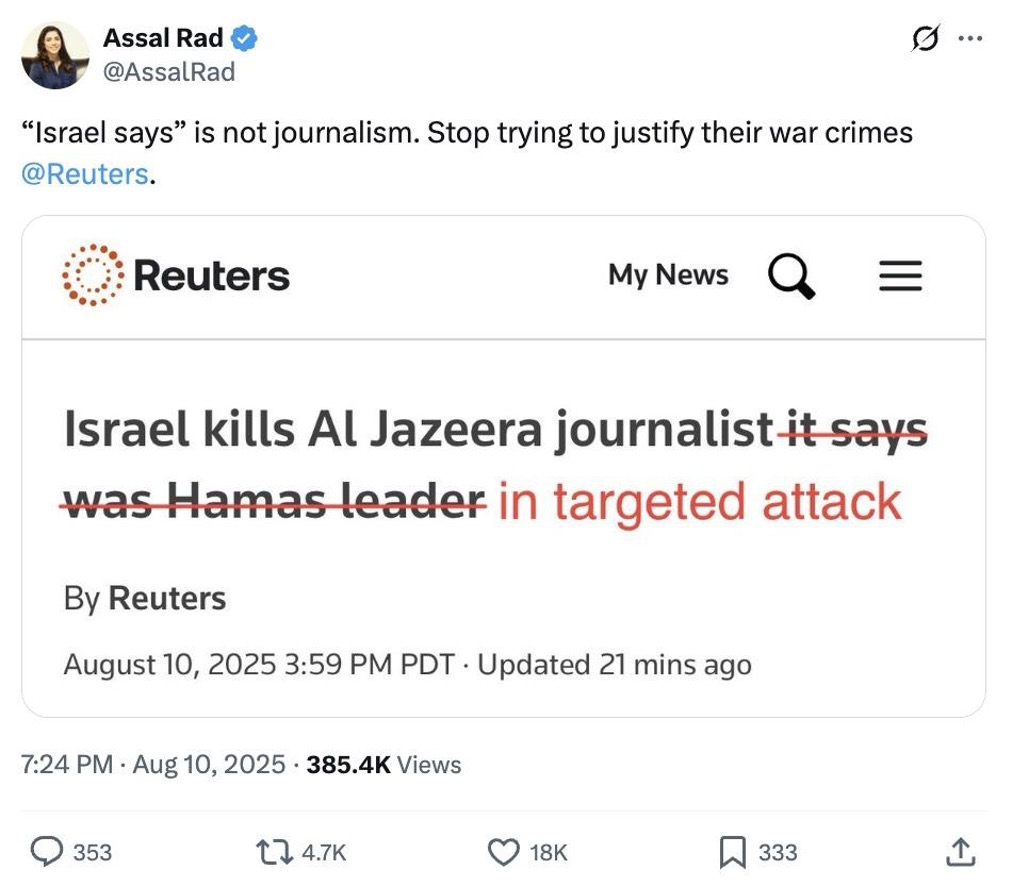
Because news outlets subscribe to Reuters and republish its content, the original headline can still be found across major media platforms. Syndicated articles do not update automatically when Reuters makes changes. Thus, making irrevocable damage to public opinion and the output of AI searches for some.
At the time, Ayyub was serving as the breaking news editor and interim editor for "coverage of Israel and Gaza," leading a team of 12 reporters. He led a team of 12 reporters covering major breaking news stories across North America, including political news in Washington, D.C., and edited, revised, and published copy. He coordinated with publishing and digital teams on breaking news content planning.
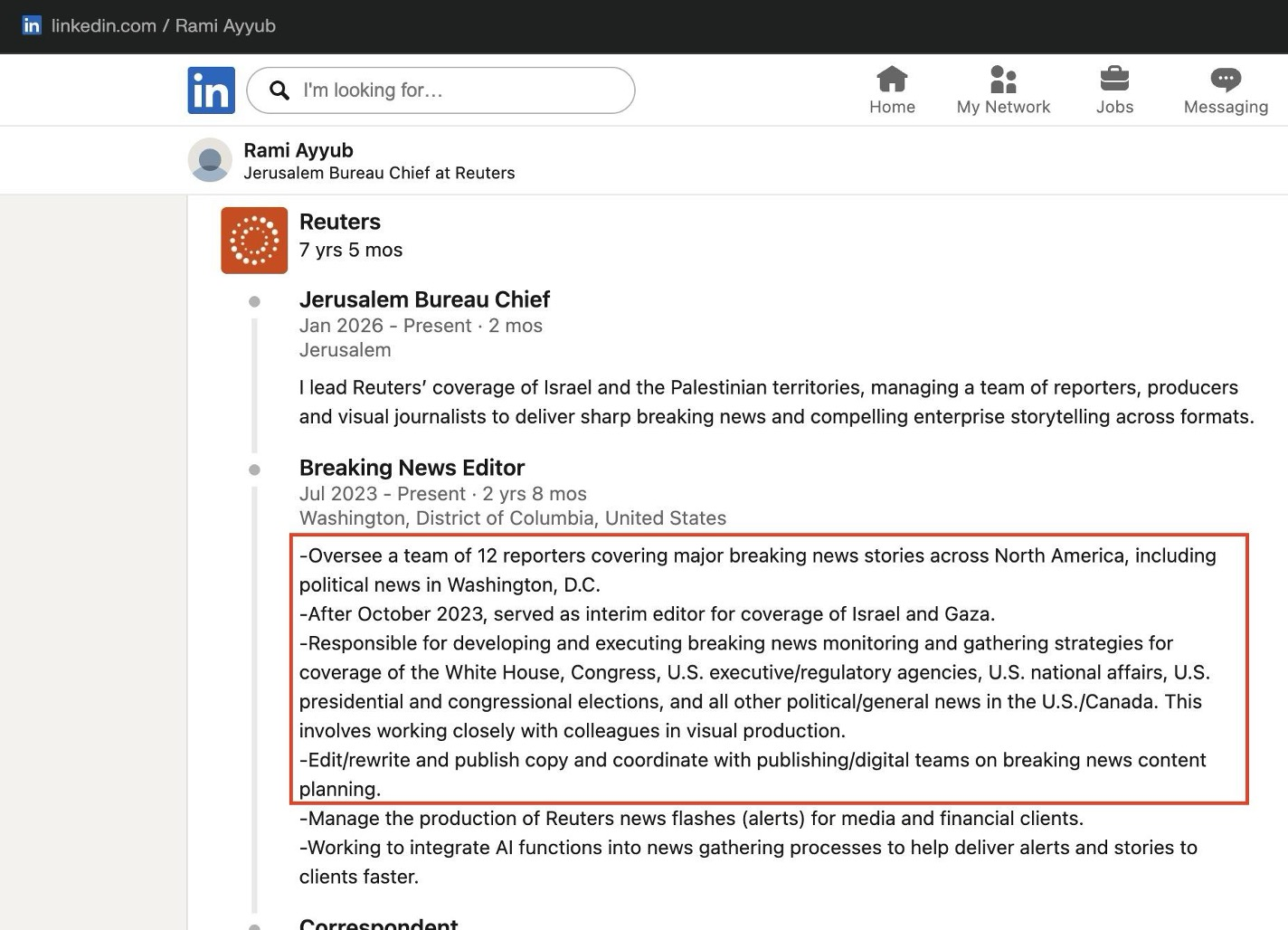
The author asked Ayyub, “As the breaking news editor and interim editor for coverage of Israel and Gaza, did you have any role in publishing the headline "Israel kills Al Jazeera journalist it says was Hamas leader," or the subsequent correction, “Israel kills an Al Jazeera journalist and says, without evidence, he was a Hamas operative”? Regardless of it, please explain the rationale behind both the headlines.” Jadaliyya will update the article if Ayyub responds.
The same journalist, speaking on condition of anonymity, added, "At news agencies like Reuters, it is difficult to hold any one person accountable. But as an editor responsible for coverage of Israel and Gaza after October 2023. Ayyub is perhaps one of the right persons to ask about editorial practices on Reuters' coverage of Palestine. At the same time, I feel, any critical reporting on him risks being weaponized by the right, and frankly, criticism from the left serves little purpose either."
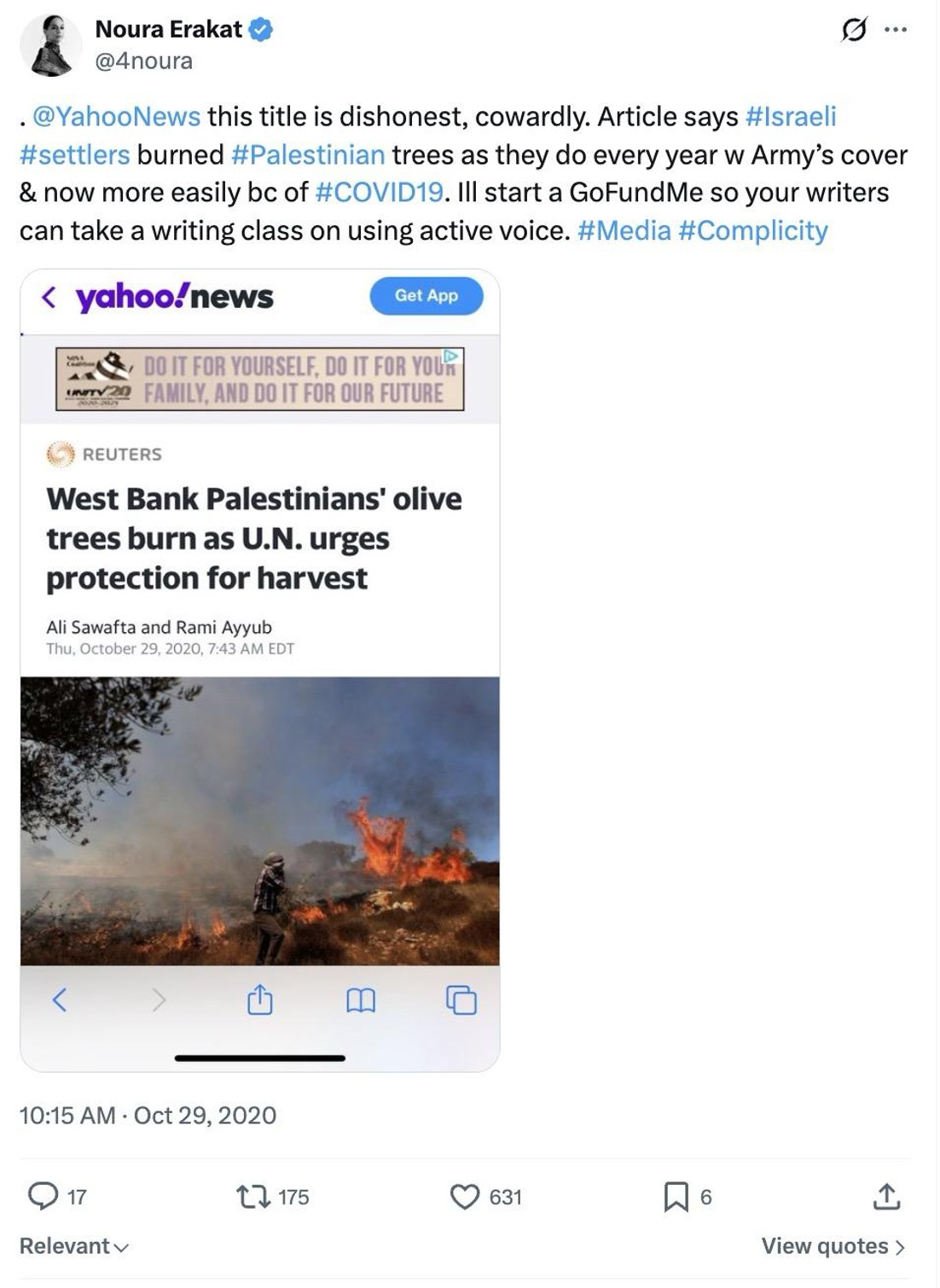
In 2020, Jadaliyya’s co-editor Noura Erakat challenged a Reuters report—co-authored by Ayyub as a correspondent—for the misleading headline titled “West Bank Palestinians' olive trees burn as U.N. urges protection for harvest”. Erakat tweeted, “This title is dishonest and cowardly. Article says Israeli settlers burned Palestinian trees as they do every year w Army’s cover & now more easily because of COVID-19.”
Last year in August, Reuters photojournalist Valerie Zink resigned. The killing of Al-Sharif, followed by the assassination of five more journalists, including a Reuters cameraman at Nasser Hospital, was her breaking point. She stated she could no longer be associated with an organization that repeated Israeli military talking points and failed to accurately report on Gaza.
The author asked Ayyub, “Since October 2023, at least two journalists have resigned from Reuters over concerns about its coverage of the ongoing genocide in Gaza, including photojournalist Valerie Zink. How has Reuters, from your perspective, reflected on and responded to internal criticism of its coverage? Have there been any substantive changes in editorial processes or guidelines that you can point to?”
Reuters’ Ceaseless Genocide Denialism
In May, last year, Reuters updated its Middle East style guide. During this period, Ayyub's LinkedIn describes him as the interim editor for "coverage of Israel and Gaza." The update permits Reuters journalists to use the word "genocide"—but only with attribution. In practice, Reuters rarely does. This reporter found it mentioned only 14 times across 300 reports published between June 21 and August 7 for Declassified. Preferred terms remain: "war," "military campaign," "retaliatory war," "campaign against Hamas," and "conflict."
An analysis of approximately 70 Israel-Palestine-related reports published between April 2024 and January 2026 in which Ayyub was listed as a contributor shows only 8 of those reports contain the word "genocide"—each time accompanied by Israel's refusal to commit genocide. This editorial pattern did not begin with Ayyub. But as the bureau chief, he will be one of its gatekeepers straight from the Holy Land.
Dr. Assal Rad, a scholar of Middle East history known on social media as the "headline fixer," said, "Reuters is one of the major Western outlets presented as a professional and neutral news source; they have a significant responsibility, especially because of their name recognition globally. Journalistic ethics and accuracy require reporting the truth. Palestinian sources are often treated with suspicion, while Israeli sources that have been repeatedly caught lying to cover up their war crimes are treated as reliable sources. My criticism is not of individual journalists, but rather of the media institutions and those in higher positions of power that censor and regulate what is allowed to be said and published.” Her documentation of Reuters headlines with pro-Israel framing is available on X.
Ayyub’s Road To Reuters
Ayyub began his career as a Financial Analyst at Lockheed Martin from August 2012 to August 2015 — his first role after completing a Bachelor of Science at the University of Maryland. On his LinkedIn, Ayyub writes that he "worked with the CFO and Financial Planning Director to resolve long-term strategic issues and complete Merger/Acquisition valuations" and "worked with Federal Aviation Administration (FAA) officials to transform the US National Airspace (NAS) infrastructure by implementing new Lockheed Martin technological capabilities into the NAS, including support for Unmanned Aircraft Systems (drone) implementation."
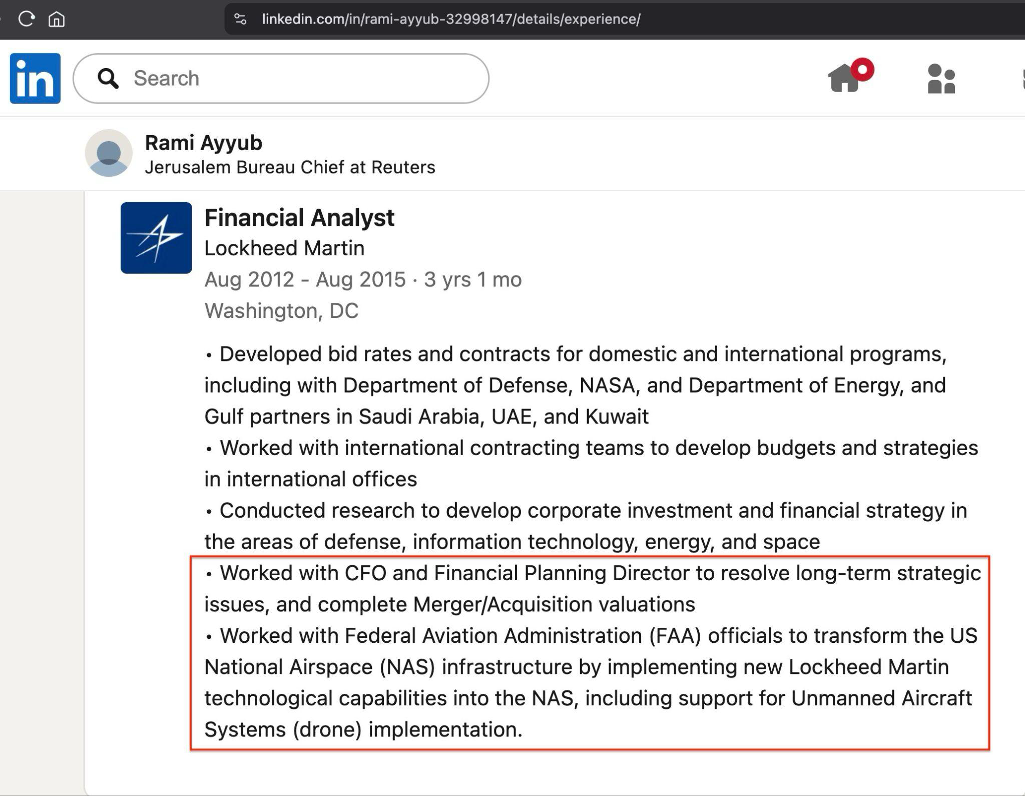
Lockheed Martin's website states, "Lockheed Martin is proud of the significant role it has fulfilled in the security of the State of Israel." In 2025, Amnesty International identified Lockheed Martin as one of 15 companies contributing to Israel's unlawful occupation, genocide, or other crimes under international law. The author asked Ayyub whether he was aware of Lockheed Martin's role in arming Israel in 2015.
Last year, Drop Site News reported Merav Ceren, Director for Israel and Iran at the National Security Council, formerly worked for the Israeli Ministry of Defense. Indeed, the comparison between the appointments of Ayyub and Ceren is not one of “apples to apples." However, it is important for the media to cover both cases so that institutions can dare to reimagine what being objective means.
Unlike Ceran, Ayyub's concern with objectivity is not regarding national security but in his ability to question hegemonic narratives as a journalist. He worked at Lockheed with key leadership as Chief Finance Official for three years; how uncomfortable would Reuters' pro-Israel slant really make him?
Dr. Des Freedman, Co-Director of the Goldsmiths Leverhulme Media Research Centre, said, "One of the 'hallmarks' of Reuters journalism, as the company itself states, is that 'potential or actual conflicts of interest' should be disclosed to a more senior figure. Given that the sale of arms to Israel that are then used in Gaza is likely to contravene humanitarian law, one would expect senior editorial appointments to be absolutely free from entanglements with weapons companies with any connection to Israel. Reuters argues that displays of political affiliation or support for partisan causes have no place in their newsrooms. Yet there is no similar comment about the need to be free from commercial affiliations that may generate political loyalties that, while not overt, nevertheless shape editorial scope. Bias emerges not just from clear political commitments but also from an identification with vested interests that mitigates against independence and the ability to ask tough questions of those in power."
Prior to joining Lockheed Martin, as an undergraduate, Ayyub was a part of the Phi Delta Theta Fraternity at the University of Maryland. As per the official page, “Phi Delta Theta is one of North America’s largest and most respected fraternities, with 190+ chapters and over 310,000 initiates since 1848. Maryland Alpha was founded in 1927 and joined Phi Delta Theta in 1930.” Their Hall of Fame includes Adam Hasner, Florida Atlantic University (FAU) President. In November 2025, FAU became the world’s largest university investor in the Development Corporation of Israel for Israel (commonly known as "Israel Bonds") with $8.2 million. In June 2023, the human rights group Democracy for the Arab World Now (DAWN) issued a statement raising concerns about Israel Bonds plausibly violating the Foreign Agent Registration Act (FARA).
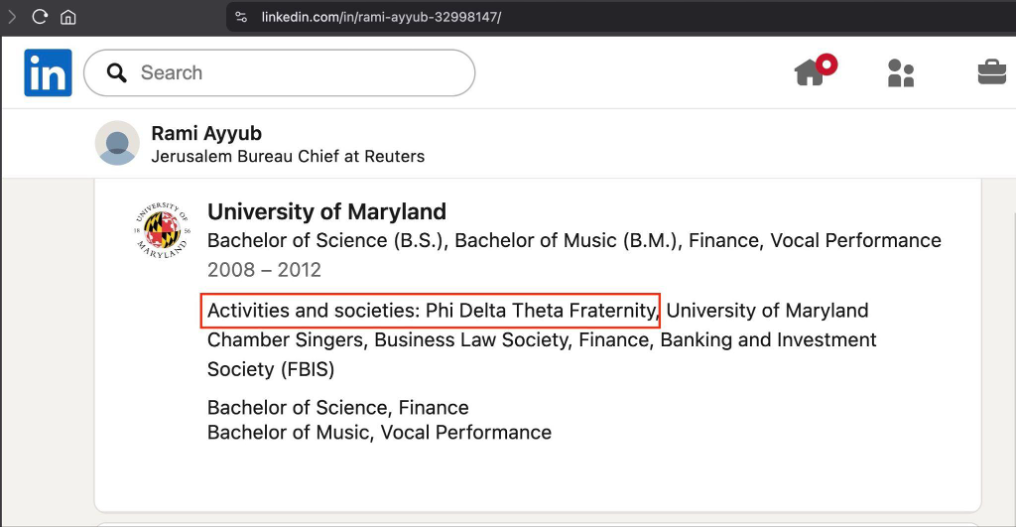
The same journalist who spoke with the author anonymously expressed surprise upon learning that Ayyub had spent three years working at Lockheed Martin and was a member of the Phi Delta Theta fraternity. Speaking on condition of anonymity, they added, "Without any judgment of Rami Ayyub’s personal journey or choices, I think this speaks to a broader pattern—hegemonic institutions tend to elevate individuals from historically oppressed groups when those individuals reflect the institution’s own characteristics back at them.”
From Lockheed Martin, Ayyub went on to intern at the US Department of State and NPR before earning his master's at Georgetown University and entering journalism. Between December 2013 and August 2017, he worked as managing editor at Global Risk Insights (GRI), a UK-based international affairs publication whose LinkedIn page cited an endorsement from Terence Szuplat, a speechwriter for President Barack Obama.
GRI's website is no longer active, but its web archive reveals a consistent pro-Israel framing of news related to the Middle East. A keyword search of GRI's account on X surfaced a June 2015 post promoting the title "Will #Hamas cooperate with #ISIS?"—linked to an article citing Israeli Major-General Yoav Mordechai's claims about Hamas despite the incident in question occurring in Egypt, not Israel: “On July 1, Wilayat Sinai, a local affiliate of the Islamic State (IS) which used to be known as Ansar Bait al-Maqdis, orchestrated a string of attacks in the peninsula that left over 60 Egyptian soldiers dead. Israeli officials accused Hamas of cooperating with the group.” The “Israel says” framing highlighted by Dr. Assal Rad is the norm at Reuters and most importantly, Israel’s accusation was not included by The Washington Post or Reuters. The readers can view Ayyub's archived bylines at GRI here.
The World Reuters Is Helping to Build
In February 2025, Palestinian poet, writer, and journalist Mohammed El-Kurd and Institute for Palestine Studies-USA Executive Director Dr. Jehad Abusalim held a public discussion at the launch of El-Kurd's book Perfect Victims and the Politics of Appeal. They spoke about reimagining Palestine not only after genocide but also after the end of Israel's illegal occupation. That reimagination cannot take root if the editors at the world's largest wire agency continue to translate the ongoing genocide as "war."
In September 2025, Dr. Norman Finkelstein delivered the lecture "Gaza, Truth & the Battle for Free Speech" at the University of Massachusetts Amherst. He said: "The beginning of all wisdom is to correctly name things… The moment you hear anyone in the media, in academia, or in political life refer to what's going on there as 'the Israel-Hamas war,' a light ought to go off in your head. This person is purveying propaganda because there is no war in Gaza. It's a genocide."
Adding to the discourse, on February 12, 2026, Haifa-based lawyer and Zeteo columnist Diana Buttu wrote about how Israel continues to kill, starve, and imprison Palestinians as the world is distracted by the language of "peace" and "process" and "plans." Editors at Reuters, with their global reach, have contributed to the genocide denialism in Palestine for far too long—but clearly not long enough for many.
Reuters has listed its ‘Hallmarks of Reuters Journalism,' and Under Freedom From Bias, Political and Community Activity section it states: “Displays of political affiliation or support for partisan causes have no place in our newsrooms… Reuters, however, expects journalistic staff in all branches of editorial to be keenly sensitive to the risk that their activities outside work may open their impartiality to questioning or create a perception of bias.” While newsrooms such as Reuters would not tolerate a journalist for wearing a keffiyeh or attending pro-Palestine/anti-genocide rallies, they would not hesitate to hire someone who worked for Lockheed or the Israeli Occupying Forces.
More recently, on February 23, Gaza genocide survivor and journalist Abubaker Abed posted, "Global complicity in the Gaza genocide would have never been possible without the massive inaction and failure of Palestinians in the diaspora and the occupied territories outside Gaza."
When is the right moment to ask any questions of Ayyub about his role at Reuters? Was it a long time ago, is it now, or will it be in the future after the forever wars end? Or maybe never because we need people to change the system from within.
Professor of Comparative Poetics and Global Politics at SOAS University of London, Dr. Rebecca Ruth Gould, in the same month, wrote, “The genocide in Gaza has revealed with brutal clarity how an entire class of intellectuals, along with the institutions that make their work possible, can be obliterated in real time while the states that fund and arm this destruction look away.” Revisiting Palestinian phenom Edward Said’s work, "Representations of the Intellectual," she added, “Intellectuals must be ready for the moment when their radical commitment to the cause of truth leads to isolation, unpopularity, and widespread condemnation.”
In an ideal world, Palestine is free and journalists, including Ayyub, do not have to navigate workspace landmines to tell the truth about their people. Ayyub’s new role carries genuine power—and genuine collective responsibility. The question is whether Reuters, who appointed him, will use this unprecedented moment to break with the euphemisms and erasures that have defined Reuters' coverage of the ongoing genocide in Palestine, or whether they will use Ayyub’s identity as a "shield" for their shoddy journalism on Palestine.