On November 19, 2023, the Houthi government in Sanaa ramped up attacks on ships passing through the Bab el-Mandeb Strait on their way to the Suez Canal, starting with the seizure of the vessel Galaxy Leader. The intent was to blockade container ships destined for Israel in response to the Israeli military destruction of Gaza. For a couple of months in 2024, the traffic of commercial vessels in the Yemeni portion of the Red Sea was severely disrupted. The main international response was a joint military campaign mounted to protect large container ships from Houthi attacks.[1] Another solution, which received very little attention from European and U.S. observers, was to reroute vessels away from the Red Sea to the Persian Gulf, unload their cargo onto trucks and expedite containers overland, from either Dubai in the United Arab Emirates (UAE) or Manama in Bahrain to Israel or Egypt. This land route discussed here passes through Saudi Arabia and Jordan and connects the two Gulf harbors of Jebel Ali (UAE) and Mina Salman (Bahrain) with the ports of Haifa and Port Said on the Mediterranean. Truck operators either opt for a southern route in Jordan toward Eilat and go on through the Sinai to Port Said in Egypt, or through the Sheikh Hussein Bridge to reach Haifa in Israel from the north of Jordan. It is an example of transshipment: the transportation from sea to land and back to sea, when either no direct connections between ports exist or when shipping connections cannot be operated. The land bridge captures new dimensions of the connections between empires, infrastructure, and wars, and sheds light on the working of normalization with Israel.
It is not the first time that wars disrupt maritime trade around the Arabian Peninsula and generate new infrastructural projects. The current war of aggression by Israel and the U.S. against Iran (March 2026) only confirms this concern. Historically, a variety of international actors have sprung up to propose and build new infrastructures with a rhetoric of innovation to facilitate international trade in the Gulf region. [2] The semantics of development and the need for capitalist trade have always been as important as the dredging of shallow creeks to build deepwater harbors and road infrastructures in the Gulf. It was British and American imperial forces that first transformed the “Persian puddle” into a strategic location between Europe and Asia, with massive port infrastructures built by Americans on behalf of BAPCO and ARAMCO from the 1940s onward. “Route-making”, Laleh Khalili shows, is always volatile, as factors such as geopolitics, fluctuating oil prices, or reluctance to cooperate transnationally to build new infrastructures intervene and force new routes to emerge.[3] Arab actors also changed the geography of shipping, seizing opportunities for new infrastructures during moments of wars and revolutions. Thus, the harbor of Aden benefited from the shutdown of Abadan in Iran during the 1951 nationalization of oil; the civil war in Lebanon pushed a lot of the local financial and insurance sector to the Gulf region; Jebel Ali, the deepwater harbor of Dubai in the United Arab Emirates, benefited from the collapse of a free trade zone project in Qish with the fall of the Shah’s regime in the late 1970s, and later from the Iraqi occupation of Kuwait in 1990.[4] But it is the first time that Israel has been involved in building regional infrastructure well beyond its immediate borders.
This new proposed land bridge has been made possible by the normalization treaty that two Gulf countries, Bahrain and the UAE, had signed with Israel in 2020. It reveals how empire is being reconfigured in the region in such novel manners that it can be thought of as an expression of neo-imperial drives by Israel and the UAE, and to a lesser extent by India. The scenes and campaigns of war that reached dramatic proportions since 2023 (war in Gaza; a military blockade in the Yemeni Red Sea, which in itself is a byproduct of the Yemeni civil war that started in 2014; the descent of Sudan into civil war in April 2023) and talks of an alternative overland corridor between the Gulf and Israel have moved the geographic focus around the Persian Gulf to the east.[5] Israel is trigger happy with its rhetoric of innovative logistics and new alliances with Asia, in which the UAE functions as a key middleman for its formidable ability to combine financial, military and logistics expertise.[6]
Talks of normalization have resumed since the signing of President Trump’s three-step peace plan for Gaza on October 9, 2025: The U.S. wants to make of Gaza a node in the “Abraham Gateway” logistics hub at Rafah,[7] but the real business has been made in the last five years by a few Gulf countries and Israel who have no concern for Gaza or Palestine.[8] The current war against Iran indicates that U.S. is still the imperial heavy-weight but in the years 2020 to 2025, Israel and Gulf partners were the drivers of new logistics in the Arabian Peninsula. One must distinguish the rhetoric around normalization (pushed mostly by the U.S.), diplomatic developments, and economic projects. Normalization entails a combination of symbolic, material and logistical components.[9] Trump’s extraordinary and unlawful seizure of Maduro and of Venezuelan oil at the start of 2026 indicates how American imperialism is alive but remains constrained by the reality of infrastructures.[10]
Focusing here on the land bridge proposed at the turn of 2023-2024 gives the opportunity to disentangle the different layers of normalization and identify actors involved in the development of new global infrastructural politics.[11] This article argues that the land bridge is more aspirational, or a PR exercise, because it calls for regional logistical coordination but with little actual construction or truck movement on the ground. Beyond the U.S. blessing, there is no American presence. The media coverage is not rich but shows that the visual representation of this route of normalization is based on conflicting semantics and antagonism in the Arabian Peninsula.
In the trail of growing economic exchange since the 2020 Accords, Israel and the Emirates have been acting as neo-imperial powers. They do not shy away from conveying an independence in their policies that combine security, economic and infrastructural projects. These changes threaten to eclipse the centrality of Palestine for the Arab Middle East. Once pressed by the international community and the Arab League to grant Palestinian sovereignty in the occupied Territories, Israel is using logistical developments to deflect this historical pressure and presents itself as an essential partner for the implementation of a frictionless and rapid global supply chain. The UAE has also been vocal in supporting some of the latest Trump’s projects to “solve” the destruction of Gaza. The Gulf is now rising as a global gatekeeper and facilitator for international (maritime) trade, but with national actors having a different map in mind. Arab actors engaging in logistical cooperation with Israel are aware of the ambiguities of normalization, but they do not want to miss a unique opportunity to enhance their strategic position. With twenty percent of the global shipment trade navigating through the Red Sea, the economic stakes are colossal.[12] The UAE, with its flagship port of Jebel Ali, “the world’s largest engineered harbor and largest container port between Rotterdam and Singapore” vies to dominate “strategic zones encompassing the Indian Ocean, Arabian Peninsula and Red Sea” thanks to its “military, commercial, and humanitarian logistics” capabilities.[13] It is no coincidence that the two genocides occurring in the Arab world (Gaza and Sudan) are either exacted, or made possible, by two staunch allies, Israel and the UAE.
There are three ways to look at this proposed land bridge: if we contrast three sets of actors (first those who originated the plan, namely Israel, the UAE and Bahrain; second other countries of the Gulf indirectly involved, namely Saudi Arabia and Jordan; and third, other Asian partners), one identifies a different semantic to talk about or represent this project of transshipment. The first aspect is about the politics of actors directly involved in announcing it in December 2023: ambiguities about the actual functioning of the land bridge abound. The second facet covers the politics of normalization: all Arab actors involved tread carefully with cooperating with Israel and use visual representations to express their hesitancy. The third feature concentrates on nascent global alliances with Asian partners. In that last case, the “Middle East” is recentered toward Asia and the projections of larger trade and political alliances.
Until Trump’s announcements of the end of the war in Gaza in September 2025, the U.S. has granted not only Gulf States and long-time allied Israel, but also India and to a lesser extent China, a lot of space and autonomy in shaping this new architecture of logistics. Gulf states are not homogeneous in their reaction to the land bridge between Dubai and Haifa and the larger geography of the overland corridor makes us reflect on new forms of imperialism that have flowed from the crushing of the democratic revolts of 2011. While tempting to read imperialism as a uniquely U.S. prerogative, especially in the age of the “Donroe Doctrine”, the alignment of Emirati and Israeli security and their focus on controlling natural resource (water, gas, oil and infrastructure bottlenecks)[14] can also be read independently from U.S. influences. Both Israel and the UAE have shared interests to stir conflicts in the Horn of Africa all the way to Somaliland and Sudan,[15] and these policies are not dictated by Uncle Sam.
Let us now look at the three scales of interpretation of the land bridge, each with some visual material about the semantic divergences.
The Land Bridge that Israel Wants
A detailed report on the signing of agreements between Israeli and Gulf partners was published in The Times of India on December 25, 2023. It states that “a land corridor for the delivery of cargo between the Gulf States and Israel through Saudi Arabia and Jordan is extended to Egypt.” Operation of the ground route got “quietly underway”, with a daily capacity of 350 cargo container trucks unloaded in Jebel Ali or Mina Salman, the main harbors of the UAE and Bahrain, respectively. The route is “not intended to replace the sea route through the Suez Canal but to offer an alternate route at a time of attacks” in the Yemeni Red Sea. It had been in the making without Egyptian involvement since June or July 2023, amid “U.S.-brokered Saudi-Israel normalization talks”. The right-wing daily The Times of Israel published two articles on the issue on December 27, 2023, and on February 14, 2024. Unlike the Indian article, these reports only refer to Israeli and Emirati private actors signing an agreement on December 24, 2023. Two Israeli companies, Mentfield Logistics and Trucknet, joined forces with Emirati-based Puretrans FZCO and the Dubai port-operating company DP World. Bahrain is mentioned as one the countries in support of the project, but not Egypt. It is the American Journal of Transportation (AJOT), in a January 12, 2024 publication, that lists Cox Logistics (based in Bahrain) and the Egypt-based logistics services company WWCS as partners in this new land bridge project with Israel.
Various websites uncritically regurgitate the same story of a successful bypass which would render the Houthis’ military operation moot. These articles speak of groundbreaking “opportunities for the logistics sector” and of a drastic cutting in shipment times. The Times of Israel speaks of twelve days gained with the land corridor (citing Israeli Transportation Minister Miri Regev), while the Israeli Ministry of Defense estimates that the land corridor could “save 80 per cent of the time on the sea route, providing a faster alternative than crossing through the Suez Canal, at a competitive price”. Both The Times of India and India Briefing cite Trucknet CEO Hanan Friedman as reducing the 14-day shipping time between the UAE and Haifa to four days by land.
Such achievements, these articles concur, would have never happened without the signing of the Abraham Accords and the groundwork done by private actors to generate trade with Israel since 2020.[16] But despite the grandiose rhetoric, in particular in Israeli media, of an innovative solution to trade disruptions, there are serious questions about how materially it would be possible to enact such a project. Discursive ambiguity can help hide the fact that the land bridge is only at its inception and not yet up and running.
It is far from clear how trucks carrying maybe two containers at a time can be more competitive, pricewise, than container ships which easily accommodate 5,000 containers.[17] The journey is probably shortened if one only estimates the time needed for a truck to cover the distance between the UAE and Haifa. But what about the time for boats to enter port, be unloaded, have their hundreds of containers sorted and reloaded onto trucks, and the heavy labor costs of drivers and people to service the trucks? The distance between the ports of Dubai and Manama and Haifa is more than 2,000 kilometers, requiring a large amount of more costly diesel (as opposed to fuel oil) as well. It seems improbable that a land corridor through barren and poorly serviced terrain can be efficient in the long run.[18]
Considering previous attempts at transshipment in the region, one can seriously doubt the feasibility of this overland path. Indeed, in 2021, Israel and Dubai Port World, which operates Jebel Ali in the UAE,[19] tried to establish another land route (called “the Med-Red Land Bridge Ltd”) to bypass the Suez Canal. This other logistical bridge spanned over a shorter distance, between the southern port of Eilat in Israel and Haifa, slightly over 400 kilometers. Back then, the objective was to ship oil without having to go through the Suez Canal.However, the Med-Red Land Bridge project never commenced because it was difficult to implement and entailed enormous environmental costs.[20]
The international articles mentioning this alternative land bridge are all clustered around the months of February and March 2024 and all take the material published by The Times of Israel, which itself is a mouthpiece for Mentfield and Trucknet, the two Israeli private companies boasting the “creation” of this land bridge. Israeli hasbara runs largely unquestioned.[21]
Discursive ambiguity contributes to the illusion that trucks already run on the ground. The four initial reports are ambiguous about the project’s degree of advancement. For some it is a “pitch” made for a route that couldsave a lot of time (AJOT), for others it seems to be already up and running: The Times of Israel speaks of“dozen trucks […] “facilitating this route to shorten shipping times for goods from textiles to electronics, raw materials for industry, metal pipes, and aluminum.” Whether this land bridge can or could shorten the time of expedition by 10 days is unclear from the report. Trucknet boss Friedman declined to disclose the truck volume the land bridge was generating when the announcement was made, nor the growth targets, but underlined that Trucknet “is seeing strong demand from the shipping lines and manufacturing shippers and exporters” (AJOT).
Normalization and Ambiguous Maps: The View of Gulf Actors
The actors involved in the new agreement also communicate with graphic material representing the working of this proposed land bridge. From Israeli hasbara to Gulf ambiguities about normalization, there is much to analyze in these visual components.
It does not matter to the Israeli private actors if the project is or will be running, because their job is to imagine and realize the future of new logistics solutions to current problems. Mentfield Logistics is a freight forwarder specializing in coordinating air, sea, and road freight while Trucknet, is a tech startup supporting transportation companies with logistics to increase the efficiency of global shipping. Both want to position themselves as gatekeepers of future services.
Trucknet’s webpage[22] includes a graphic illustration of trucks moving along the land bridge, as well as a Google map tracing the journey from Dubai to Haifa and Port Said (see Picture 1). The first illustration is an example of the interface Trucknet customers could use to find space for their cargo to be shipped on trucks operated by other companies. This modelized moving of trucks, with imagined journeys of 2 days and 7 hours for a container shipped from Mina Salman (Bahrain) to Haifa and of 4 days and 2 hours from Jebel Ali (Dubai) to Haifa is window-dressing. It is a communication effort to attract future international investors and sell the potential of innovative technology in support of large infrastructural developments, rather than the actuality of shipping containers overland. Semantics and materiality are two different sides of the transshipment coin.
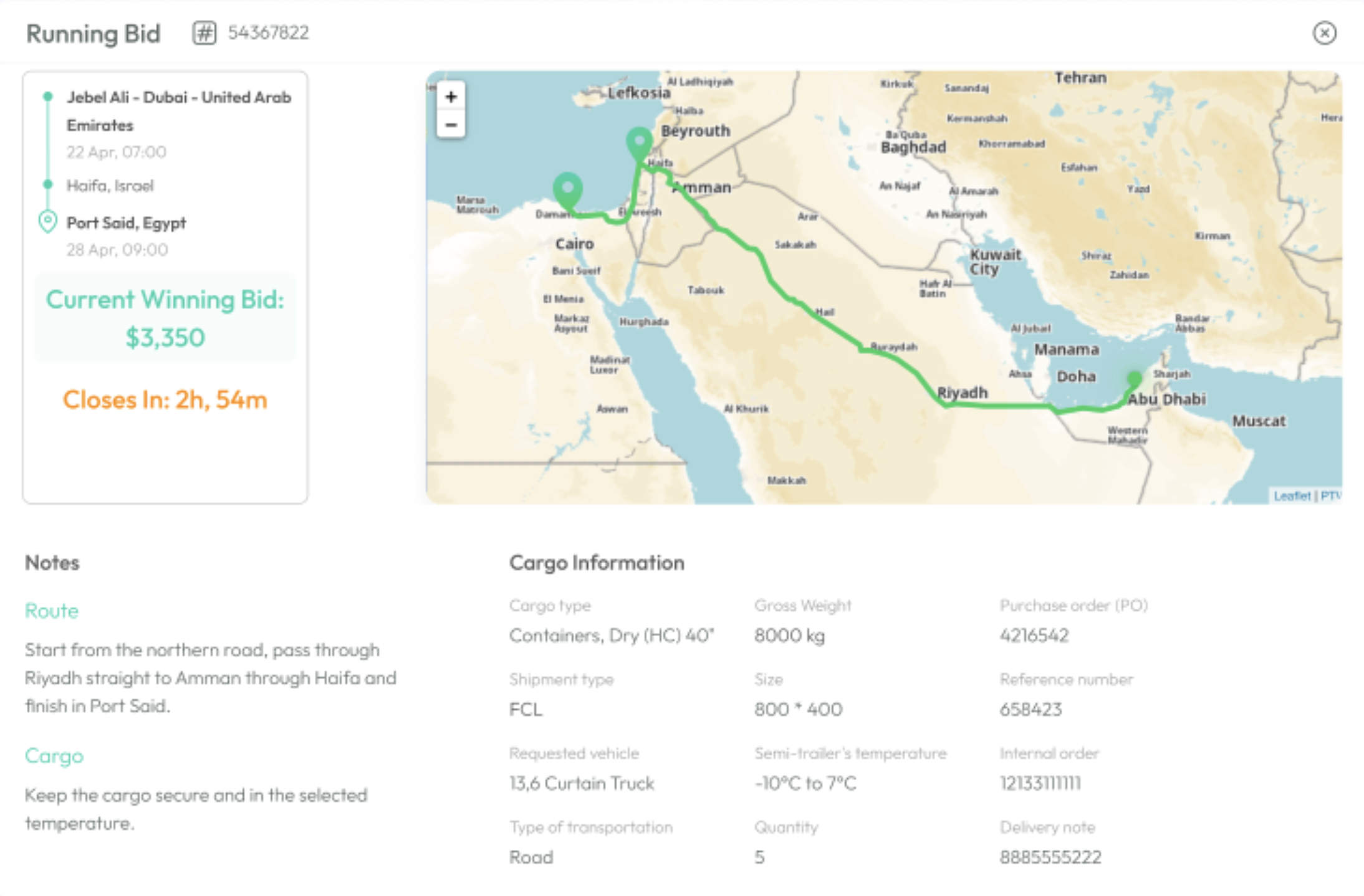
Picture 1: Trucknet’s map of the “land transport route from Bahrain and the UAE to Israel, continuing to Europe and Egypt”
The PR and visual materials used by Gulf partners suggest that they are not entirely comfortable with the politics of normalization: the maps and imagery they use may resemble Israeli illustrations, but with two very conspicuous differences. First, the visual material by Trucknet lists the logo of all Gulf and Egyptian partners (Puretrans, Cox Logistics, and WWCS).[23] There are no logos of any partners on the webpage of Puretrans. Cox Logistics’s website entails some partner institutions, but nowhere do we see any reference to Israeli partners. Second, the map of Puretrans (see Picture 2) indicates its interest in cross-peninsula connections but the arrows that connect the harbor of Jebel Ali indicate two countries in green: the UAE and Jordan not Israel or Egypt. It is as if the Mediterranean reaches the borders of Jordan.[24] The fact that Israel is not represented in the Emirati visual material is evidence that there is a reluctance for Gulf actors to display the possible extent of normalization with Israel at a time of genocide and ecocide in Gaza.
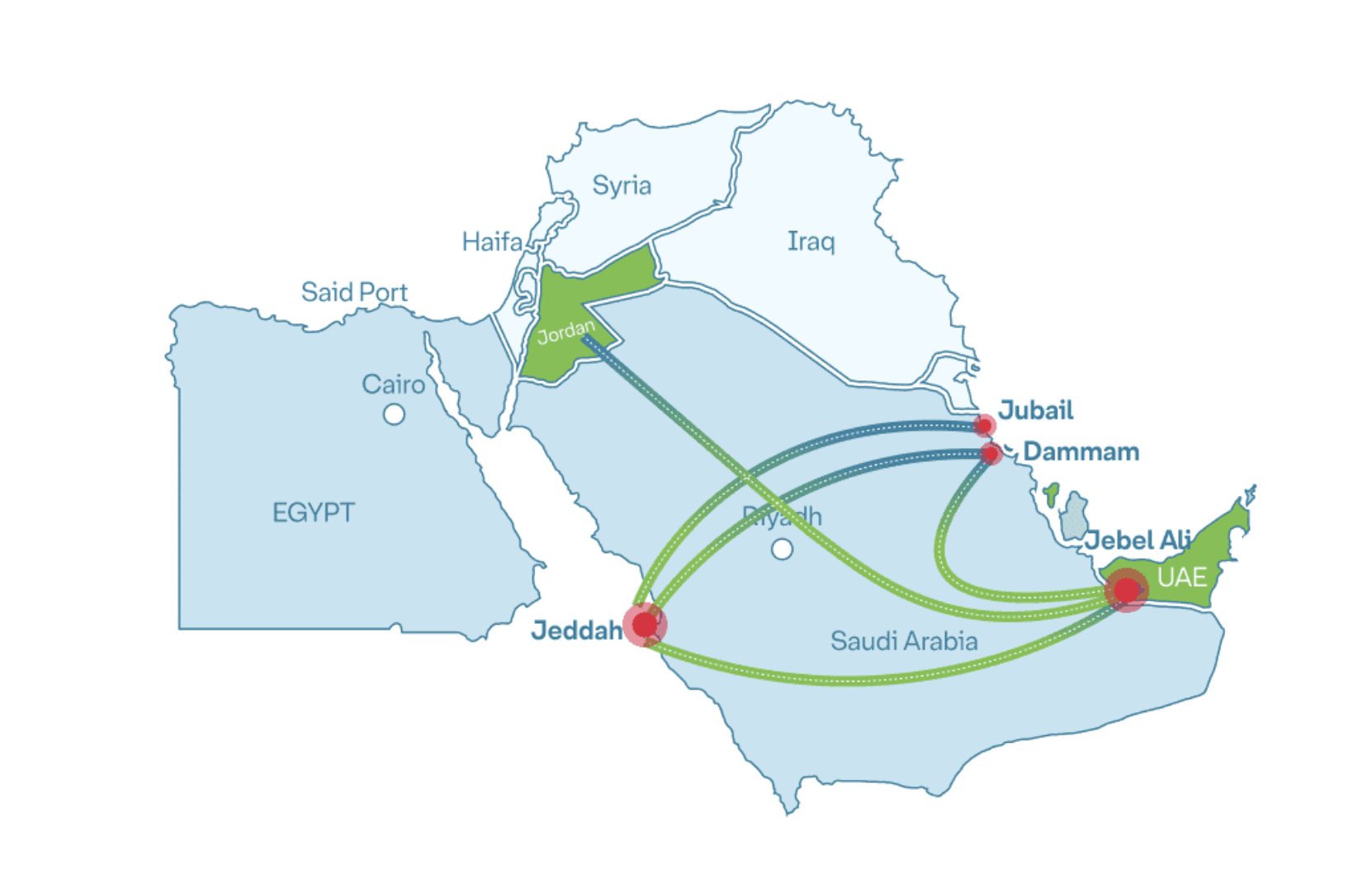
Picture 2: PureTrans’s map: “comprehensive land transportation routes that bridge the Mediterranean and the Arab Gulf”
Emirati media likewise do not report on the signing and launching of this land bridge. The National, Khaleej News and WAM, the Emirati news agency, have not, to the best of our knowledge, run any stories on the transshipment agreements with Israel, or on the actual movement of freight along this land route. Indeed, considering how Israel’s destruction in Gaza, and later bombings of Lebanon, Iran and Syria, are badly perceived by Arab populations, this reluctance to represent Israel in these logistic maps should come as no surprise.[25] In the UAE, where 80 percent of the population opposes normalization with Israel[26], the only reference to logistical development around ports comes from a recent project with Oman. What the UAE media outlets are keen to disclose is the successful delivery of humanitarian aid to Gaza. It would be obscene and inappropriate to boast about logistics “successes” of freight heading to Haifa when the Gaza Strip has been placed under even tighter restrictions of humanitarian aid and food delivery well after the signing of Trump’s plan for Gaza in October 2025.
Jordan is another country that wants to tread carefully with the land bridge. Arab regimes know that they would face profound anger from Arab populations if they were to confirm an economic project that only favors hyper-capitalist developments and the deepening of Israeli interests while the deliberate and genocidal starvation of Gazans continues. The Jordanian government denied the first rumors in December 2023 of the creation of this land bridge, describing it as "absolutely false". A few weeks later Jordanians took the street in February to denounce the “land bridge as treason” (Picture 3) and express solidarity with Gazans. Journalist Hiba Abu Taha was arrested in May 2024 “for exposing the government's role in facilitating increased trade with Israel”, while Jordanian truck drivers expressed discontent with the politics of normalization with Israel.[27]
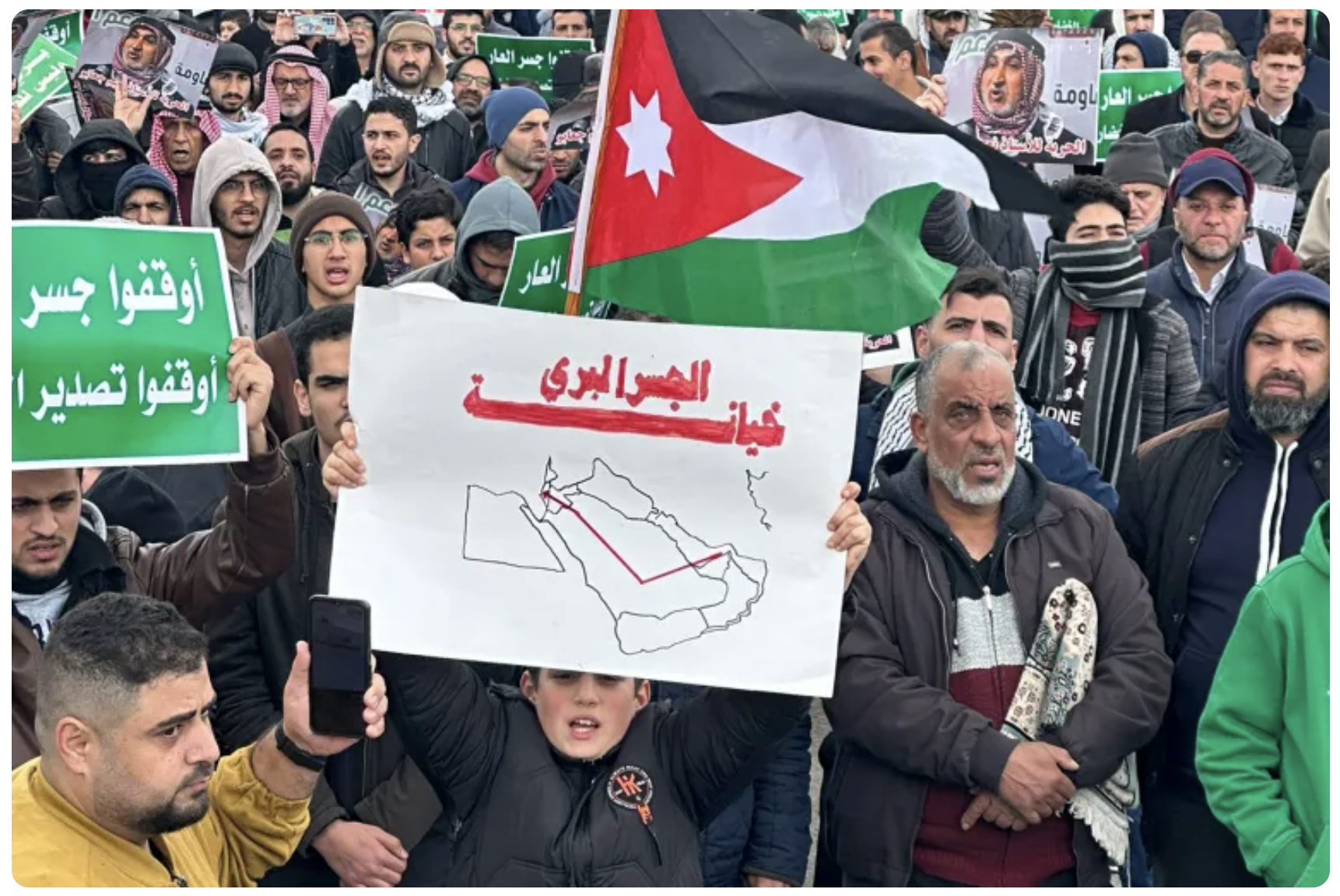
Picture 3: Protests in Amman, April, 2024. (Source: Al-Jazeera. The boy carries a poster with the text “The land bridge is a betrayal”. The map traces the line that crosses Saudi and Jordan and connects Dubai to Haifa. The green signs read “Stop the bridge of shame!” (jisr al-‘aar), add “Stop the exports [to Israel]”.)
For the Arab actors of the Gulf involved, the representation of these new infrastructures is an act of diplomatic equilibrium. It is about minimizing the degree of normalization with Israel, while recognizing each other’s priorities and objectives.[28] Does Dubai partner Puretrans imagine Jordan as the end of a journey toward the Mediterranean? (Picture 2)? By not naming Israeli, it probably does not want to upset the Hashemite kingdom by indicating their close working with Israel, when it comes to border cooperation, thus preserving a modicum of Arab unity. The visual material of Puretrans also indicates the east-west route that Saudi Arabia is building between Jeddah to Jubail and Dammam, the two eastern Saudi ports on the Gulf that have historically been essential for the logistics necessitated by ARAMCO. It also connects Jebel Ali with all these Saudi ports.
If Saudi Arabia has not recognized Israel, unlike the signatories of the Abraham Accords, the country is very close to Bahrain and the UAE when it comes to gradual opening with Israel. Elham Fakhro notes that these three Arab countries have entertained sustained discussions with Israel since at least 2009. Saudi Arabia was onboard with the use of Israeli surveillance technologies, such as the spyware Pegasus, and the sharing of security information.[29] No real normalization for the Saudis, but a form of normalization light.
A report by the Indian Briefing also mentions the enormous infrastructure that Saudi Arabia has started building since Crown Prince bin Salman launched his pet project of a futuristic city called NEOM.[30] This hub, close to the shores of the Red Sea, is also mentioned by Puretrans (Picture 2). It relies on railroad connections between Jeddah, Dammam and Jubail that link Riyadh, the capital city, to the western and eastern coasts of the Saudi kingdom.
Overall, the land bridge project demonstrates an uneven reinforcement of ties between Israel and Gulf states. The semantics of normalization is more or less open: Jordan and Saudi do not want to be shown as enabling the land bridge; Emirati and Bahrainis are timid in acknowledging this bridge with the Mediterranean via Israel and Egypt; while Israeli companies are adamant to show they hold strategic keys to this logistics project.
Global Maps: New Lines of Empire?
Last, on a more global level, the land bridge points to new dynamics and partnerships with India and China. Empires have always been about merging economics with political interests and have reconfigured portions of the globe through war and new infrastructures. They always had to somehow cooperate with their peers (think of British, French and German empires in pushing for unequal treaties with China in the 1840s or in splitting Africa in the late 19th century).
At the end of 2023, these larger connections involved not Atlantic actors, but India – the first country to report on the creation of this land bridge – and China, which helps Saudi with its own infrastructural developments. The Gulf region and its maritime infrastructure are looking east, as is Israel. The politics of infrastructure and the semantics of transshipment re-center Western Asia away from the classical “Middle East”, seen from Euro-Atlantic, and place it at the center of new commercial and political ties with Asia.
For Asian actors, it is acceptable to work openly with Israel. Indian media demonstrated a keen interest in this site of transshipment by being the first to disclose the signing on December 25, 2025. This is likely related to the U.S.-backed India-Middle East-Europe Economic Corridor (IMEC), announced during the G20 Summithosted in New Delhi in September 2023. Indian Prime Minister Modi has entertained warm relations with Netanyahu in recent years, culminating with a February 25, 2026 speech by Modi in the Israeli Knesset where he gave full endorsement to Israel.[31] IMEC is imagined as a gateway for internet data cable, hydrogen and electricity connecting India to the Gulf, Israel and Italy, and foresees the development of new railways in Saudi Arabia.[32]
Another emerging powerful actor in the region is China. This influence stems from the country’s Belt and Road Initiative entering the region in 2017 with the unveiling of the Saudi China Landbridge Consortium (SLCC). This domestic Saudi land bridge project is not about transshipment, but about the construction of domestic Saudi railways, where freight travels on an east-west axis, and not internationally north-west through Jordan to Israel. China’s cooperation with the Saudi political elite also facilitated, in 2023, a diplomatic thaw between the Saudi monarchy and Iran, and thus also with the Houthis in Yemen.[33]
Imperialism in this region has historically contributed to the fusion of economic and security concerns, as exemplified by Arang Keshavarzian in his masterful Making Space for the Gulf: Histories of Regionalism and the Middle East (2024). The story of transshipment since 2024 may illustrate the rise of neo-imperial actors: wars are used to create new infrastructures as in the past but state actors now leading the charge are freed from older imperial powers such as the U.S. and Britain. Israel and the UAE are the most active in these processes, each with their own agenda. The UAE is involved in the conflicts in Yemen and Sudan[34], while Israel connects its genocide and ecocide in Gaza with new infrastructure projects that needs Asia’s balance.[35] Both countries have no interest in directly controlling vassal-states or ruling over distant territories, as empires used to do. But they are keen to produce spaces that reinforce material control in ever larger portions of the globe, with maritime routes likely to again become central in their struggle for hegemony.
The U.S. is still present, but has been, at least until 2026, more reactive rather than leading the charge. In Trump’s GREAT Trust (“Gaza Reconstitution, Economic Acceleration and Transformation”) of September 2025, he seems to endorse the maps that combine the proposed routes of the Haifa-Dubai land bridge and the infrastructure of the IMEC initiative. The map (here in Picture 4 [36]) envisioned Gaza as integrated, via Egypt and Saudi Arabia “into the Abrahamic fabric and the broader IMEC initiative.” The land bridge fades into future rail projects.
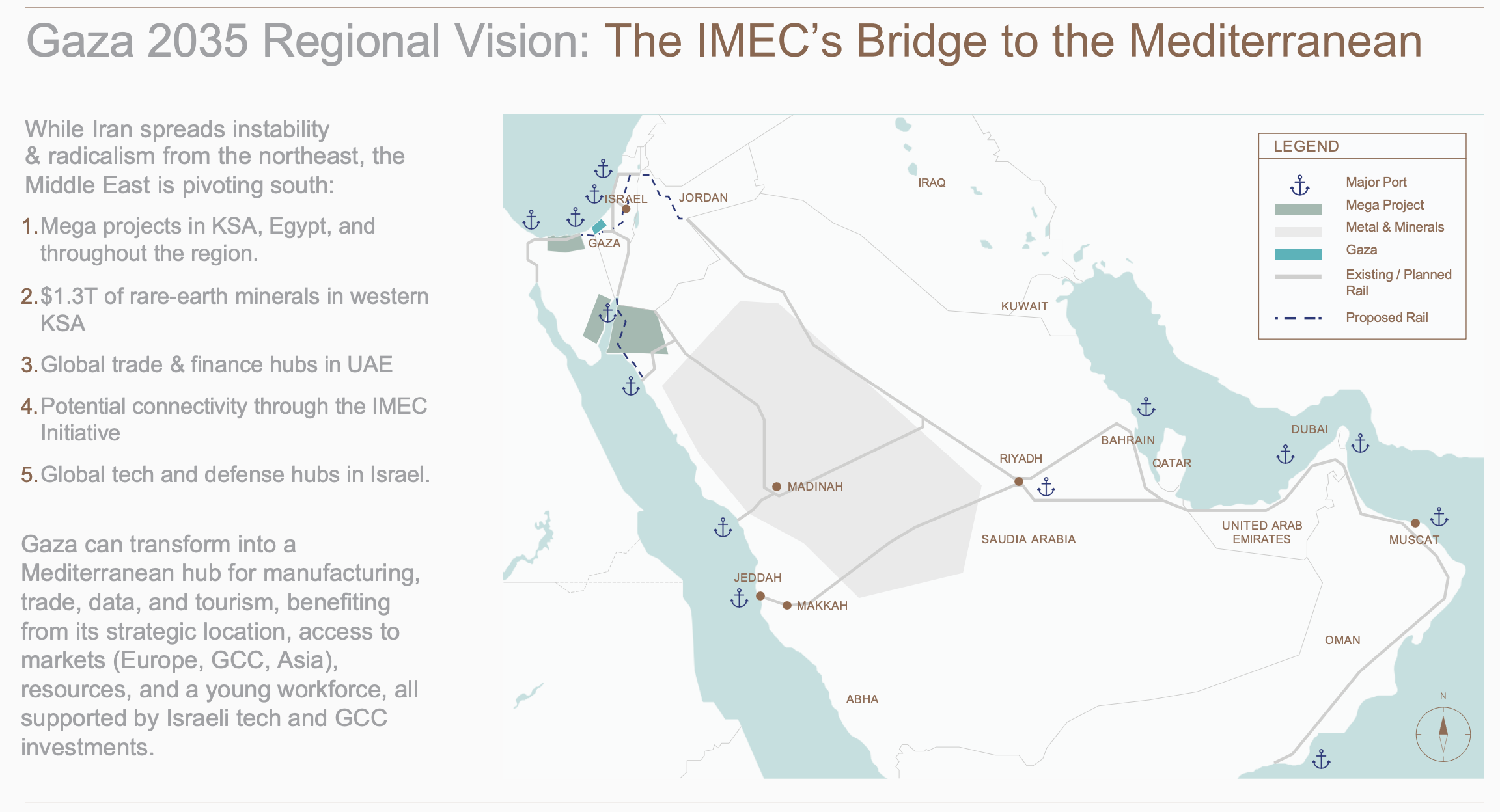
Picture 4: Trump’s GREAT Trust. Gaza and the IMEC Initiative (Source: Washington Post, Aug. 29, 2025)
The map of Picture 4 seems to satisfy all parties: Gaza should be reconstructed and connected to a “Mega Project” from Rafah to the Al-Arish region (producing, among others, electric cars); Israel’s harbors of Eilat and Haifa are further integrated in the IMEC projects; Saudi’s infrastructural developments (railways and NeoM, marked in grey-green east of the Sinai) gain primacy in these overland routes; the Gulf monarchies and Emirates are offered new connections free of the Hormuz chokehold; while the U.S. gain access to rare earth minerals in Saudi (zone marked in grey in Picture 4).
It should not be lost that this is also a map of the counter-revolution against the democratic revolts of 2011. GCC sent troops into Manama to crush the Pearl Square protests: now new roads and railways would facilitate mobility of security forces. Israel and Egypt restored a tight control over Gaza and the Sinai as well as a cooperation over the Suez Canal (which was threatened by the openings made by President Morsi to Iranian ships between 2012 and 2013). The UAE have entered into competition with Saudi over the control of Yemen: the map only hints at the growing influence of Dubai Port in Aden, Socotra, and since December 2025, of the control over the entire oil infrastructures in the Hadramawt after the military advances made by the Southern Transition Council in Yemen (the Emirati ally),[37] all the way to the Horn of Africa and Sudan.
It has not been lost to Sudanese civilians that the Abraham Accords, which Sudan was arm-twisted by the U.S. in signing in 2020, have favored the “interest of transnational elites” and have connected “authoritarian regimes across the region, from Israel to the UAE”.[38] Hemetti, the leader of the RSF, sent Sudanese mercenaries to fight in Yemen at the start of the civil war there; he now receives lavish support from the Emirates, ranging from weapon or “humanitarian” support. Material resources from Sudan, particularly gold but also access to arable lands in the western provinces are increasingly channeled in favor of the Emirates. Without an eye on the Emirati web of harbors and infrastructures spread around the Gulf, the Red Sea and the Horn Africa, one cannot make sense of the project of a land bridge with Israel. This proposal has been mostly a PR exercise since few trucks move containers[39], but it reveals a larger appetite in Israel and the UAE for neo-imperial futures.
The unprovoked war of aggression by Israel and the U.S. against Iran (March 2026) will generate new ideas for “route-making” and addressing the problem of logistical bottlenecks. Pipelines are the hot commodities now that the Hormuz Strait is closed. But land bridges, railroad and cable infrastructures, securing navigation through the Red Sea will remain important. New maps of logistics now include post-Bashar Al-Asad Syria, and might reinforce Israel-UAE cooperation, possibly with Egypt, for questions of navigation in the Red Sea.[40]The U.S. has re-asserted its imperial might with the bombings in Iran. Yet, Israel has been the leading actor in forcing this war on the U.S. Instead, Gulf monarchies have been much more vulnerable from the Iranian drone attacks and disruption of navigation in the Hormuz Strait. With India reinforcing its security cooperation with Israel, the new war seems to confirm that a new center of gravity emerges around Israel and some of its Asian partners.
[1] “Operation Prosperity Guardians” started on December 18, 2023. Bahrain was the only Arab state to join. Other Gulf countries opted out to avoid escalation with Teheran. See Elham Fakhro, The Abraham Accord. The Gulf States, Israel, and the Limits of Normalization (Columbia University Press, 2024), p. 221.
[2] Laleh Khalili, Sinews of War and Trade: Shipping and Capitalism in the Arabian Peninsula (Verso Books, 2020). See also Arang Keshavarzian, Making Space for the Gulf: Histories of Regionalism and the Middle East (Stanford University Press, 2024)
[3] See Khalili, 49-75.
[4] See Khalili and Keshavarzian.
[5] Meaning that the Persian Gulf is not on the fringes of the Euro-Atlantic world anymore. Rather, the indirect connections between Israel, a couple of Gulf countries, India and China turn the Gulf into a central political and economic region for global trade.
[6] Rafeef Ziadah, 2019. “Circulating Power: Humanitarian Logistics, Militarism and the UAE”, Antipode 51(5): 1684-1702.
[7] See Rafeef Ziadah, "Hardwiring Normalization—Infrastructures, Extraction and Gaza’s Future," Middle East Report 315/316 (Summer/Fall 2025).
[8] The excellent book by A. Hanieh, R. Knox and R. Ziadah (2025, Resisting Erasure. Capitalism Imperialism and Race in Palestine, Verso Books) provides a classical account of the historical destruction and dispossession of Palestine by combined “fossil capitalism and Empire in the Middle East”, Israeli settler colonialism and the gradual submission of the PNA to debt economy and increased dependency during the Oslo years.
[9] "A Note on the Cover Image," Middle East Report 315/316 (Summer/Fall 2025).
[10] Trump wanted U.S. oil producers to take control of Venezuelan oil facilities, but have refused to do so: infrastructures there are too old and obsolete, according to American private capitalist actors.
[11] The article was written before the U.S. and Israel’s war against Iran in March 2026.
[12] https://www.india-briefing.com/news/red-sea-crisis-global-trade-alternative-land-corridor-uae-jeddah-israel-31090.html/
[13] Ziadah 2019, “Circulating Power”: 1690, and 1692.
[14] See, for example, Dana and Safieddine’s contribution to MERIP special issue on normalization, one on security alliance between Israel and the UAE and the other about Israel’s effort to control newly discovered oil fields in the Eastern Mediterranean. Both articles are published in Middle East Report 315/316 (Summer/Fall 2025: Tariq Dana, "The Military-Industrial Backbone of Normalization”; Hicham Safieddine, "From Oslo to Offshore—The Rise of Energy Normalization in the Eastern Mediterranean". See also Ziadah. 2019. “Circulating Power”.
On water control by Israel, see Ziadah R., C. Henderson et al., 2026 “Disruptive Geographies and the War on Gaza Infrastructure and Global Solidarity”, Geopolitics 31(1), pp. 456, 464 and 468. On water and food security from the Emirati perspective, see Christian Henderson & Rafeef Ziadah, 2023. “Logistics of the neoliberal food-regime”, New Political Economy 28(4), 592-607.
[15] See Henderson & Ziadah, 2023. “Logistics of the neoliberal food-regime”, 592-607 and Yotam Gidrom, 2020. Israel In Africa. Security, Migration, Interstate Politics. London: Zed Books. In December 2025 Israel was the first country to recognize Somaliland as an independent state.
[16] See Fakhro, The Abraham Accord, 111-148. Dana notes that trade between Israel and the UAE “soared to $3.24 billion in 2024, marking an 11 percent increase from the year prior” (MERIP, Fall 20205: “"The Military-Industrial Backbone of Normalization”).
[17] The Ever Given, the ship that run aground in the Suez Canal in 2021, is a 20,000 TEU vessel, meaning that it can transport at least 10,000 containers.
[18] AJOT is the only article that notes the increased costs with the land bridge “works out at 15-20% more expensive than the traditional ship-only passage”.
[19] On Dubai Port World (DP World), see e.g R Ziadah, 2018. “Transport Infrastructure”. See also Christian Henderson & Rafeef Ziadeh, 2023. “Logistics of the neoliberal food-regime”, New Political Economy, 592-607.
[20] Fakhro, 2024. The Abraham Accord, 116-117.
[21] One article, published by Mondoweiss in February 2024, shared the same skepticism about the project. It denounced the Israeli media claims about the land bridge as a “charade to hide that Yemen’s blockade is working”. Later investigative journalism indicate that some trucks are transiting on this overland bridge. See the April 4, 2024 article “ma haqiqat wujud jisr barry?” [What is the truth about the existence of a land bridge?”], Al-Jazeera (in Arabic).
[22] https://trucknet.io/premier-middle-east-transportation-route/. The website provides what looks like live data: time of departure of a truck in Jebel Ali, estimated time of arrival at Haifa, temperature of the cooled container, ride number, etc.).
[23] See https://www.timesofisrael.com/houthi-bypass-quietly-goods-forge-overland-path-to-israel-via-saudi-arabia-jordan/ or https://trucknet.io/premier-middle-east-transportation-route/
[24] See https://puretrans.ae/?req=534466. The Dubai company describes itself in these terms: “Our company specializes in managing comprehensive land transportation routes that bridge the Mediterranean and the Arab Gulf, effectively creating a vital logistic connection between Asia and Europe.”
[25] All these trucks would also be sitting targets for sabotage. See MERIP essays on trucking, war, and profits in Jordan and Iraq, at https://merip.org/2007/06/the-war-economy-of-iraq/,https://merip.org/2015/05/jordans-longest-war/ and https://merip.org/2009/11/making-big-money-on-iraq/.
[26] Fakhro, 2024. Abraham Accords, p. 3.
[27] See Elia El-Khazen, 2026. “Truck Drivers at a Crossroads: On the Relevance of Trucking Communities to Regional and Global Anit-Normalization Movements”, in Ziadah Henderson et al., 2026 “Disruptive Geographies and the War on Gaza”, 479-484. See also Majd Bargash, "Energy, Water and the Cost of Jordan’s Dependence on Israel," Middle East Report 315/316 (Summer/Fall 2025).
[28] Like in Jordan, the divide between the official government position and segment of the population opposing normalization with Israel is tangible. See Gulf CAN, "Refusing the New Normal—An Interview with the Gulf Coalition Against Normalisation," Middle East Report 315/316 (Summer/Fall 2025).
[29] See Fakhro, 2024. The Abraham Accord pp. 48-49, and 63-64. On the Abraham Accord and cybersecurity cooperation, see Marwa “Normalizing the Surveillance State”, MERIP 307/308 (2023).
[30] On NeoM and large urban development projects in which Israeli-Gulf technology plays a big role, see Tarvainen, A. & Challand, B. (2024) “Innovation as erasure: Palestine and the new regional alliances of technology.” Transactions, 49.
[31] See https://www.aljazeera.com/news/2026/2/25/indias-modi-addresses-israeli-parliament-on-first-day-of-visit. India is Israel’s largest arms buyer.
[32] Ziadah, "Hardwiring Normalization”.
[33] Beijing helped Riyadh and Tehran initiate diplomatic discussions about the Gulf and also about the Houthis. See Sanaa Center, “Houthis Make Official Visit to Riyadh for Talks with Saudi Arabia” (Sept. 2023).
[34] The UAE gives weaponry and logistic support to factions in these two countries. In Yemen, it supports the Southern Transition Council, the Aden-based secessionist government, while in Sudan, the Emirates support the Rapid Support Forces (RSF) led by Hemetti (former Janjaweed leader during the first genocide in Darfur) against the Sudanese Army of General Burhan.
[35]Prime Minister Netanyahu, in his September 28, 2024 speech to the UN General Assembly, presented two maps of the Near East, one with countries marked in black (“The Curse” – a reference to the countries hostile to his country, from Iran, Iraq, Syria, and Lebanon), and the other marked in green with the title “The Blessing”. This second map presents Egypt, Sudan, India, the UAE, Bahrain and Saudi Arabia colored in green, like Israel, which are connected with a red arrow that starts with India and ends in the south-eastern corner of the Mediterranean.
[37] See “STC 'Promising Future' Operation Secures Oil-rich Hadhramaut in South Yemen”, 22 Dec. 2025. Note that the UAE back-pedaled in January 2026 and asked the STC to hand back control of the Hadhramawt to Saudi and its Yemeni allies, the government in exile.
[38]Bayan Abubakr, "The Abraham Accords and Sudan’s Global Counterrevolution," Middle East Report 315/316 (Summer/Fall 2025).
[39] An article by-Al-Jazeera (April 2024) documents the passage of Dubai trucks crossing Jordan toward the border with Israel.
[40] On Saudi betting on Syria, rather than Israel, for its fiber-optics cable route, see https://www.middleeasteye.net/news/saudi-arabia-wants-fiber-optic-cable-greece-run-through-syria-instead-israel (February 2026). The future of these projects will depend on how much Iran looses power in neighboring countries.