Media Wars
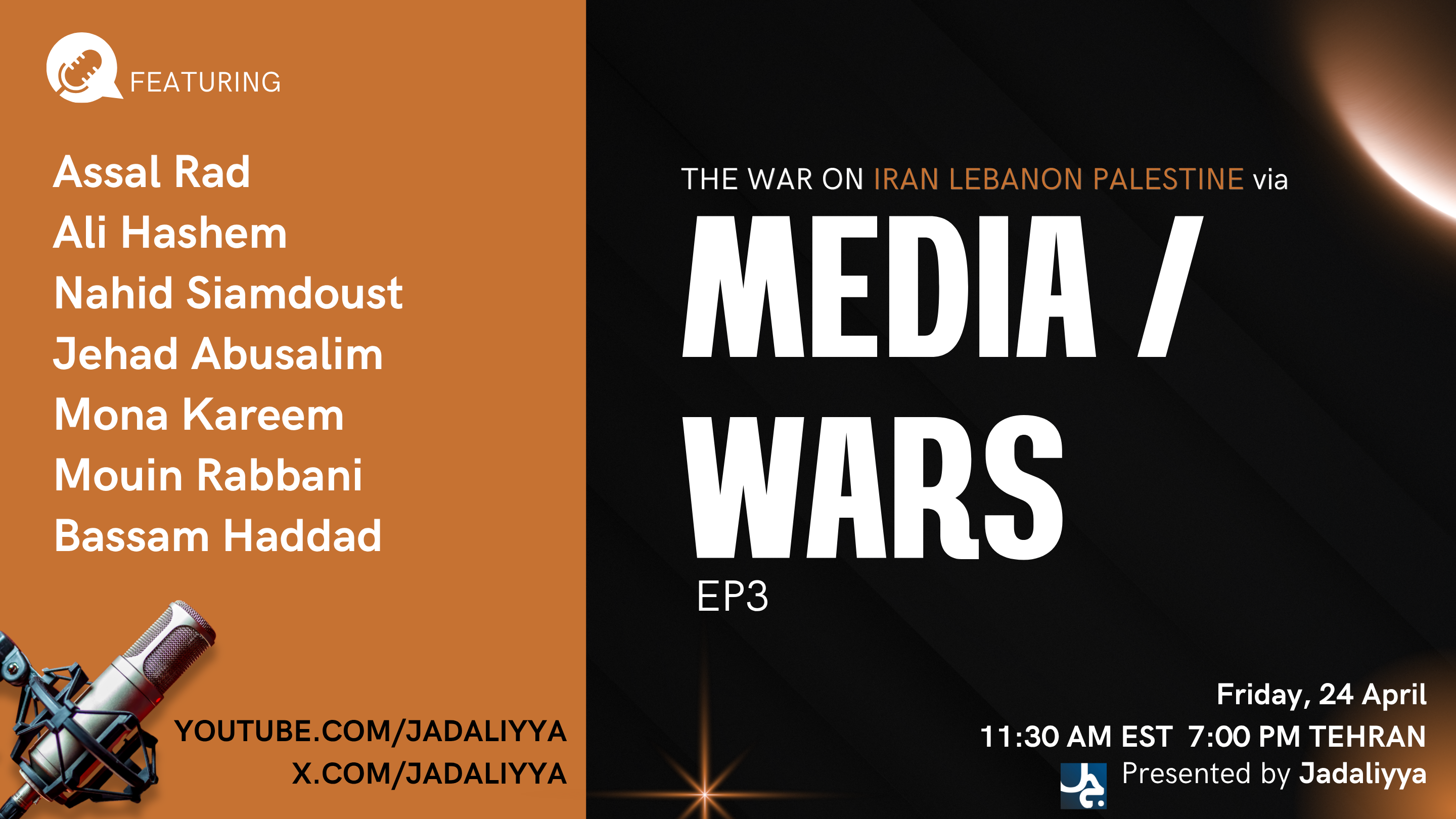
Episode 3
The War on Iran
The War on Lebanon
The War on Palestine
Featuring
Assal Rad
Ali Hashem
Nahid Siamdoust
Jehad Abusalim
Mona Kareem
Mouin Rabbani
Bassam Haddad
Friday, 24 April 2026
11:30 AM EST | 7:00 PM Tehran
In this third episode of Media Wars, hosts Bassam Haddad and Mouin Rabbani speak with Ali Hashem from Tehran on the various developments seen from a local lens. Assal Rad addresses how the corporate media is covering the war against Iran, Jehad Abusalim shares a new project to document the Gaza Genocide, and Mona Karim details increased repression in Gulf States during this war. We also do a rapid-fire “Rogue Media Wars” segment to conclude the program. Social Media / Wars examines the truths and absurdities of our era, centering on the US–Israel war on Iran. Fast-paced and eclectic, it blends media roundups with commentary and analysis to expose the folly and brutality of empire and imperial media. The program moves between granular detail and broad historical and geopolitical context, treating weighty, world-altering subjects in a casual, sometimes irreverent voice. Not suitable for children.
Media Wars examines the truths and absurdities of our era, centering on the US–Israel war on Iran. Fast-paced and eclectic, it blends media roundups with commentary and analysis to expose the folly and brutality of empire and imperial media. The program moves between granular detail and broad historical and geopolitical context, treating weighty, world-altering subjects in a casual, sometimes irreverent voice. Not suitable for children.
Featuring
Ali Hashem is a seasoned journalist and researcher. Over the past 20 years, he has worked with various news outlets, each with distinct editorial guidelines, and some with conflicting agendas. This extensive experience has provided him with the expertise to navigate the complexities of practicing journalism in a highly politicized environment while adhering to his journalistic values. During his tenure at BBC, AlJazeera, AlMayadeen, and other prominent networks, Ali built a solid foundation in news and current affairs. He developed his skills in reporting, interviewing, producing, live coverage, and overseeing teams on the ground. Additionally, he contributed analysis and news reports to several respected outlets, including BBC Arabic, Al-Monitor.com, The Huffington Post, The National, The Sunday Times, The Guardian, Tokyo's Facta magazine, and The Middle East Institute in Washington, with a focus on Iran, Political Islam, and the crisis in Syria.
Assal Rad is a historian of the modern Middle East. She is currently a Nonresident Fellow at the Arab Center Washington DC and DAWN. She works on research and writing related to U.S. foreign policy issues, the Middle East, contemporary Iran, and Israel/Palestine. Her writing can be seen in Newsweek, The National Interest, The Independent, Foreign Policy and more, and she has appeared as a commentator on BBC World, Al Jazeera, CNN, and NPR. Assal completed a PhD in History from the University of California, Irvine in 2018 and is the author of The State of Resistance: Politics, Culture, and Identity in Modern Iran (Cambridge University Press, 2022). Follow Assal on X/Twitter: @AssalRad and IG: @AssalRad_
Nahid Siamdoust is Assistant Professor of Media and Middle Eastern Studies at the University of Texas at Austin. She is the author of Soundtrack of the Revolution: The Politics of Music in Iran (Stanford, 2017) and co-editor of the forthcoming volume “Iran Amplified: One Hundred Years of Music and Society” (Harvard, June 2026). This year she is a EUME fellow of the Alexander von Humboldt Foundation in Berlin, where she is writing her new book on Iran’s post-revolutionary public.
Jehad Abusalim is Executive Director of the Gaza Genocide Center, a documentation and memorial institution building a permanent, verified record of genocide in Gaza. He is a writer and historian originally from Deir el-Balah in the Gaza Strip, Palestine, and a PhD candidate in History and Hebrew and Judaic Studies at New York University. He has spent over 17 years leading research, publishing, and public education on Palestine, with a focus on Gaza's past, present, and future. He is co-editor of Light in Gaza: Writings Born of Fire and has contributed to leading academic, policy, and media platforms.
Mona Kareem is a poet, translator, and literary scholar. She is the author of four poetry collections, selections from which were published in English as I Will Not Fold These Maps. Her translations include Ra'ad Abdul Qadir's Except for This Unseen Thread, Octavia Butler's Kindred, and Ashraf Fayadh's Instructions Within. She teaches Arabic literature at Washington University in St Louis.
Mouin Rabbani is a researcher, analyst, and commentator specialising in Palestinian affairs, the Arab-Israeli conflict, and the contemporary Middle East. He has among other positions previously served as Principal Political Affairs Officer with the Office of the UN Special Envoy for Syria, Head of Middle East with the Martti Ahtisaari Peace Foundation, and Senior Middle East Analyst and Special Advisor on Israel-Palestine with the International Crisis Group. Rabbani is Co-Editor of Jadaliyya, where he also hosts the Connections podcast and edits its Quick Thoughts feature, Managing Editor and was Associate Editor of the Journal of Peacebuilding and Development, and a Contributing Editor of Middle East Report. He is Non-Resident Fellow at the Center for Conflict and Humanitarian Studies (CHS) and at Democracy for the Arab Wold Now (DAWN). A graduate of Tufts University and Georgetown University’s Center for Contemporary Arab Studies (CCAS), Rabbani has published, presented and commented widely on Middle East issues, including for most major print, television and digital media.
Bassam Haddad is Founding Director of the Middle East and Islamic Studies Program and Associate Professor at the Schar School of Policy and Government at George Mason University. He is the author of Business Networks in Syria: The Political Economy of Authoritarian Resilience (Stanford University Press, 2011) and co-editor of A Critical Political Economy of the Middle East (Stanford University Press, 2021). Bassam is Co-Founder/Editor of Jadaliyya Ezine and Executive Director of the Arab Studies Institute. He serves as Founding Editor of the Arab Studies Journal and the Knowledge Production Project. He is co-producer/director of the award-winning documentary film, About Baghdad, and director of the acclaimed series Arabs and Terrorism. Bassam is Executive Producer of Status Podcast Channel and Director of the Middle East Studies Pedagogy Initiative (MESPI). He received MESA's Jere L. Bacharach Service Award in 2017 for his service to the profession. Currently, Bassam is working on his second Syria book titled Understanding The Syrian Calamity: Regime, Opposition, Outsiders (forthcoming, Stanford University Press).