|
|
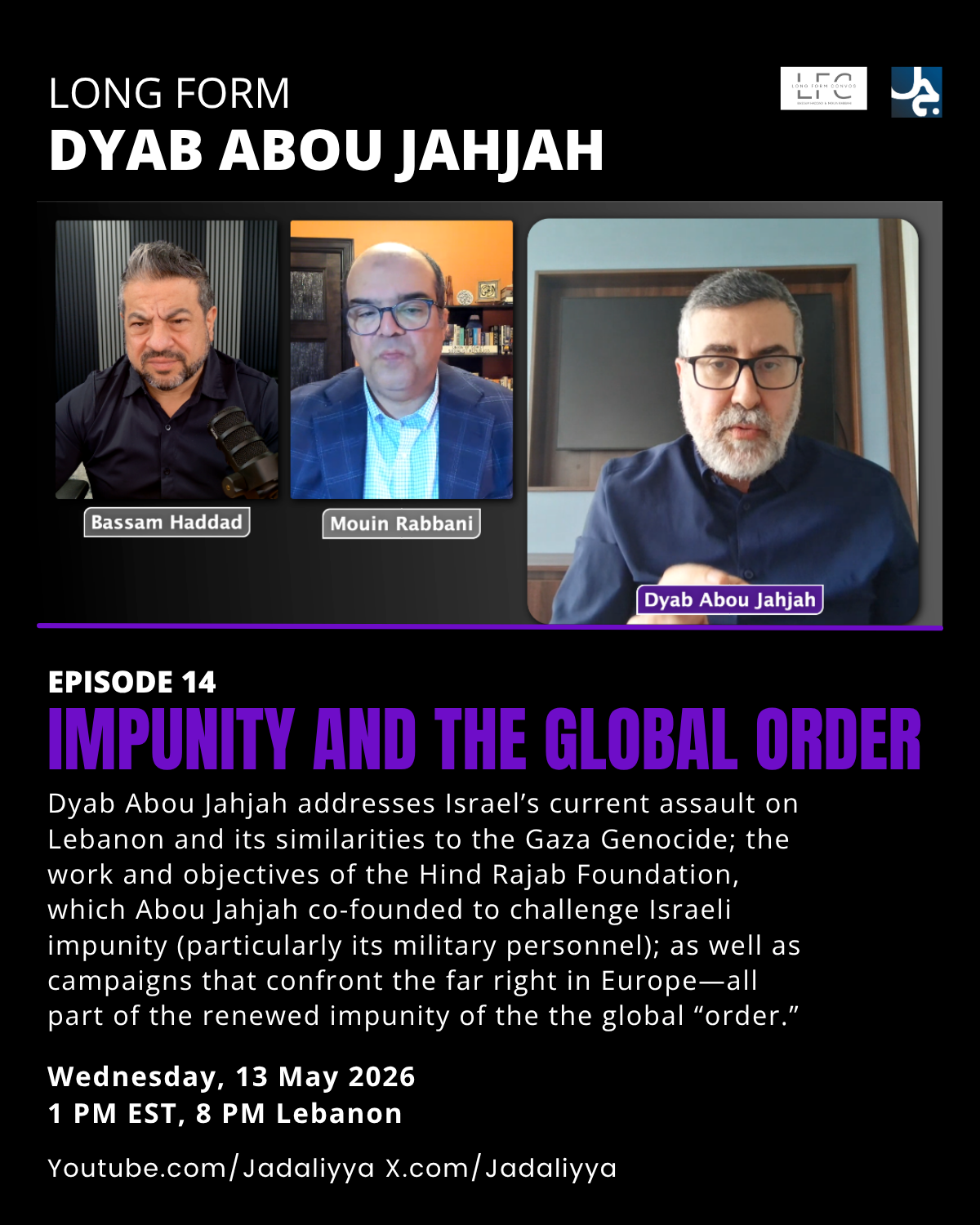
with Dyab Abou Jahjah
Hosted by Bassam Haddad & Mouin Rabbani

A Jadaliyya Podcast
In this episode of Long Form, Dyab Abou Jahjah addresses Israel’s current assault on Lebanon and its similarities to the Gaza Genocide; the work and objectives of the Hind Rajab Foundation, which Abou Jahjah co-founded to challenge Israeli impunity and particularly that of its military personnel; and campaigns to confront the far right in Europe--all part of the renewed impunity of the global “order.”
Long Form consists of a series of lengthy discussions and conversations with leading thinkers, scholars, and activists that explores the most pressing issues of our day, sheds light on their context and dynamics, and in so doing seeks to explore the broader theme of challenges to the global order and how these might affect it.
Featuring
Dyab Abou Jahjah is a Lebanese-born Belgian political activist, writer, and public intellectual whose trajectory combines contentious grassroots activism, legal advocacy, and sustained engagement with political theory. Born in southern Lebanon, he was displaced with his family during the 1976 Israeli invasion, an experience that has shaped his political outlook. He later settled in Belgium, where he rose to prominence in the early 2000s as a function of his participation in public life. During this period, he became a central and controversial figure in Belgian public life. In 2003, he was arrested and faced multiple charges, including allegations of incitement to riots and the creation of a private militia linked to the AEL’s “civil patrols” initiative in Antwerp, which monitored police activity. The case received extensive media coverage, and Abou Jahjah was, for a time, portrayed as a major internal security concern in Belgium. Internationally, his profile drew attention as well; he was notably compared to Malcolm X in a profile by The New York Times.
In 2008, after several years of legal proceedings, he was acquitted of all charges. Following this acquittal, he transitioned more decisively into writing and commentary, becoming a recognized columnist and public intellectual in Belgium. His work has appeared in major outlets, including De Standaard, where he wrote on politics, society, and international affairs. His writings extend beyond immediate political controversies into broader questions of power, sovereignty, and political philosophy. He has developed a body of work that combines normative arguments on justice with critical analysis of Western foreign policy and global governance structures.
Abou Jahjah has remained a polarizing figure, particularly regarding the Palestinian question. His refusal to adopt positions aligned with mainstream European political discourse—specifically his stance on resistance in Palestine—led to the termination of his column at De Standaard, illustrating the persistent friction between his views and dominant media frameworks.
He is also the founder of the Hind Rajab Foundation (HRF), an organization focused on documenting alleged war crimes and pursuing legal accountability through national courts and international mechanisms. His work within HRF, including efforts to identify and initiate proceedings against alleged perpetrators, has been described by some supporters as analogous to historical efforts to track war criminals, while critics strongly contest this framing. The visibility of these activities has, according to reporting, exposed him to serious threats and intense political backlash. Earlier in his career, he was also involved in legal efforts in Belgium targeting Ariel Sharon under universal jurisdiction legislation, in relation to alleged war crimes connected to the Sabra and Shatila massacres—an episode that became a landmark in debates on international accountability. Overall, Abou Jahjah’s profile is that of a politically engaged intellectual whose work traverses activism, legal strategy, and theoretical reflection, consistently centered on questions of justice, power, and resistance.
Bassam Haddad is Founding Director of the Middle East and Islamic Studies Program and Associate Professor at the Schar School of Policy and Government at George Mason University. He is the author of Business Networks in Syria: The Political Economy of Authoritarian Resilience(Stanford University Press, 2011) and co-editor of A Critical Political Economy of the Middle East(Stanford University Press, 2021). Bassam is Co-Founder/Editor of Jadaliyya Ezine and Executive Director of the Arab Studies Institute. He serves as Founding Editor of the Arab Studies Journal and the Knowledge Production Project. He is co-producer/director of the award-winning documentary film, About Baghdad, and director of the acclaimed series Arabs and Terrorism. Bassam is Executive Producer of StatusPodcast Channel and Director of the Middle East Studies Pedagogy Initiative (MESPI). He received MESA's Jere L. Bacharach Service Award in 2017 for his service to the profession. Currently, Bassam is working on his second Syria book titled Understanding The Syrian Tragedy: Regime, Opposition, Outsiders (forthcoming, Stanford University Press).
Mouin Rabbani is a researcher, analyst, and commentator specialising in Palestinian affairs, the Arab-Israeli conflict, and the contemporary Middle East. He has among other positions previously served as Principal Political Affairs Officer with the Office of the UN Special Envoy for Syria, Head of Middle East with the Martti Ahtisaari Peace Foundation, and Senior Middle East Analyst and Special Advisor on Israel-Palestine with the International Crisis Group. Rabbani is Co-Editor of Jadaliyya, and a Contributing Editor of Middle East Report.
“The old world is dying, and the new world struggles to be born: now is the time of monsters.” – Antonio Gramsci

\\ LONG FORM CONVERSATIONS //
There can be little doubt we are living in a time of monsters. But is the global order that emerged after the horrors of the Second World War dying in a paroxysm of conflict and violence that are tearing its foundations apart? Or are as we experiencing yet another period of upheaval that will be absorbed and leave the world as we know it fundamentally intact?
Long Form consists of a series of lengthy discussions and conversations with leading thinkers, scholars, and activists that explores the most pressing issues of our day, sheds light on their context and dynamics, and in so doing seeks to explore the broader theme of challenges to the global order and how these might affect it.