Dylan Baun, Beirut Radical: A Global Microhistory from the Sixties to the Lebanese Civil War (I.B. Tauris, 2025).
Jadaliyya (J): What made you write this book?
Dylan Baun (DB): Archival fragments—while doing dissertation research in Beirut in 2013, I found an obituary for the subject of this book, Imad Yusuf Nuwayhid (1944-1975), in the pages of the Lebanese Communist Party’s newspaper. The practice of memorializing party members killed in the Lebanese Civil War (1975-1990) was not uncommon and his obituary was fairly standard: some biographical information, reference to the battles Imad fought in, and a word on Imad’s service to the party and its causes. What was unique about Imad was that he kept surfacing in my archival searches. Most important was a note that he translated the work of anti-Zionist thinker, Abram Leon. I eventually found Imad’s 1969 Arabic translation of Leon’s The Jewish Question according to Marxism, which included a five-page introduction on why he wanted to translate the book. This was a promising lead, but what convinced me I really had something was when I got in touch with Imad’s living family (cousins first, brothers and sisters next) who were open to discussing him and the events that led to his death on 28 October 1975. Our discussions opened me up to one pathway by which a young person entered the war and the battle over their memory that unfolded thereafter. In 2018, the Nuwayhids provided me access to Imad’s personal files, including badges and certificates from his job in the hotel industry as well as letters he wrote while abroad working in European hotels throughout the late 1960s and early 1970s. This was the moment I knew I had enough material to write a book on Imad and how he speaks to the eras he lived in and the people he encountered, both while living and as a “martyr.”
J: What particular topics, issues, and literatures does the book address?
DB: Beirut Radical provides a sketch of the life, death, and legacy of one of the some 170,000 people who perished during the Lebanese Civil War. While studies on the war have covered memory, martyrdom, and the collective trauma associated with the war, there is very little work that speaks to individual experiences and pathways to war or how those single lives are remembered today. For Imad, the route was circuitous, phased, but always about the liberation of Arab people, and Palestinians in particular, from the structures of colonialism that oppressed them. While Imad is unique, Beirut Radical shows how he was representative of a generation of Arab young men and women that came of age in this tumultuous era of the Cold War. This serves as a contribution to studies on Lebanon and the war, but also more broadly to the literature on the Global Sixties. Much of that work focuses on the youth politics and culture that connected Europe to the Middle East, Asia to the Americas in the 1960s. Beirut Radical builds from this and also uncovers what young people were studying (for Imad, hotel administration) and how they balanced this with the emancipatory struggles on their time (Palestine, for him). I believe that this quest for socialization and “adulting” should be a critical element of any comprehensive study on youth activism in the 1960s, and is highlighted by the micro-level, historical, and global methodology I employ.
J: How does this book connect to and/or depart from your previous work?
DB: Beirut Radical starts off where I left off with my first book, Winning Lebanon (Cambridge University Press, 2021): the 1950s, youth politics and culture, and Lebanon’s post-independence period. Where I foregrounded organizations and movements in that book, they provide the backdrop for the story of Imad in Beirut Radical. While Winning Lebanon and my other publications have adopted microhistory as an approach (i.e., bottom-up history, single events, and people as the starting point to speak to broader topics and themes), this is my first where I follow one person in and out of the archives. This took me, like it did Imad, from Lebanon to Europe (where he studied and worked) to the United States (the home/archival base of the hotel he worked for, Hotel Intercontinental Phoenicia in Beirut). In this way, I found the project to be quite free flowing, and I hope the writing reflects that. To this end, one of the big differences in this book is how me and my experiences are a character in the book. I start each chapter with a fragment of how I met Imad, his cousins, his comrades, and his admirers. This was a hard choice, one that I hope does not distract from the story I am trying to telling, but rather provides a window into to the choices and decisions historians make when telling stories.
J: Who do you hope will read this book, and what sort of impact would you like it to have?
DB: In a word, everyone! I wrote this book with accessibility in mind at every juncture. I do not think one needs to know much about Lebanon to read this book, but if you have interest in the sixties, biography, and memory, I hope it satisfies. Perhaps most importantly, I want Lebanese people, both those who live in Lebanon and those in the diaspora, young and older, to read this book. Imad is the story of Lebanon: hope, trauma, amnesia, and memory. For those non-Lebanese I hope it is a good story, one that has people reflect how we do history and specifically history of the 1960s. For those Lebanese, I hope it generates a critical conversation on what is remembered, misremembered, and what ought to be focused on from this critical era.
J: What other projects are you working on now?
DB: Two projects, one short-term, one long-term. The short term is on Daniel Oliver, a Scottish Quaker missionary who lived in Imad’s village (how I learned about him in the first place) and was tasked on several British diplomatic missions to Palestine in the 1930s and 1940s. It is also a micro-level study, focusing on how one missionary changed his attitudes (from largely Zionist to pro-Palestinian) based on his experiences in Palestine, and what that means for the Question of Palestine today. The long-term one is a project on style—looks, feels, vibes—in the Arab world in the 1960s. I want to take what I have learned about Imad (how young people sought to be authentic to their place while engaging in global cultural production) to the entire region in this era. Moreover, I want to connect literatures and mediums that often exist separately—film, music, fashion—through exploring the historical context that created them. Selfishly, I want to write about some of my favorite hobbies (I’m a cinephile, lover of world music). I think Beirut Radical benefited from that, something I want to build on and supersize.
J: What message would you like to send to Imad?
DB: Hello Imad. I’m in awe of all you accomplished in your thirty-one years on this planet. It’s sad that Lebanon and Palestine still are not free, but it is my hope that your story inspires many to see how the two struggles have always been connected. Two questions if I may: did you really skip going out in Hamburg? And was Nabil this wild in the sixties?! Send my regards to your parents, Jihad, Jinan, and Sami. Be well, my friend.
Excerpt from the book (from pages 1 to 5)
A Man, A Martyr, and Claiming Him
The Comrade Martyr, Imad Nuwayhid
Beirut, Fall 2013
This is when I first met the subject of this book. I saw his face and read the words al-Rafiq al-Shahid ‘Imad Nuwayhid, The Comrade Martyr, Imad Nuwayhid. They were on the front page of the October 29, 1975 edition of the Lebanese Communist Party’s newspaper, al-Nida’, the Appeal. The picture and text of Imad were placed above two other fallen comrade martyrs: Diyab Ismael and Muhammad Maki.
Over a decade ago, I was working on my dissertation and spending almost every day in the microfilm reading room at the American University of Beirut’s main library. Skimming through this October 29, 1975 issue and its frontpage story, I learned that Imad, Diyab, and Muhammad had died in a battle in Beirut the day prior, six months into what would become known as the Lebanese Civil War (1975-1990). I turned the handle of the microfilm reader to page four, as the newspaper instructed me, to learn “about the martyrs.” Then I read Imad’s obituary, listed first in bullet-point format:
|
The Martyr Comrade Imad Nuwayhid |
|
|
|
|
|
As hard as I try, I can’t remember my exact reaction to Imad’s obituary. A major theme of my dissertation was the recruitment strategies of parties to the war. I knew that in this instance, like many others, regardless of faction or side during the war, the Lebanese Communist Party was memorializing their “martyrs” that died at the hands of the “enemy,” here fighters of the right-wing Kataib Party, in order to compel the living rank and file to take up arms—if they hadn’t already—and fight. As one of the 18,500 people killed in the first two years of the war, Imad’s death was, sadly, unremarkable. The information on Imad, with a focus on service to the Communist Party, and little on his personal life beyond where he was from, was then one piece of evidence towards my argument of party memorialization for recruitment. I believe if this is all I had found on Imad, an archival fragment during the war, through the eyes of a political party turned wartime militia, I would not, and could not, have written this book.
But Imad kept coming back. As I continued scrolling through issues of al-Nida’ into November and December 1975, I saw funeral notices for Imad, remembrances on Imad written by his comrades, and reports of memorial services turned rallies for Imad. In one research note, I wrote, ‘Ok now really, who is Imad? So much dedicated to him.’ In another, ‘Imad is your guy.’ I’m not sure if the density of materials for Imad was as amazing as I wrote—or for that matter more than for Diyab or Muhammad—but weeks later, I was introduced to this project’s single most important document.
In another room of the main library of American University of Beirut, Archives and Special Collections, I was pointed by the head archivist to a 1980 volume, authored by the Lebanese Communist Party and titled Shuhada’ al-Hizb al-Shuyu‘i al-Lubnani 1975-1980: min Ajalak ya Watani, The Martyrs of the Lebanese Communist Party: for your Sake oh my Nation. Each of its some 300 pages is dedicated to someone affiliated to the Lebanese Communist Party who died in the war. Regardless of whether the person was a young man, woman, older, or a child, the format is the same: picture, birth-to-death years, and biographical information. On page 64, there he was (see figure 0.1 below).
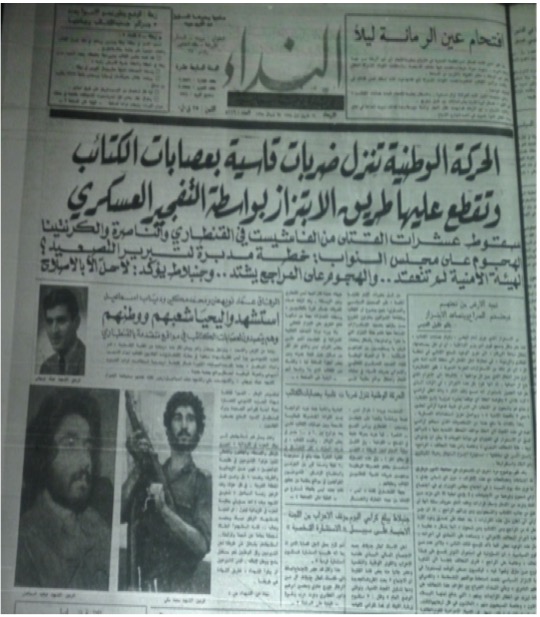
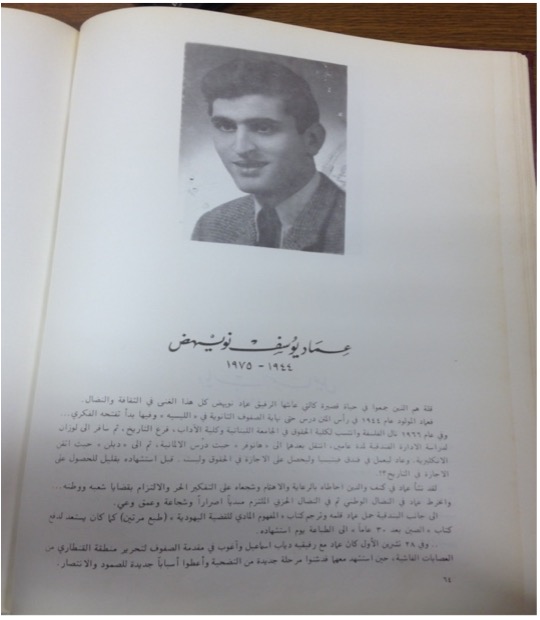
Figure o.1—First glimpses of Imad Nuwayhid. On the cover of al-Nida’, October 29, 1975 (side top left on left), and in Shuhada’ al-Hizb al-Shuyu‘i al-Lubnani 1975-1980: Min Ajalak Ya Watani, 1980. Courtesy of the Lebanese Communist Party.
The entry on Imad included so much more than his al-Nida’ obituary. It read that he was actually born in 1944—not 1945, as the al-Nida’ obituary cited—making him 31 at the age of his death in the battle of Qantari on October 28, 1975. He studied law, history, literature, and philosophy at the Lebanese University in the 1960s. I read on. “He worked at Hotel Phoenicia” in Beirut and “traveled to Lausanne [Switzerland] to study hotel administration for a period of two years.” I knew Beirut fairly well, so I was familiar with the famous hotel near its waterfront. What I didn’t know at the time, and looked up later, was that Phoenicia was part of the U.S.-owned Intercontinental Hotel Corporation, a subsidiary of the once U.S.-owned Pan American Airlines. And while the entry informed me that Imad studied hotel administration, I did not yet know that he attended the most prestigious hospitality school in the world: École Hôtelière de Lausanne. Then, I read the following: “From the side of the rifle, Imad carried his pen and translated the book ‘A Materialist Understanding for the Jewish Issue.’”
I was blown away. I had been studying the war since undergrad; its causes, rooted in the Lebanese political system that favored Maronite Christians over other groups; its actors, including the Palestinian Liberation Organization, which sought to win support of local leftists towards regional liberation; its costs, including the loss of 170,000 lives, even more injured, displaced, and emigrated, and billions of dollars of damage. However, I had rarely considered, and knew so very little of those 170,000 people who died in the fifteen plus years of on and off warfare. This was not (solely) due to my naivety. Whether it be the trauma caused by bringing back the dead or state-sponsored amnesia around the war, there was so very little out there on those killed, combatants or civilians. But this note on Imad’s translation gave me a path to continue following him and his intellectual work. I learned thereafter that the book he translated, from French to Arabic, was written by Abram Leon and titled La Conception Matérialiste de la Question Juive (in English translated as The Jewish Question: A Marxist Interpretation). Leon was a Jewish, Polish, Belgian, anti-Zionist, Trotskyist who wrote this book in 1942, only two years before he died as a prisoner at Auschwitz concentration camp.
Simply put, this entry on Imad humanized him and, equally important, others like him that died during the war. Maybe there were not just fighters, or even intellectuals turned fighters. They were young people with lives and career aspirations. Since that fateful day when I first saw a picture of Imad in al-Nida’, I have learned that the question of who he was, how people remember him, and what that shows about the Lebanese Civil War is not so simple.
Javier Cercas’ book, Lord of All The Dead, is instructive here. It follows the story of Cercas’ uncle, Manuel Mena, who died in the Spanish Civil War. The book’s blurb sets up Cercas’ seemingly contradictory inquiries: “Who was this young man? A fascist hero whose memory is an embarrassment to the left-leaning author, or a committed idealist who happened to fall on the wrong side of history?” Similar questions guide Beirut Radical: who was Imad Nuwayhid? A leftist intellectual or a self-interested hotel worker? A martyr or a victim? An idealist youth with hopes and dreams that got caught up in the Palestinian cause and the war? Or was he even a fighter at all? And what does all of this mean for how Lebanese carry the war with them today?
It is my hope that by the final pages of this book, I have answered these questions as well as other important ones that Imad’s life, death, and legacy, have led me to ask. But for the sake of an initial answer, I find that Imad was none of these things alone, but all of them together. Considering Imad as a window into something much larger—grounds for a “global microhistory”—I argue that he represents a generation of what I term “practical radicals;” a global generation who were as invested in their politics as their income while they came of age under a growing American empire. Although much more is known about the former, particularly support for left-wing ideologies in the turbulent 1960s, Imad’s life highlights how young people pursued them, equally, alongside their career aspirations. Imad’s death in the war, then, shows the twisting path by which some young radicals ceded their autonomy to liberation struggles. Thereafter, and well into the present, multiple actors (political parties, comrades, and family members) battle over the memory of the fallen, claiming individuals like Imad Nuwayhid for their own, rivaling purposes.