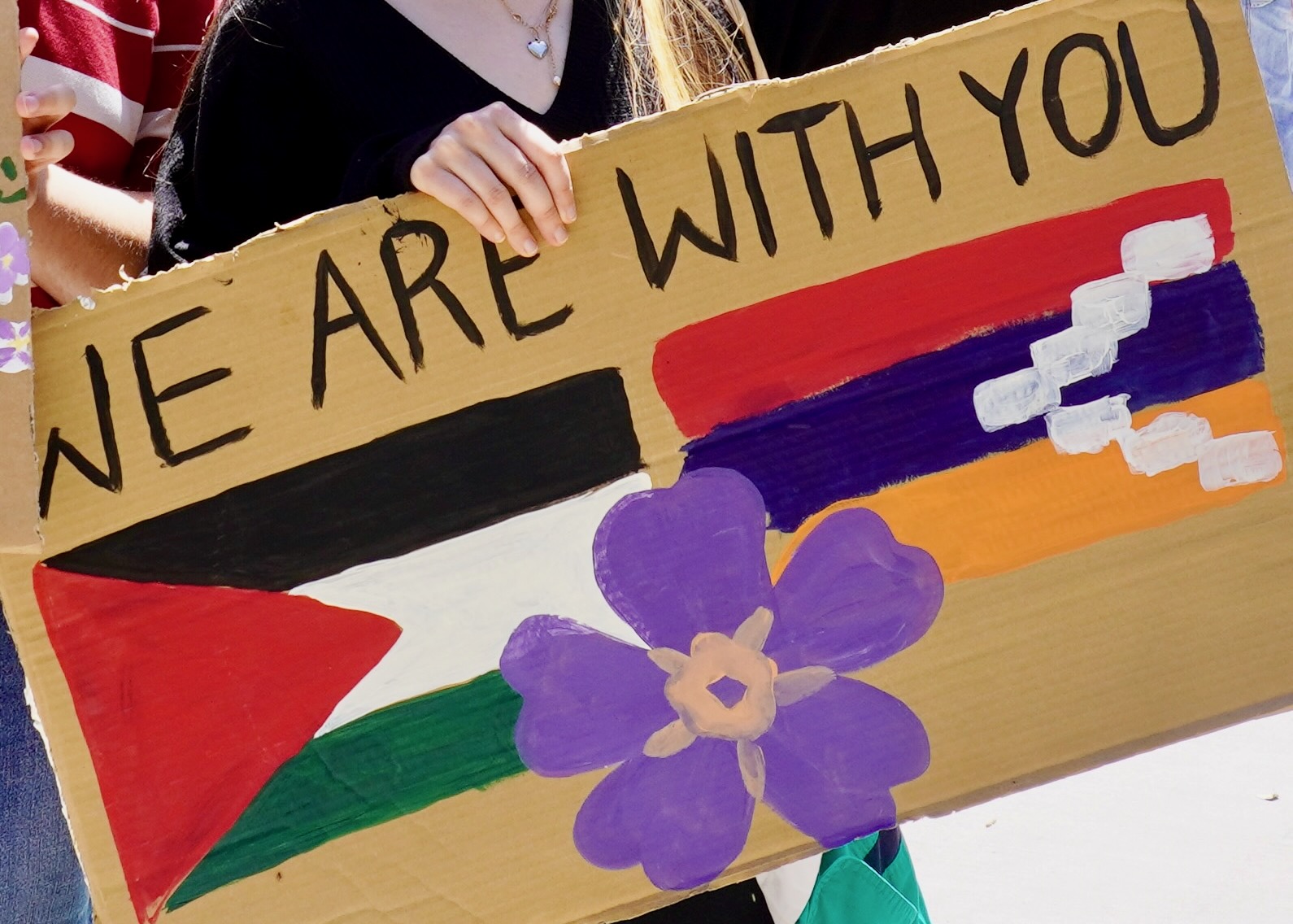
Keith David Watenpaugh, “The Pomegranate and the Orange: A Comparative Framework for Genocide in the Middle East – The Ottoman Armenian Medz Yeghern and the Palestinian al-Nakba,” Journal of Genocide Research, 2026, 14 (3-4).
Jadaliyya (J): What made you write this article?
Keith David Watenpaugh (KDW): A Dirk Moses, my generation’s leading scholar of genocide, asked me to write an essay drawing together the Palestinian and Armenian historical experience of decades of mass atrocity for the Journal of Genocide Research’s special forum, Israel-Palestine: Atrocity Crimes and the Crisis of Holocaust and Genocide Studies.
The special forum has become one of the few spaces available for thoughtful, peer-reviewed scholarship on historical and theoretical issues raised by Israel’s genocide of the Palestinians, and where scholars could use their academic freedom to address this grotesque moral failure in a timely and generative way. Many of my most valued colleagues in field of modern Middle East history, including Mark LeVine, Uğur Ümit Üngör, Yoav Di-Capua, Elyse Semerdjian, and Melanie Schulze-Tanielian have also accepted Dr Moses’ invitation—plenty of others have refused. Acknowledging genocide of the Palestinians—just as in the past acknowledging the genocide of the Armenians—can come with a heavy personal and professional cost; I admire my colleagues who took on this task.
I agreed to write for two other reasons. The first, I dissent from the whole notion that the fields of genocide studies and Holocaust studies are in crisis. These are both robust fields; the only crisis happens when scholars and politicians instrumentalize Holocaust memory—the ongoing cultural and social process by which the Nazi genocide of Europe’s Jews during World War II is remembered, commemorated, and given meaning—to achieve unethical political ends, primarily creating a culture of impunity around Israel’s efforts to destroy the Palestinians as a people. The abuse of Holocaust memory has distorted the field to the degree that an honest appraisal of Israel’s action is difficult, especially when the genocide of the Jews of Europe is used as the exemplar of genocide and not just an example.
By employing the Armenian case of genocide, as I do in this work, I show how we can understand what has happened to the Palestinians is genocide without recourse to the Holocaust; it is my way of signaling a possible way to affirm the value of the field of genocide studies that is intellectually sound and repositions it as a basis for solidarity and repair.
The second reason is that one of the major problems of late-Ottoman and post-Ottoman history in the Arab Levant and Iraq is how the scholarship treats the several genocides and moments of mass atrocity of the periods as disconnected and discrete episodes. In my own thought and writing I have challenged this idea. The field’s reluctance to see the ideological, legal, and social threads running through the genocides of the Armenians, Kurds, Alevis, Assyrians, Yezidis, Palestinians, and others has prosaic origins in how we are trained and have divided up our fields, but is also a function of the academic denial of all of these genocides, and the very real fact of their denial by governments like Turkey, Israel or the United States. Denial has had an impact on funding, job placements, publications, and collegial solidarity. I saw Dr Moses’ invitation to write the first scholarly comparison of the Armenian Medz Yeghern and al-Nakba as a chance to explore how we as a field could confront that legacy of denial.
J: What particular topics, issues, and literatures does the article address?
KDW: The article brings the WWI-era effort by the Ottoman Empire to destroy the indigenous Armenian community of Anatolia into conversation with the Zionist and later State of Israel project to eliminate the Palestinians, beginning in 1948. The article builds a framework for comparing the two based on core elements of the theory of genocide: an intertwined logic of elimination, a common language of dispossession, and shared architecture of erasure.
As I unfold this logic, language, and architecture, I also show the shared nature of Palestinian and Armenian suffering and resistance over the last century and the connection between the two communities’ struggles, in places like Jerusalem and in the diaspora. I explore how the genocide of the Armenians influenced Zionist thought and action in the interwar period, prior to the Holocaust. In the article I was particularly interested in how early leaders of the Yishuv viewed the destruction of the Armenians not as a basis for intercommunal solidarity but instead as evidence for what not to do as they built their state. Equally I discuss how both communities were victims of urbicide (the wholescale destruction of the built environment), memoricide (the erasure of the indigenous from sites of memory and public history), and toponymicide (the renaming of places and cities with names denying past indigenous presence).
J: How does this article connect to and/or depart from your previous work?
KDW: I have written extensively on the history of post-genocide relief in the region, most notably in my 2015 Bread from Stones: The Middle East and the Making of Modern Humanitarianism (University of California Press). Over the last couple years, I have begun to write about genocide in comparison, partly as a way to confront the abuse of Holocaust memory, and partly to bring together ideas I have developed over a generation of teaching one of the United States’ largest comparative genocide courses for the UC Davis Human Rights Studies program. Prior to this article, I published "'Kill the Armenian/Indian; Save the Turk/Man': Carceral Humanitarianism, the Transfer of Children and a Comparative History of Indigenous Genocide" for the Journal of the Society for Armenian Studies. That article put in the same frame contemporaneous carceral humanitarian institutions—American Indian Boarding schools and Ottoman WWI-era orphanages—to explore the transfer of children during genocide. An article I am completing, “The Human Right to charge Genocide: Decolonizing the Genocide Idea and Reclaiming a Powerful Tool of Human Solidarity,” uses the experience of African Americans and Native Americans charging genocide to confront the colonialist and racist origins of the 1948 Convention on the Prevention and Punishment of the Crime of Genocide.
J: What other projects are you working on now?
KDW: Until a few days ago and prior to the US/Israeli war against Iran, I was on sabbatical at the American University of Beirut, where I am working on human rights history of the Syrian Civil War (2011-2024) and a graphic novelization of Karnig Panian’s Goodbye Antoura: A Memoir of the Armenian Genocide for Stanford University Press.
J: Tell us about the article’s title and accompanying image.
KDW: For Armenians, the pomegranate, nur, is an ancient symbol carved into pre-Christian Armenian standing stones, woven into Armenian liturgy, painted with Ararat cochineal in illuminated manuscripts, and stenciled on walls as a protest. In the modern period, it has come to be associated with Armenian loss and sacrifice during the 1915-1922 genocide. It figures prominently in Armenian art and film, most notably in Sergei Parajanov’s 1969 Soviet masterpiece, The Color of Pomegranates, which tells the story of the Medieval poet Sayat-Nova. The shamouti, the indigenous Palestinian sweet orange (rebranded by Israel as the Jaffa Orange), is the most recognized and powerful symbol of post-1948 displacement and economic loss, the subject of resistance and guerilla actions, and a leitmotif in Palestinian literature and art, Ghassan Kanafani’s 1962 short story collection, The Land of Sad Oranges, being the preeminent example.
I took that photo at the Spring 2025 pro-Palestinian protest encampment at my university, UC Davis. I was deeply moved by the image on the poster and, as I write in the article, two Armenian-American graduate students had painted the simple sign—on one side the flag of Palestine dating from the 1936 revolt, and on the other the flag of Nagorno-Karabkah, an Armenian enclave that had fought for its independence thirty years ago and was erased by Azerbaijan in 2020 following a brutal war. At the center is the purple forget-me-not flower that commemorated the centenary of the Armenian Genocide. Among the reasons for bringing genocides into a comparative perspective is to achieve the kind of human solidarity and intuitive understanding of atrocity that the sign represents.
Excerpt from the article (from pages 2 to 5)
After 7 October 2023, many Armenian activists and scholars, who study the destruction of the Ottoman Armenians, took note of the Israeli invocation of the desert as a place for temporary [Palestinian] exile and saw the photographs of families walking down dusty roads carrying their earthly belongings. They found proof in those statements and images of the broader genocidal nature of Israel’s war against the Palestinians because it resembled so closely the words and pictures bound up in the genocide of their ancestors. In this forum, Elyse Semerdjian first drew the parallels between the genocide of the two communities, highlighting the role of human-caused starvation as a tool of atrocity, and placed Azerbaijan’s recent destruction of the Armenian community of Nagorno-Karabakh into the same frame. More so, she asks us to engage in the act of “Comparing memories of extreme violence [to] form a bulwark against genocide denialism and plant the seeds of solidarity within the global struggle against mass violence.” Writer and artist Mashinka Firunts Hakopian juxtaposed photographs of 1915 Anatolia with 2020 Nagorno-Karabagh and 2023 Gaza, to illustrate what she calls the “recursive loop of colonial violence.” More critically, for Semerdjian and Hakopian, the shared fragments impose an ethical burden on descendants of genocide survivors to bring their intuitive and empirical knowledge of how it unfolds and reproduces itself to efforts at justice and prevention. “This form of knowledge also presents a duty,” Hakopian concludes, “a responsibility to speak, to act, to attempt to prevent future recursions from materializing.” Armenians know what being sent to the desert means because they know why the Ottoman state sent their ancestors there: the desert is the site of human non-being. For these scholars and activists, the atrocity that is Gaza in our moment is not held in abstract juxtaposition with what happened to their ancestors as a similar event; rather, it follows the same logic – to paraphrase A. Dirk Moses – unfolding merely against another Middle Eastern people.
The Armenian Genocide is a “canonical genocide” only in the sense that there is broad acceptance that it meets the common definition of the word, as well as the legal standard imposed by the 1948 Convention on the Prevention and Punishment of the Crime of Genocide. In the genealogy of the idea, Raphael Lemkin invoked the deportations and mass killings of 1915–1922 and the failure to bring the perpetrators to justice as an inspiration for his concept. It is recognized as genocide by the United States, France, Germany, and Mexico, among other countries. Outside of Turkey, where denial of the Armenian Genocide is official policy, it is difficult in both academic and political circles to deny it or disregard it as genocide without negative repercussions. Thus, comparing the genocide of the Palestinians with the genocide of the Ottoman Armenians is different than comparing it with either the Holocaust or the settler-colonial genocide of indigenous peoples, which has been more often the case among scholars of genocide, including in this journal.
Analogizing the Palestinian experience with the genocides of the indigenous emphasizes the inextricable link between settler colonialism and genocide and the idea that genocide is not an event but a process; still, that juxtaposition often feels forced in the face of the diversity of the Native American or Australasian experiences and the economic and political similarities of Israeli and Palestinian societies. Similarly, if any genocide is compared with another genocide at all, it is usually with the Holocaust. I see it is a default position caused by the fact that the history of the Holocaust is known in a way that the histories of other genocides are not. This is just like the Holocaust can be more of a political claim calculated to demand attention and justice that would not be the same were one to invoke another “canonical” genocide, say, Rwanda or Bosnia.
For the genocide of the Palestinians, the irreducible fact of comparison with the Holocaust is that the perpetrator community is descended from survivors of the Holocaust, and the Holocaust sits at the center of Israel’s raison d’état. In this instance, the act of comparison becomes the issue rather than the comparison’s factual substance, even to the point that doing so can be labelled antisemitism, inviting legal or administrative sanction. In both cases, what I call the categorical distance, meaning the degree of intellectual, historical, and geographical “stretch” one must make to draw them into comparison, is so great as to lessen the comparison’s overall analytical usefulness. In policy circles and public discourse, that same stretch makes the larger claim of genocide less persuasive.
In response to the problems of categorical distance and embracing the idea of solidarity-by-analogy, my contribution to this journal’s forum takes the interlaced history of atrocity and exile as a starting point and argues in part, that the trajectory of the Medz Yeghern (Great Catastrophe) helps us understand how Gaza is not an aberration in the history of Israel/Palestine and follows a pattern or logic with origins in the 1940s al-Nakba (Catastrophe), the word used to describe the massacres and forced migration of Palestinians at the formation of the State of Israel. When these are compared, the intuitive...recognition of genocide by scholars like Semerdjian, Hakopian, and others resolves in such a way as to indicate that Palestinians are only a few steps behind Armenians on the way to complete erasure in their homeland.
More than an exercise in the shared and the different, this contribution is also a call to better understand the historical strands that connect the Medz Yeghern and al-Nakba and indeed those that run through other moments of twentieth and twenty-first century mass violence in the Middle East, including the Seyfo, meaning the destruction of the Ottoman Assyrians alongside the Armenians; the 1923 Mübadele/Antallagí or the League of Nations-sponsored exchange of populations between Greece and Turkey; the 1937 Dersim Tertelê, the Zazaki word that connotes extermination and deportation of Anatolian Alevis; the al-Anfal, the 1980s Iraqi Baathist genocide of Kurds and Assyrians; the Seventy-fourth Ferman, the 2014 genocide of the Yazidi by militias of the Islamic State in Iraq and the Levant and the mass atrocities, chemical warfare and genocide of the Syrian civil war (2011-2024). Drawing these threads together allows for the understanding of those episodes less as discrete and exceptional and more a product of a shared Ottoman past, encounters with multiple kinds of settlers and colonialisms, including Ottoman and Arab, and the brutal realities of the ethno-nationalist and authoritarian ideologies that emerged as the Ottoman state began to collapse after 1909...
Beyond placing al-Nakba into the larger history of atrocity in the post-Ottoman Middle East alongside the Medz Yeghern, this framework can address three other problems in the conceptualization of generations of violence against Palestinians. The first is that it confronts a key lawfare and diplomatic narrative strategy of the Israeli state – and indeed of other genocidal states – to “exceptionalize” the overarching legal, military, and social context of their policies to evade accountability under international law or liberal democratic norms. Second, what I am presenting here is a comparative analytic framework for the study of genocide against the Palestinians that is free from the burden of Holocaust memory, while at the same time, connecting that study with research on generations of atrocity against Armenians. This places a developed and theoretically informed body of scholarship – born of struggle against denial – into analytical play. Third, while introducing the theory and vocabulary of the Australasian and Western Hemispheric experiences of genocide has been a good strategy, and indeed I have found the Native American Studies concept of survivance especially useful in describing post-genocide diaspora Armenian life and culture, those comparisons may be too distant in time and space to be effective and consequently too easy to dismiss as polemical. The Medz Yeghern overlaps geographically, legally, and politically with al-Nakba as both genocides unfolded within a deeper history of colonialism and violence in the Middle East. Thinking about them together is a first step towards a theory of genocide in the Middle East that does not draw on the Holocaust as a central referent but rather emerges from within a shared past of atrocity, displacement, diaspora, and trauma. […]
Figure 1. Student activists holding signs in solidarity with Palestinians during a 1 May 2024 rally at the University of California, Davis. Photo caption: The flag on the left is the flag of Palestine, on the right is the flag of the former Armenian Republic of Nagorno-Karabakh, binding them together is the forget-me-note emblem commemorating the Armenian Genocide of 1915–1922. Photo credit: author.