[This piece is the first part in a three-part series on agrarian erasure in southern Lebanon. Click to read Part 2 and Part 3 of this series. The authors completed this research in early 2026, weeks before Israeli forces pushed back into southern Lebanon. It appears in the three weekly parts.]
Since then, much of what is described in these pages has come under renewed attack. Villages have emptied and refilled and emptied again. Fields have burned and orchards have been uprooted. Roads, irrigation networks, and homes have been damaged or destroyed. One of the interviewees who generously shared his time, memories, and reflections with us during this research was later killed in an Israeli airstrike.
Yet this essay is not primarily about war. It is about the ground upon which war repeatedly lands.
Since October 2023, Israel has waged war across the region, on Gaza, and alongside it, on Lebanon. In southern Lebanon, the bombardment has not stopped since. On March 2, 2026 it escalated into a full ground assault: Israeli forces pushed back into southern Lebanon as they had in 1978, 1982, 1993, 1996, 2006 and in 2024, and as they had threatened across every year between, in the incursions and daily overflights that never truly let up. The farmers in these pages have measured their whole lives against this occupation.
The assault has fallen the hardest on the south. Of all the dead and wounded the Lebanese Health Ministry has counted nationwide, 84 percent, some 13,278 people, were in Nabatieh and the South, the two governorates that make up Jabal Amel. As of mid-June, at least 3,912 people have been killed across the country, 3,291 from southern Lebanon alone.
The war has also devastated the agricultural landscape itself. In June 2026, a joint assessment conducted by Lebanon's National Council for Scientific Research (CNRS-L) and the Ministry of Agriculture, in coordination with UNDP, FAO, and WFP, found that more than 56.320 hectares of agricultural production areas had been affected, largely in southern Lebanon[1]. The assessment estimated $41.2 million in direct damages, 1.380 hectares requiring rehabilitation, and production losses valued at more than $530.5 million. These figures offer a glimpse of the scale of widespread destruction of orchards, agricultural infrastructure, and productive land, confirming that the war is being fought not only against people, but against the conditions that make agrarian life possible.
A ceasefire nominally took hold on April 16. In the two months since, more than 1,400 have been killed, most of them, again, in the south. Israeli forces remain inside the country, holding their line up to the Litani river, which is to say across the very orchards and tobacco terraces this essay walks through. Parts of the ground studied here are now occupied.
The research that follows traces something slower than war: the substitution of one crop for another across Jabal Amel, citrus giving way to banana and now avocado, alongside the transformation of the forms of life rooted in those landscaped. That violence that burns and destroys agricultural fields and the forces that reorganize them are not separate stories. They unfold in the same places, upon the same communities, and increasingly through the same logics of dispossession.
What follows begins with the ground itself, and with the long history of how it was made to change.
A History of What Was Planted
Historians go back to the turbulent years between 1840 and 1860 to showcase how the idea of Lebanon itself is one produced by the entanglements of (colonial) discursive and political practices. The Culture of Sectarianism by Ussama Makdisi narrates these factors, beginning with the cumulative impact of the Egyptian invasion led by Ibrahim Pasha (1831-1840), the consequent fall of the Shihab dynasty, the Ottoman reforms (Tanzimat), and the gradual intervention of European powers in the local affairs of Mount Lebanon, all opened the region to a new political order based on religious differentiation and colonial rule of the French and the British. Accordingly, Lebanon was born out of these competing narratives. More specifically, the 1842 proposal of the double Qaimaqamiyya, the 1860 proposal of the Mutasarifiyya, the 1920 Maronite-French proposal of Greater Lebanon, the Lebanese state was a colonial attempt to resolve the sectarian problems of Mount Lebanon between the Druzes and the Maronites.
Fast forward to 1943, Lebanon was made independent as “a product of the Franco-British colonial partition of the Middle East.”[2] However, Jabal ‘Ameli fellaheen, workers, and Shiite leaders (among many other groups)[3] expressed dissent and resistance to the Lebanese national project in the 1930s. Ultimately, Jabal ‘Amel (and other regions) was forcibly annexed to become a rural and peripheral hinterland that worked to pacify Faisal’s project in Damascus, enable extraction by annexing tobacco production after the decline of silk, taking over natural water reserves, among other (colonial) geopolitical and economic reasons for the creation of a modernized capitalist nation-state.
One hundred years later, Jabal ‘Amel continues to face state (racialized) neglect, sectarian-corporation exploitation and extraction, and subject to “Israeli” settler colonial encroachments, wars, and daily Israeli bombardments (2023-2026). Navigating such a terrain is sensitive and poses serious ethical questions and limits. Yet, it is precisely this sensitivity which made this research incumbent upon us as social scientists, especially our positions as insiders-outsiders. In other words, we are not here to tell a tale, neither ours nor theirs. Social scientists must remember that the risk of (actual) violence while researching and writing is always present. Nonetheless, we write to begin a conversation through listening, hoping we honor the sorrows (and horizons) we are met with in the field.
As the second part of this series focuses on our field-based exploratory study conducted by two Southern Lebanese social science researchers between late 2025 and early 2026 across the Jabal ‘Amel geography, this first part draws a brief history from combining quantitative analysis of open-source FAOSTAT data on crop production, imports, and exports (1961-2024). The quantitative crop trend analysis centers on citrus (lemon and orange), bananas, and avocado because these are specifically grown in Jabal ‘Amel and subject to local, regional, and global supply and demand. Crucial to explicate here are our limitations. Publicly available datasets (including FAOSTAT) do not provide crop-level production and export data disaggregated by sub-regions within Lebanon. As a result, national-level figures are used as proxies to trace long-term structural shifts affecting crops known to be concentrated in the South. This approach prioritizes analytical coherence over exhaustive crop coverage, while acknowledging the limits of sub-regional disaggregation. While South Lebanon’s agricultural production includes olives, custard apple and other significant non-edible crops like tobacco, they are excluded from the analysis presented for both analytical and empirical reasons.
From Citrus to Avocado, a History of Crop Substitution in Jabal ‘Amel
After the 1840s, citriculture became a prosperous industry for Palestine, especially for the port city of Yafa. Interwoven with its social, economic, and urban landscapes, citrus fruits (mainly yaffawi oranges) became one of the national symbols of Palestine. Between 1922 and 1930, citrus accounted for 54% of Palestine’s total exports.[4] Yet, after a series of proto-Zionist land grabs and encroachments on Palestinian lands up to the Zionist extermination project of the 1948 Nakba, Palestinians were forced out of their homelands, many leaving behind citrus orchards and olive groves.
As Palestinians arrived and settled in Lebanon, especially in Tyre, the citriculture industry in Jabal ‘Amel boomed. From the 1950s onwards, citrus crops (oranges and lemons) dominated production for much of the period, yet their export share declined unevenly over time. Citrus expansion coincided with post-independence state-building and agrarian modernization efforts. In 1954, the Lebanese state established the Litani River Authority to harness the Litani for hydroelectricity and irrigation, laying the foundation for the South Lebanon Irrigation Project and the broader Canal 900 scheme that gradually expanded irrigated agriculture in the South and Beqaa. In parallel, the Green Project (al-Mashrou‘ al-Akhdar), launched in 1963, subsidized land reclamation, terracing, well-digging, and irrigation infrastructure for farmers. Together, these initiatives alongside Palestinian refugee labour and expertise, facilitated the intensification of coastal citriculture and consolidated citrus as both an economic pillar and a territorial strategy in Jabal ‘Amel during the 1950s and 1960s.
When aggregated by production versus export composition period, Figure 1 below illustrates a transition in Lebanon’s agriculture from citrus-dominated systems in the 1960-80s, to banana expansion in the 1990s–2000s, culminating in a rapid avocado-led restructuring after 2015. Figure 1 juxtaposes the changing composition of agricultural production (right) and exports (left) across major crops in Lebanon from 1961 to 2024.
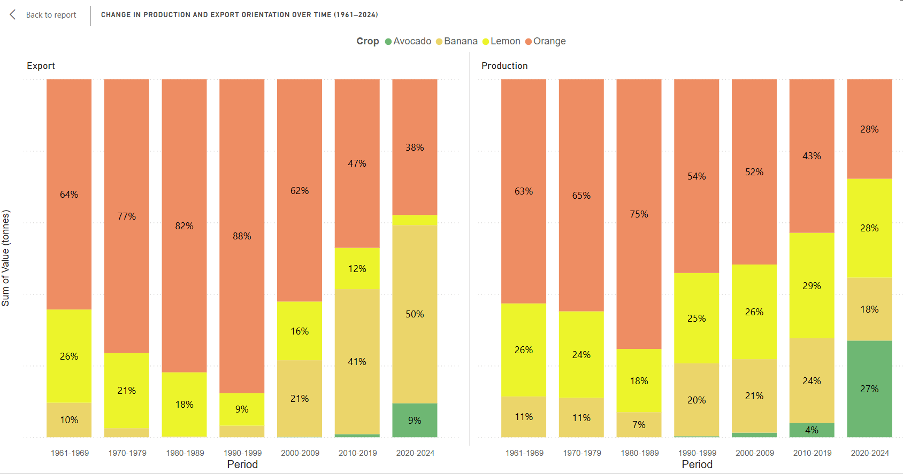
Figure 1. Production versus export composition across major crops in Jabal ‘Amel in Lebanon, 1961-2024. Source: FAOSTAT, Food and Agriculture Organization of the United Nations (FAO). Authors’ visualization based on FAOSTAT production data.
Bananas are introduced here as part of the comprehensive account of Lebanon’s crop history, and more importantly as an example of the potential trajectory of avocados. A local interview with a former agricultural trader active in banana and citrus markets from the 1980s through the early 2000s situates this shift earlier, tracing banana cultivation in Damour back to the 1960s as a locally driven adaptation to domestic demand, shorter production cycles, and mounting wartime economic uncertainty. Banana cultivation emerged through locally driven adaptation. This distinction does not rest on crop nativity or on monoculture itself, but on the mode through which restructuring unfolds. In the case of banana expansion, the change emerges and is negotiated from within, whereas avocados are externally parachuted, requiring coaxed behavior change, and financed for export markets to meet a global thirst for this value chain.
Oral histories and interviews suggest that this transition from citrus to banana was supported by the dispersal of agricultural know-how from Damour-based farmers further into South Lebanon. From the mid 1990s onward, particularly after 1996, the time series shows a clear reversal where exports began to overtake imports and continued to rise gradually into the late 1990s and early 2000s. As production volumes increased, bananas shifted from an imported crop to an export-oriented one, serving regional markets, mainly Syria and more recently Iraq. After 2000, export volumes rose exponentially with further banana cultivation and a broader replacement of citrus with banana that at the time offered higher and more reliable export values.
Bananas emerged as an intermediary crop, expanding during the civil war and post-war decades as a locally driven adaptation to domestic demand, shorter production cycles, and regional trade opportunities. Figure 2 reveals that banana imports and exports in Lebanon are closely entangled with periods of agrarian transition, conflict, and post-war restructuring. A pronounced banana import peak appeared in 1977, a time when much of South Lebanon was oriented toward citrus, particularly lemons and oranges, while domestic banana production was still limited to 20 km south of Beirut in Damour. Additionally, this first banana import spike during the period between 1961-2024 coincides with the early years of the civil war (1975-1991), marked by infrastructure breakdown, displacement, widening access gaps between East and West Beirut, and heightened insecurity (including porous borders with Syria), all of which disrupted internal supply chains resulting in greater reliance on imports to meet local demand for bananas. Imports fell sharply in 1978, before rising again intermittently in the early to late 1980s reflecting unstable conditions of war and uneven domestic production capacity. The highest import peak in 1991 coincided with the end of the civil war, which aligned with a structural agrarian shift in decisive banana cultivation that replaced citrus on the Southern Lebanese coast.
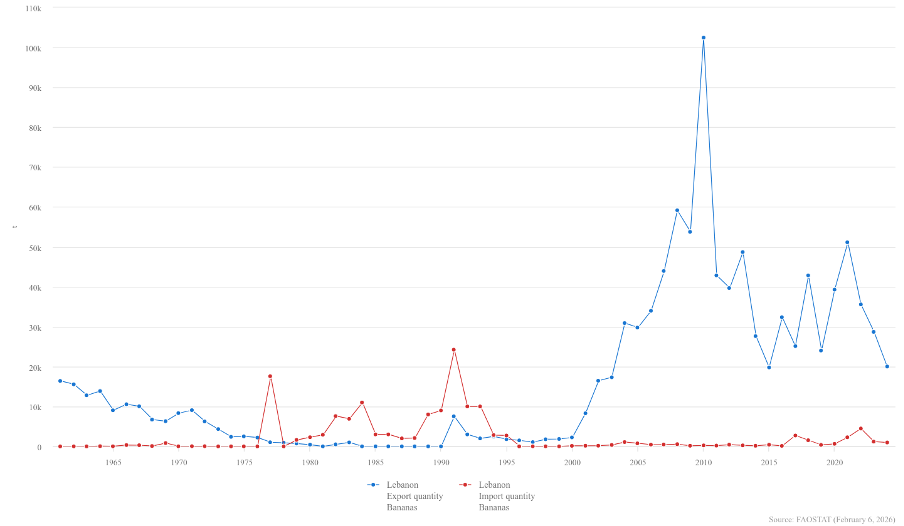
Figure 2. Time Series of Banana Import and Export Quantity in Lebanon (1961-2024). Source: FAOSTAT, Food and Agriculture Organization of the United Nations (FAO).
From the 1960s onward, banana cultivation expanded gradually along the Tyre–Qana coastal strip, and by the 1990s and 2000s, banana monoculture had largely replaced citrus. The banana shift provides a historical precedent of a structural pattern where agrarian space is reorganized around a single cash crop with concentrated risk. The current avocado hype follows a similar substitution logic, except more explicitly directed by donor-mediated conditions and global export markets. Today, as you walk through orchards in Jabal ‘Amel, particularly along its eastern coastline, citrus trees are disappearing. Not only replaced by bananas, but by a brand new variety of tropical trees, chief among them avocados, a global consumer trend that has helped dry up the ground waters from Chile and Mexico to Morocco, and is set to do the same elsewhere.
Avocados are export-oriented from the outset and assume a disproportionate share of exports relative to their production footprint (see Figure 1). Juxtaposed side by side, the production and export quantities point to a consolidation of export-oriented monoculture and a reallocation of agrarian space and resources. Anecdotal evidence from interviews with several farmers and land owners in the region made it clear that 30-40 year old citrus orchards were and are being razed to grow more lucrative crops that promise export value, namely bananas in earlier decades and avocado more recently. Beyond the export value avocado brings, interviewees pointed to additional reasons including citrus crops requiring heavier labour and inputs of pesticides and herbicides (which are imported and costly).
The shift from bulldozing citrus orchards to cultivating avocados is one case among many that make visible the perverted logic of local-global imperial designs of developmentalism and humanitarianism in the agricultural sector. In 2018, Lebanon had roughly 40,000 avocado trees; by 2024, that number skyrocketed to one million. A local value chain expert with a long history of supporting avocado value chains estimated that local consumption could absorb a maximum of 5000-7000 tonnes annually, meaning that as figure 3 below shows the remainder of Lebanon’s rapid surge in avocado production is structurally dependent on regional export markets (KSA, Jordan, Egypt, UAE, Iraq etc), with Europe remaining largely aspirational rather than realized.
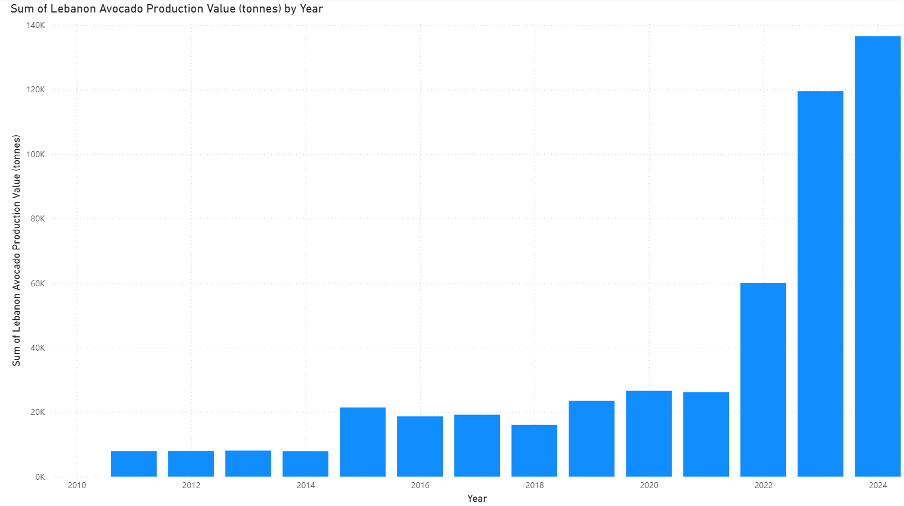
Figure 3. Lebanon avocado production (tonnes), 2011-2024. Source: FAOSTAT, Food and Agriculture Organization of the United Nations (FAO). Authors’ visualization based on FAOSTAT production data.
Figure 4 traces the rapid expansion of avocado production over the past two decades within a broader substitution of Lebanon’s perennial crop landscape. From 2011-2016, citrus (oranges and lemons) remain dominant, with bananas occupying significant though fluctuating values. After 2016, citrus values declined, particularly oranges, and never recovered to earlier levels. Similarly after 2018, bananas experience volatility and then contraction. Avocados, in contrast, display sustained and then exponential growth, especially from 2021 onward, with a dramatic leap between 2022-2024. The acceleration of avocado cultivation occurs alongside the contraction of both citrus and banana, indicating substitution rather than value added diversification. Olives are included in this figure to clarify the distinctiveness of the avocado rise. Although olive production has also expanded in recent years, coinciding with South Lebanon’s international recognition for high-quality olive oil, this growth reflects value upgrading within a historically embedded Mediterranean crop. Avocado and olive cultivation trends may appear superficially similar in volume, yet they operate within fundamentally different temporal and ecological systems.
While Figure 4 illustrates a rapid avocado expansion, FAO’s 2024 Emergency Assessment indicates that this happened within a landscape of profound agrarian loss. Southern Lebanon and the Beqaa Valley, with Jabal ‘Amel among the most severely affected zones, incurred $118 million in agricultural damages and $586 million in losses. Citrus and banana orchards, historically embedded in Jabal ‘Amel, account for nearly $107 million in combined damages and losses, with over 2,154 hectares of orchards burned in Nabatieh and the South governorates.
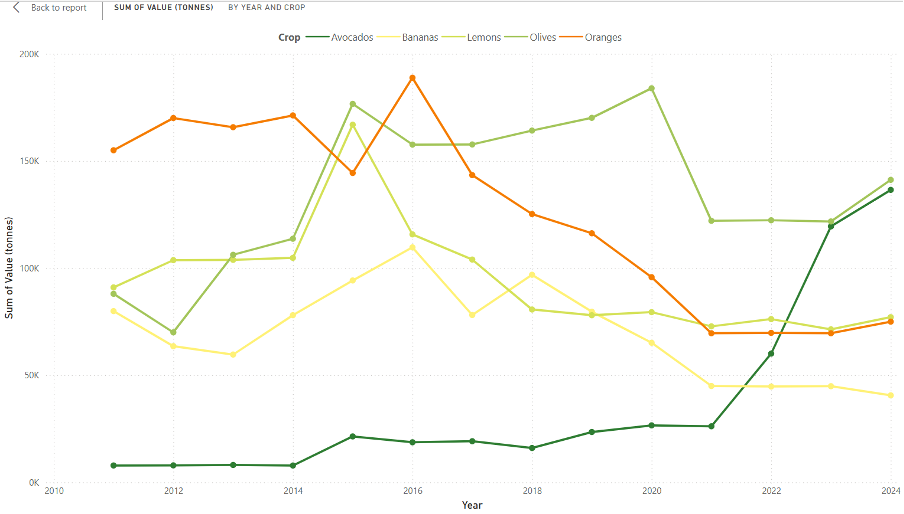
Figure 4. Comparative Production Trends of Key Crops in Lebanon, 2011–2024 (Tonnes). Source: FAOSTAT, Food and Agriculture Organization of the United Nations (FAO). Authors’ visualization based on FAOSTAT production data.
Figure 5 expands the frame beyond Lebanon to the Eastern Mediterranean, where Israel and Lebanon emerge as the region’s most significant avocado producers between 1994 and 2024. The spatial clustering of production across a militarized border reveals that export-oriented perennial restructuring is unfolding within one of the most geopolitically volatile landscapes in the region. Long-term orchard investments, dependent on stable trade corridors and certification regimes, are being consolidated in territories marked by recurrent conflict and infrastructural disruption. The juxtaposition of high-value perennial export crops with a heavily militarized frontier underscores the paradox at the heart of the current agrarian restructuring and reflects a broader logic in which crisis and export specialization co-exist and mutually reproduce one another.
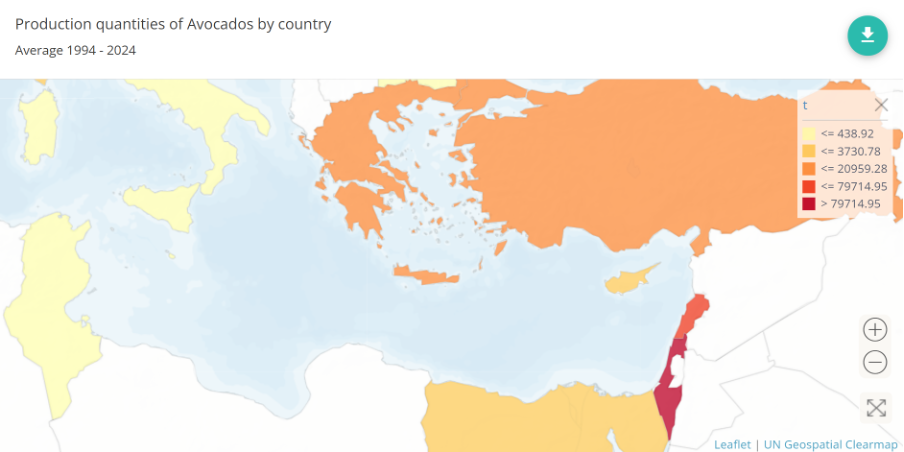
Figure 5. Production quantities (tonnes) of Avocados by country in the Eastern Mediterranean. Source: FAOSTAT, Food and Agriculture Organization of the United Nations (FAO).
As we began tracing the emergence and surge of avocado farming, we found that the story (unironically) begins with USAID. In the broader humanitarian context, Lebanon’s post-war agricultural sector has been shaped by Euro-American interventions channeled through organizations like the UN FAO, UNDP, and the World Bank. Since 1992, 263 projects—worth a combined $285 million, €5.7 million, and 167 billion Lebanese pounds (at an exchange rate of 1,500 LBP to the dollar)—have been implemented across Lebanon, a scale that far exceeds national emergency allocations in the public education sector. For comparison, Lebanon’s 2024 Education Emergency Cost Response Plan (EECRP), finalized in October 2024 in the midst of Israel’s war against Lebanon, was estimated at $25 million as the minimum required to stabilize public education, of which only $1.5 million was secured as of early 2025 (Asfari Institute, 2025).
USAID’s Lebanon Industry Value Chain Development (LIVCD) project, which ran from 2012 to 2019 with $46.2 million in funding, was a project framed as a means to “develop inclusive and competitive value chains” as they aim to raise the “income for rural populations”. A first of its kind tackling avocado value chain, the LIVCD project trained 964 avocado growers, expanded cultivated land to 700 hectares between 2012 and 2016, and doubled yields from 500 kg to 1 ton per dunam. USAID proudly highlights their “success” in facilitating Lebanon’s first avocado exports to Europe in 2017 and new trade channels to Jordan. More tellingly, it disbursed $4.01 million in loans to just 24 avocado growers.
These efforts were continued and amplified by local and international actors, from the René Moawad Foundation to the Dutch Centre for the Promotion of Imports from Developing Countries. Moreover, the Lebanese government, through a combination of privatization and neoliberalization of the economy rubber stamped these extractive humanitarian-industrial projects. In 2017, the Council of Ministers commissioned a $1.4 million study to draft a (neoliberal) economic vision, later outsourced by the US-based consulting firm McKinsey & Company. One of its major agricultural recommendations was avocados (alongside cannabis) as priority crops to boost the Lebanese economy.
The authors have traced what changed on the ground. The next part turns to how these transformations entered everyday life itself, how agrarian time is reorganized, how expertise comes to govern farming, and how donor-led interventions help produce the figure of the ‘modern farmer’. It begins with tracing how the explosive rise of avocados emerges from a broader nexus of international development agendas, financial engineering, and geopolitical restructuring; and ends with our encounter with an old man and his tobacco, and the hours he no longer keeps.
[1] National Council for Scientific Research - Lebanon (CNRS-L), Key Findings from the Agricultural Damage and Loss Assessment of War-Affected Agricultural Areas in South Lebanon, June 19, 2026, https://cnrs.edu.lb/key-findings-from-the-agricultural-damage-and-loss-assessment-of-war-affected-agricultural-areas-in-south-lebanon/
[2] Traboulsi, F. (2012, p.75). A history of modern Lebanon. Pluto Press.
[3] For a history of Jabal ‘Amali uprisings, See Abisaab, M. (2009). Shiite peasants and a new nation in colonial Lebanon: the Intifada of Bint Jubayl, 1936.
[4] For a history of citriculture in Jabal Amel, see Makkawi, M. (2024). Ruderal refugeehood: Agriculture, urbanism, and Palestine in southern Lebanon (Doctoral dissertation, New York University).