From Spain to Syria, all countries along the northern coast of the Mediterranean were rocked by wildfires, deaths, and evacuations this summer. The Balkans also suffered. The fires resulted in record high emissions, heating the globe further and preparing the way for more intense calamities.
These disasters are rolling over the entire region like fate – a divine force we can do nothing to influence. Both expert-dominated accounts and sensational public debates reinforce a sense of hopelessness, desperation, and inevitability, even if this is not their intention.
Over the last few years, internationally respected outlets have increasingly pointed out the central role of human-induced climate change in the spread of wildfires, along with another set of human-based factors. But “human-caused” is a factually inaccurate and ethically unfortunate term. First, it fails to notice that capitalism has so thoroughly restructured nature that there is at least a trace of human impact in most disasters today. Second, the term “human-caused” serves to obscure the power inequalities between “humans” – especially between those who contribute the most to (e.g. companies, governments) and those who suffer the most from (e.g. peasants, natives) wildfires. Broad references to “climate change” also create the same effect: the obscuring of global geographical inequalities in the production of carbon and other harmful materials.
The current dominant framing of the issue has solid implications for action too. Defining the culprit as an undifferentiated, universal “human” collectivity leads us to expect experts to manage and tame this beast through global legislation. The power-blind legislation they come up with, even though highly inadequate and mostly subservient to wealthy countries’ interests, is ironically blocked or further dampened by the elite of those countries. This sociologically blind process shifts the discourse to the sins of the (again undifferentiated) “individual”: the consumers with their carbon footprints, the arsonists with their petty calculations, the negligent campers or peasants who let their fires get out of control.
Even some environmental organizations emphasize individual responsibility. They not only blame random individuals for starting fires, but also expect people to warn companies (through individual, non-organized action) in the rare instances that they notice institutional responsibility. The enormity of the problem, the unwillingness of power holders to deal with it, and the ridiculously small actions non-elite people are asked to take create the sense that nothing will change. We are helpless.
Each summer, a more public, less expert-dominated blame game also flares up. More prominent on social media and national newspapers and television rather than the “respectable” global outlets, the blame game underemphasizes global warming and draws attention to more tangible actors. Even though this game creates possibilities for relatively more politicized discussion and intervention, it frequently takes a reductionist and occasionally conspiratorial turn. It culminates in blurring the structural and comprehensive nature of the crisis, and in blunting and twisting society’s response. It could help break the illusion of helplessness, which it instead exacerbates.
In sum, both the expert-oriented global coverage and the more sensational national debate kill the possibility of organized and effective social and political action.
Power Lines and the Privatization of Energy
There are, luckily, dynamics that could break this deadlock.
This summer, one factor has claimed center stage, especially in Turkey: the increasing centrality of energy companies in starting fires. Negligent private companies’ downed and decrepit power lines initiate major fires across the world, including the Global North. The causal links between powerlines and wildfires are complex and they cannot be reduced to a single factor such as the nature of ownership and control. Nevertheless, renewing and maintaining powerlines is expensive and (in the absence of public pressures) private companies have no incentive to watch out for their costs to society and nature. In other words, the increasingly for-profit nature of energy companies does not singlehandedly “create” but certainly aggravates this problem.
Throughout western Turkey, private companies’ powerlines appear to have ignited devastating wildfires this summer. Whereas powerline-induced fires accounted for roughly 5% of burnt areas in 2010, the rate is now at a whopping 25%. Much of electricity production and circulation has been privatized, and consequently left without care and maintenance, in the same timeframe. The beneficiaries of this privatization spree refrain from all kinds of public duties, including paying adequate taxes. They nevertheless receive ample public subsidies.
None of this implies that companies on their own are the sole culprits. The system, as a whole, is the ultimate cause. The profit drive of these companies is only a piece, albeit a major one, of a broader equation. A non-exhaustive list includes unbridled construction into forest areas; the post-1980s downgrading of the public sector, including disaster preparedness; and global warming, itself a result of the unbridled push for profit.
Nevertheless, the visible and politically targetable companies give an opportunity to society to begin to address this wider set of issues, and thereby erode the sense of helplessness. If a targetable culprit is named in a non-conspiratorial way and society begins to self-organize to undermine it or at least hold it responsible, this step could kickstart a process whereby people learn to cooperate with each other to bring under control forces that otherwise seem impersonal and beyond reach.
What are the chances that such a process could take off the ground? What are the existing political and social responses to this complex, global picture of intensifying wildfires?
Common Tropes and Practices: Erdoğanism, Volunteerism, Conspiratorialism
This summer, mainstream media in Turkey shortly acknowledged the centrality of energy companies and privatization to the picture but swiftly moved to other culprits. Reverting to the usual suspects also brought with it insistence on the accustomed solutions.
For the opposition, the main culprit is abundantly clear and requires no discussion: Erdoğan’s visionless government, which has led to the plundering of public resources and lack of preparation for any disaster. Erdoğan, by contrast, emphasizes the need for municipal governance, which the opposition reads as a deflection of responsibility. Most of public debate thereby reduces the wildfires to an issue of Erdoğanism. According to the opposition, once the Master Villain is removed, there will naturally be less fires. From the Erdoğanist standpoint, the AKP needs to grab municipal power from the opposition to slow down the devastation.
To the degree that the government and the mainstream opposition grant that a simple replacement of those in national or local power will not completely take care of the problem, they both uphold volunteering as a supreme value to deal with these hard times. During peak fire season, the pro-government daily Hürriyet dedicated the front page of its Aegean supplement to a town that established volunteer units that monitor the forests around the clock.
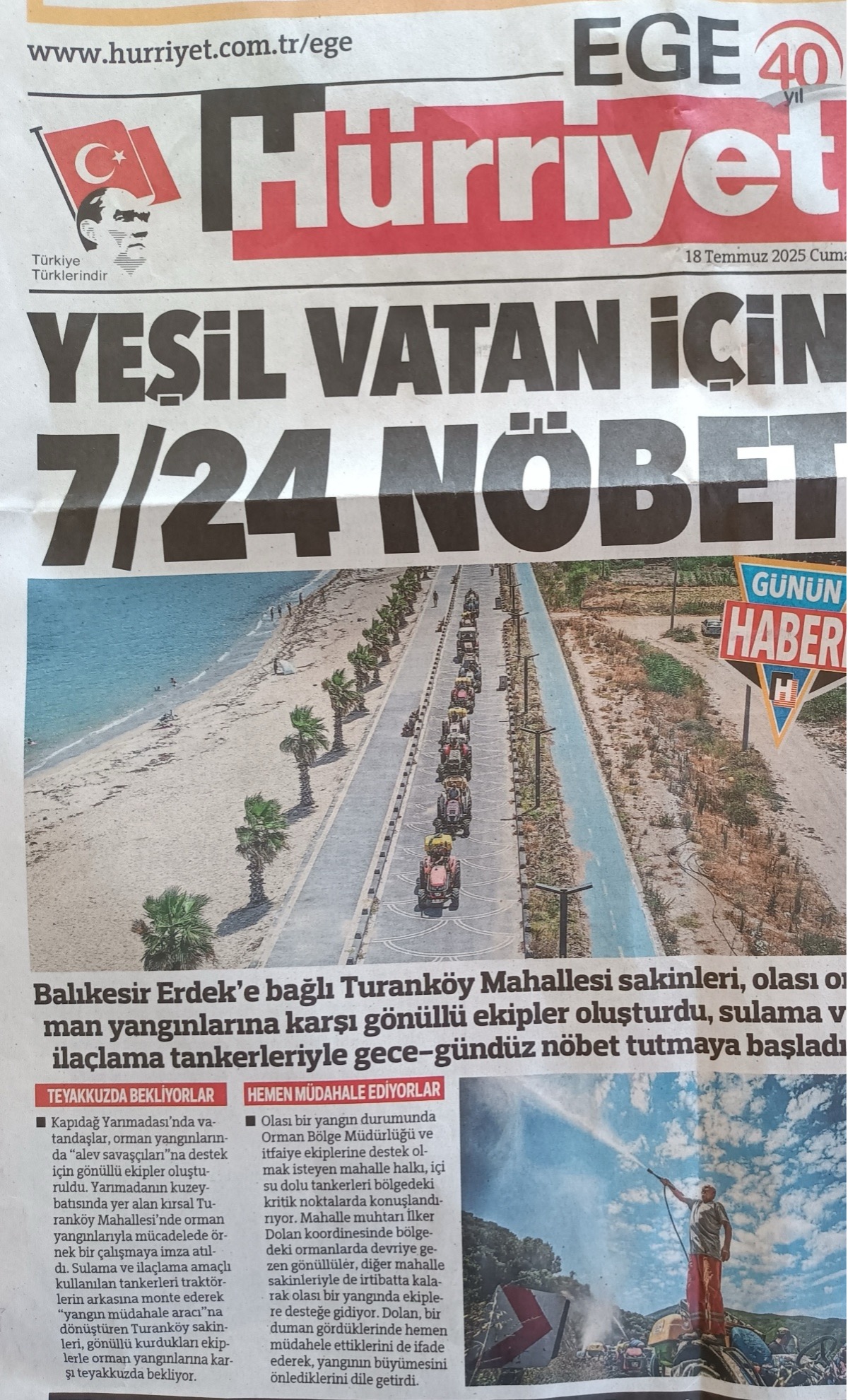
Volunteerism can indeed be a starting point for society to shake off its sense of helplessness. Even throwing a bucket of water appears more noble than turning a blind eye or watching the fires on television and shedding tears. However, volunteering has serious limitations, as seen in a fire in Eskişehir (central Anatolia), where five volunteers perished along several firefighters. Volunteers have neither the necessary equipment, nor the training. The opposition claims this to be the case even for workers, and the situation is much more dangerous when it comes to volunteers. As I will discuss below, it is not that volunteerism is entirely misguided, but its parameters need to be rethought. Indeed, there are actors on the ground who are currently transforming their own volunteering practices in a productive way.
The government resorts to Islamic tropes to speak to criticisms and deal with the difficulties. The fatalities are constructed as martyrs (“şehit”). The Directorate of Religious Affairs organizes prayers against fires, further fueling the opposition’s charges of religious obscurantism and deflection. Just like volunteerism, though, putting prayers into the picture is not in itself a detrimental digression. A shared religious reflection on wildfires could be an opportunity to rethink human beings’ increasingly rapacious relationship with nature. But in the hands of a religious regime that actually intensifies the system’s inimical stance to nature, prayers become yet another tool to reinforce helplessness by fostering the sense that disasters are a matter between God and his subjects.
The government and the mainstream opposition share two additional, much more pernicious, lines of politicization: ethnic and conspiratorial. There is widespread belief that Kurdish activists (or other nefarious, anti-national, treacherous forces) start the worst of the fires. Anti-Kurdish conspiracy theories predominate online.
This type of conspiratorial thinking is not unique to the Turkish or Middle Eastern context, although it is widespread there. As the far right gathers strength across the globe, disasters are increasingly blamed on immigrants and minorities. For instance, in neighboring Greece, many mainstream media accounts blame non-European immigrants for wildfires without any proof. Conspiratorial thinking about wildfires is also widespread in the United States. Even though the sense of righteous indignation that comes with naming a scapegoat feels temporarily empowering, it only feeds into the overall mood of helplessness.
Public Responses in a Mediterranean Region
Conspiracy theories appear ignorant, stupid, mean, and heartless. Yet, their circulation and internalization are parts of quite complex social processes, as shown by the information I collected for a research project. I have been travelling across southwestern Turkey and talking to its residents about the fires and connected issues during the past few years. A gradual transformation is in place: not only is there more sensitivity to ecological issues, but disparate “folk” analyses have been converging on a few, relatively “structural” themes, despite the ongoing prevalence of conspiracy theories.
Each summer, I hear more talk of collusion between politicians (of all colors) and major companies and their neglect of both natural and social needs as the root cause of the problem. Each summer, I also hear more people saying that they need to unite and remove these actors. Even though they are still a small minority, for a growing number of people this is not only talk.
More individuals, including those who have stayed away from activism throughout their lives, have started to participate in challenges against power holders. A gradual awakening has even blurred the boundaries between volunteerism and activism. For instance, volunteers who initially got together to help firefighters during the disasters of previous years have become aware of the government’s and allied companies’ responsibility and subsequently found themselves mobilizing against capital’s incursion into nature – not just during disasters, but as a “natural” extension of their environmental sensibilities and practices. If volunteerism can be re-politicized in such ways at a greater scale, it would not only contribute to more awareness of structural forces but also help break the sense of helplessness.
Despite all these positive changes, as fires spread during the summer of 2025, I also observed a strong tendency to sideline structural explanations and resort to conspiracy theories. Even people who followed the more ecologically and socially sensitive media sources found frequent refuge in blaming saboteurs. As emotions got intense, people abandoned complex thinking and wanted to condense all their anger and lash out at single targets. Tellingly, the energy companies appeared too cold and impersonal, and didn’t serve them well as an emotional punching bag. But minorities and “external forces” (“dış güçler”) did.
Some of these conspiracy theories were remarkably colorful, far-fetched, and disturbing. For instance, one person told me that the AKP government (and other national governments) were working with “globalists” and Jews – allegedly including Elon Musk! – to finish agriculture and prepare the world for artificial nutrition. This plan was allegedly spearheaded by Jewish companies against powerless nations and their poor peasants. Igniting fires was only one of their methods to obliterate traditional farming.
Pointing out that Musk is a Nazi-sympathizing antisemite helped me very little in this conversation, since my interlocutor changed track and responded with a barrage of other “facts.” This bizarre scenario didn’t find support among most of the people who talked to me, but almost everybody was invested in finding some invisible nefarious actor behind the extraordinary, record-breaking wildfires of 2025. The AKP was deliberately slow in its fire response, they told me. This sluggishness interestingly coincided with an omnibus bill (Law No. 7554) that would open olive groves and other agricultural areas to mining. By drawing attention to these real, tangible processes, conspiracy theories legitimized the emphasis on invisible actors.
Yet, instead of actors who successfully hide themselves, environmentally destructive practices are guided by global and national corporations that openly cooperate with governments and transnational agencies such as the EU. Serious journalism has been uncovering the concrete links between legislation that opens the door to the plunder of burnt forests, government inaction, privatization, and wildfires. Some of these liaisons might indeed harbor clues regarding conspiratorial action or inaction on the part of the government or its cronies but these can be analyzed without falling back on stories about Jews, Kurdish activists, evil traitors, “external forces,” and the like. These liaisons are in the very nature of semi-peripheral capitalism rather than resulting from the bizarre plans of evil cults. For instance, in recent years, Turkish exports of forest-based materials have skyrocketed along with the increase in wildfires. Such plunder of nature is a typical way in which peripheral and semi-peripheral countries are integrated into world capitalism, and appreciated and accepted by global power holders. No need for fantasies regarding evil cults and hypothetical “external forces” when the EU, the IMF, the WTO, and the otherwise critical mainstream Western press applaud the victories of Turkey’s trade orientations, as long as the latter fit their interests.
Why can’t society recognize more structural processes and the visibly responsible powerful actors? Why resort to conspiracy theories?
Contextualizing Conspiratorial Thinking Within Hegemony
Misinformation and disinformation, possibly organized and spread by some of the very culpable actors, might be playing a role. But despite all “learned” (academic, diplomatic, political) insistence on fighting falsehoods with facts, people do not buy into misinformation/disinformation due either to ignorance or to lack of brains. The primary reason for attachment to certain ideas (regardless of their factual accuracy) is their alignment with one’s practices, material interests, and everyday concerns.
Fully and consistently admitting the structural forces and power balances behind the wildfires could be very disorienting and upsetting, since these are interwoven with one’s own practices. Not just the ruling parties, but mainstream opposition parties are also involved in the destruction, especially through local governance that facilitates construction into forest and coastal areas. Through their connection to these parties and similar forces, many non-elite people are also contributing to the problems. For instance, the lodging of most people is a mini-land grab: we live on land that was once exclusively used and enjoyed by human and non-human natives. Moreover, either the acquisition or the maintenance of our lodging is secured through legislation by (nationally or locally) governing parties and implementation by businesses connected to them. Then, there is the smaller contributions of each of us, through the lives we lead – the famous carbon footprint. Through all these connections, everyone is a part of the ecologically destructive system that causes the extraordinary wildfires of our era.
This broad complicity constitutes the material basis of “hegemony”: the active, willing participation in the system that oppresses us, to the point of destroying our future livelihoods. Material and emotional investment in our current practices pushes us to seek relief in shifting the blame to targets we can easily hate, especially in times of extraordinary and saddening destruction, such as the 2025 wildfire wave. Cursing undefined “external forces” might help one blow off steam but given that no one in southwestern Turkey has the capacity to touch these targets – we don’t quite even know who they are –, it further reinforces the conviction that we are helpless in the face of wildfires.
In other words, conspiracy theories constitute the tip of a colossal iceberg. Even if you eliminate them through heavy-handed public campaigns of scientific “enlightenment,” they would reemerge in other forms – just like the iceberg would still stick out of the water even if you cut or melted its tip off.
The way out of this impasse, therefore, passes less through spreading correct information or “consciousness” and more through a multifaceted strategy that reorganizes society via an alternative hegemony. After all, a solid part of existing hegemony is the material and ideational inability to imagine and implement another relation to the earth and energy production and consumption. This very inability is the objective basis of our shared subjective sense of helplessness. It is not an individual and mental failure to be corrected through scientific information, but a collective and practical one. Imagining a “sustainable” world in the abstract – either on the pages of a journal or in the mind of an individual – is pointless and ineffective unless that imagination is shouldered by social actors determined enough to implement it.
Resistance to construction into forest areas, olive groves, and villages has sprouted all over southwestern Turkey, possibly paving the way to a new coalition of social forces – a new hegemonic bloc. Privatization of coastal areas has been another spur to social movements in the last years. There are many legal battles raging between the profit-obsessed government on the one hand and villagers and other locals, attorneys and activists on the other. The government’s latest legislation in July was meant to completely obliterate these battles and further open the land to business.
Law No. 7554 was met with public outcry and even physical skirmishes in the parliament. Villagers camped in front of the parliament building for days to block the legislation. The governing AKP-MHP bloc ignored the concerns and passed the law. This was certainly a major victory for the government.
But the law might backfire. Deprived of pathways within the legal system and through courts, even more people might make recourse to organized mass politics. Organized mass movements declined in Turkey ever since the bloody military dictatorship in the 1980s, of which the governing AKP-MHP bloc is the ideological inheritor. Even the most popular local resistances have so far boasted at best a few thousand dedicated fighters. Law No. 7554 has given dispersed resistances a common cause, but the shared language does not yet go much beyond saying “no” to ecological destruction. As the government further organizes capital’s endless incursion into nature, people might have no other choice than to mobilize in the millions not only with a rejection of the current system and a disorganized set of alternative practices – as happened, for instance, during the Gezi Rebellion – but with a clear alternative agenda and combative organizations.
Labor: The Missing Link
One consistently missing part of the puzzle of building a new hegemonic bloc is a labor stance on wildfires. A labor line is necessary to develop a constructive and forward-looking, rather than merely defensive, ecological politics in general.
Even though mostly in the margins, there are attempts to politicize the fires in a comprehensive way that integrates ecological, social-structural, and labor issues. These attempts draw attention to overwork and abusive work conditions, temporary/seasonal work, lack of preparation and equipment, and low wages among forestry and fire workers. However, it is not only “protective” and “reproductive” labor that needs to get more involved in environmental decision making. To continue some kind of civilized life on earth, human beings will need to carry on activities akin to farming, logging, and, mining.
The discussion of what the post-capitalist versions of these activities should look like cannot be solely a technocratic or academic/scientific exercise: It must involve society. Nor can the balance between such productive, pro-productive, and extractive activities be left solely to the owners and managers of companies. For a socially oriented resolution of the climate crisis, self-organized labor needs to take the leadership in deciding how the future equivalents of mining and farming will be reconciled with ecological responsibility. Currently, companies mobilize their workers to fight nature defenders. This equation needs to be turned on its head.
Raising the Banner of Society and Nature Against Profit
The depth and severity of the current ecological crisis calls for sustained and self-conscious collective action: nothing short of the reorganization, and indeed self-organization, of society to subordinate the profit motive and bureaucratic sluggishness. The current politicization of the fires along established cleavages impedes this self-organization.
Except in rare cases, disasters are politicized in ways that deflect from structural problems, leading to hopes that the punishment of a few bad apples or the replacement of the governing party will resolve the problem. The responsibility of social science and journalism is to underline that the situation will get much worse in only a few years unless societies self-organize to defeat profit-driven actors.
Yet, intellectual interventions can only accomplish so much. Even scientifically well-defined targets – such as the companies that cause more fires every year and the transnational policy bundles that enable them – will feel as untouchable as mysterious “external forces” if society is not organized to undermine them. Therefore, if our atomization persists, even sound social science and journalism could perpetuate the sense of helplessness. We need more debate on why the ecological self-organization of the past decades has been less than ideal, but in the meantime, our adversaries will be helping us. As they say in the American labor movement, “The best organizer is the boss.”
The governing parties, their cronies, and transnational capital have been the winners in the past few decades. Still, the extreme destruction they have been fostering throughout the Mediterranean and the Balkans might ultimately teach people that there is “no other way out” than building an organized mass movement. Only a labor-, native-, and peasant-led social bloc that dumps the existing political options and builds a fresh ecological agenda would definitively subordinate economic activities to social and natural needs.