[This piece is the first in a three-part roundtable series discussing energy justice in the Arab World at the Arab Council for the Social Sciences conference in Beirut on 15 May 2025. Click here to read Part II and Part III of this roundtable.]
Over the past decade, a new landscape of critical energy studies has seen the development of the concept of “energy justice” as a heuristic and analytical tool that can help us form a wider public narrative around energy linked to the climate justice movement. It is a way to speak to our right to energy and make energy visible in everyday life. As part of the (En)visioning justice project, Ala’a Shehabi (UCL), Muzna Al-Masri (UCL), and Dana Abi Ghanem convened a roundtable on 15th May 2025 at the 7th ACSS conference in Beirut. The idea of the roundtable was to think collectively about developing a research frontier for energy justice in solidarity with the issues and the people of the Arab region. As energy scholars, what kind of research agenda do we need that can contextualize and challenge universalized theories of energy justice? Such theories are often rooted in liberal paradigms that peripheralize, exceptionalize and ignore the extreme energy conditions in the Arab World. The roundtable brought together in person Benjamin Schuetze, (Arnold Bergstraesser Institute (ABI), Freiburg), Eric Verdeil (Sciences Po), Hamza Hamouchene (Transnational Institute (TNI)), Zeina Abla (Ebla Research Collective), and Trish Kahle (Georgetown University Qatar), in addition to Muzna Al-Masri (UCL), Ala’a Shehabi (UCL), and Dana Abi Ghanem, the organizers. Muna Dajani (London School of Economics) was prevented from entering Lebanon so could not attend in person, but was interviewed by Ala’a and Muzna after the roundtable and her contribution was added. Dr. Abaher El-Sakka, Birzeit University, provided a final reflection and summary. At the ACSS, we discussed foundational questions that we hope can challenge the epistemic hegemony of classic approaches in energy studies.
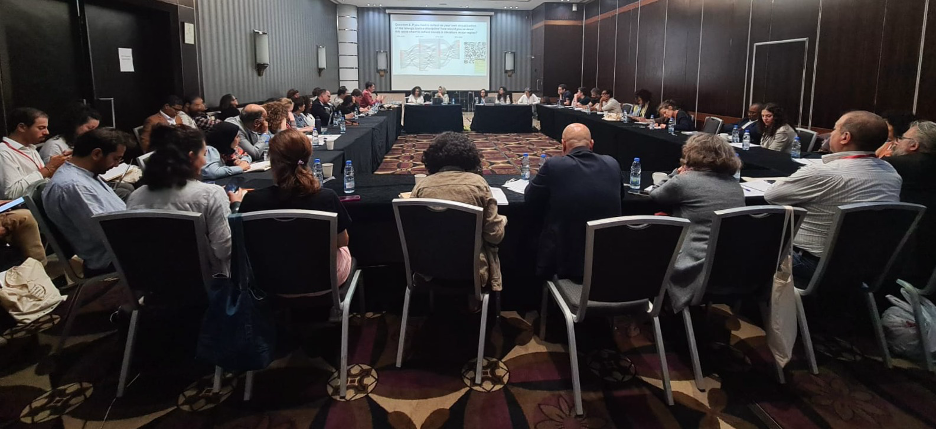
Photo of the workshop participants, 15 May 2025. Photo credit: “The (En)Visioning Justice Project.
Question 1: Why “energy justice”? Could you describe your current research interests in energy justice? What are the common understandings, lived experiences, or general political discourses of energy injustice in different communities, political groups, or public discourses throughout the region?
Ala’a Shehabi: This project is led by Muzna and myself who began to explore issues around energy justice back in 2019, building on growing scholarship on electricity in Lebanon. During the Lebanon uprising at the time, electricity prices and power cuts became powerful symbols of a broken political system. As people on the ground called for citizens' assemblies, we started considering how to work on energy not just as a research topic but as a space for deliberation, creating possibilities for alternative and more just energy systems. Based on this, we organized a pilot citizens’ assemblyas a small experiment to understand what it means to create a space for deliberation about energy justice. Despite the challenges of gathering people during the pandemic, those who participated helped us uncover new ways of thinking about how people relate to energy and the citizens’ assembly allowed for the articulation of the energy imaginaries that citizens favored; one based on a “circular economy” perspective, which connects energy, water, and waste in an interconnected system.
This year, we co-organized two further citizens’ assemblies. The first, in Beirut, focused on energy communitiesand collaborative or cooperative models for energy production and pathways for cleaner, cheaper and less labor demanding energy solutions in Beirut’s urban context. This assembly was more hands-on, providing learning opportunities for participants. The second assembly took place in Tunisia and focused on plans to produce green hydrogenin the southern town of Gabès. For these citizens’ assemblies we really need stronger narrative tools around energy justice. We therefore come to the idea of energy justice from below through a new method.
Muna Dajani: To think about energy justice, we need to start with the histories and stories untold instead of the ones where our region’s diversity and richness is flattened and reduced to appease orientalist and colonial worldviews that have dictated for centuries whose life matters and whose does not. In particular, and in these times of genocide, this means reflecting on what the Western world’s energy transitions seeks to preserve, protect and secure. Against this hegemonic worldview and future making, silenced and invisibilized histories, futures, and conceptualizations of injustice need to emerge. We are now stuck in a moment where justice has become a rhetoric instrumentalized to make normative claims by the most powerful in global environmental governance fora, where market-based instruments and actors dominate and orchestrate global solutions to address our current polycrisis. Justice is turned and shoved around in many ways—climate justice, just transitions; energy justice—that reduce the true potential of justice to political empty promises and a facade of inclusion. Like many other movements, such as the environmental justice movement, which began by exposing systems of inequality and injustice, energy justice has been co-opted in different ways.
Justice movements start from the grassroots; from people speaking up against injustice experienced and enacted against them and their worlds. Justice is not something policymakers want to achieve; it comes from the masses, from the ground up. My interest in energy justice comes from the grounded lived experience of people. But I am wary of the current moment because this moment of polycrisis tells us we need to talk about what a true “just energy transition” means to our region and worlds. But I am also aware of how justice can be co-opted. Policymakers, practitioners, and big companies have claimed it as a concept, but green energy transitions, in particular, reproduce colonial logics of extractivism and exploitation. Our region is where these processes have been enacted and resisted. I am interested in those new geographies of green extractivism; stories of what might be called “peripheral” geographies and people. Where do we start to point out an injustice that happened, situate it within a genealogy and a historiography of compounded colonization and dispossession, and politicize it again? Of course, Palestine’s experience of injustice is entrenched, multi-layered, continuing, expansive, and an open wound. We cannot think of injustice only in the current moment when it is so very monstrous, clear and structural. As we see in the current genocide, unleashing ecological violence against people, lands, and ecosystems, we cannot escape thinking about energy injustice. What Vijay Kolinvijadi and Asmaa Ashraf so eloquently articulate as green and environmental discourses and fantasies materializing at the expense of disposable and exploited bodies and geographies, of the Majority World, and in particular our region. We must be cognizant of the scale of injustice that has long plagued our worlds across its past, presents and futures as we embark on these debates and discussions. We need to trace connections from the everyday politics of claims and rights-making that communities use to secure access to water, electricity and land, to the broader colonial modernity against which we are forced to forge our lives and futures.
Eric Verdiel: You ask us to think, speak, and share some of the ways this notion of energy justice or injustice is experienced in the Arab world. I thought the cartoons by Emad Hajjaj, a Jordanian journalist and cartoonist, would be very interesting to illustrate some of these experiences.
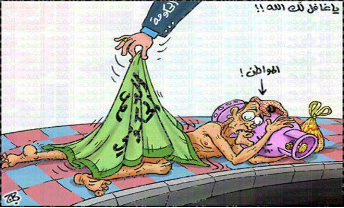
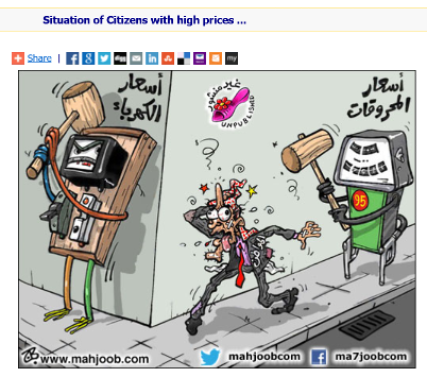
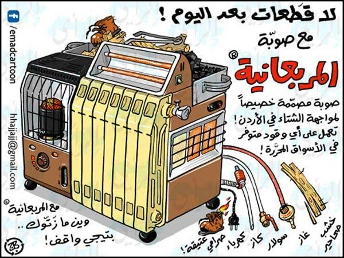
Maybe the first one is the most telling. We see Abu Mahjub, a Jordanian citizen, sleeping with the gas cylinder, which is used in Jordan for heating homes during the harsh winter. We see the blanket covering him being lifted by the state, saying “Al-da’am al-hukumi.” So it is really the “belifting” of the citizen. It says a lot about how energy justice and injustice are experienced. First, a bodily experience and politics is at the heart of this notion. We also see Abu Mahjub on one of the other representations being extorted by an electricity meter and a gasoline pump. In this series, Hajjaj speaks about the “meter,” the machines that count energy, also referring to a sense of abstraction coming with the infrastructure upon which people have become dependent. The last drawing is a very strange oven called al-marba‘aniyya, the oven of the “forty coldest days in winter” as peasants in Bilad al-Sham refer to, that symbolizes all the “bricolage” (DIY efforts) that citizens need to implement to cope with threats to their access to energy, like collecting wood for heat when gas is not affordable. The cartoons symbolize some of these experiences: the state revoking the citizen's security, and everyday life being absolutely dependent on these infrastructures to access a certain level of consumption, comfort, and wealth. This dialectic is very important to start understanding energy politics and energy justice.
Benjamin Schuetze: The most important point for me is that energy justice is ultimately a very contingent concept; it is what people make it. On this note, I would criticize any form of energy determinism and caution against the romanticization of renewable energies. Questions of energy and justice are related, but not deterministically. They are related in whatever way humans make them relate. I'd like to give two quick examples to demonstrate how the ideal of energy justice can also be used to replicate exploitative and repressive structures. One relates to the notion that often floats around that renewable energy is going to be an automatic means of democratization. There is a tendency to assume that renewables are powerful forces for democratization because they make it possible to decentralize energy supply, empowering citizens and local communities. This is a deeply problematic statement because first and foremost, corporate actors use renewables to make a profit. Further, states like Morocco and Israel use renewables to re-enforce illegal colonial regimes in the Western Sahara, Palestine and the Golan Heights, as Muna Dajani and others have shown. Another example relates to portrayals of greater regional energy cooperation as supposedly creating a win-win-win situation. The EU, for instance, claims that greater energy connectivity with North Africa would create jobs, making economies in the EU and in North Africa greener, and that these deals will help stop climate change. In reality, most of the jobs in renewables are located outside of the region. Also, if we look at the association agreements that the EU has drawn up with North African states, they include energy interconnectivity, but also the further containment and repression of migration to the EU. It is important to realize that the discourse of energy justice can also be used to perpetuate forms of repression and exploitation.
Trish Kahle: As a historian, I will present a slightly different perspective. Before we can define energy justice, we need to understand the energy system, and who and what counts within it. Energy systems, understood in this broader way,emerge from histories that have shaped how people think about the stakes of energy and justice. This is what I'm really interested in understanding in my own project examining an energy system in a rural village in northern Jordan. I want to understand how ordinary people lived with energy, how they understood it, and how it shaped the different parts of their lives. I want to understand the role they played in constituting that energy system, and how it has gendered the different forms of labor that surround it. I am interested in the kinds of choices people have and the kinds of choices which are foreclosed. Paying attention to the lives and labors of ordinary people offers not only a way to identify where injustice or justice might take place, but also actually allows us to understand energy as being constitutive of political imaginaries.
It’s true that often when people imagine an energy system, they are thinking about fossil fuel systems, contemporary renewable energy systems, or electric power systems, but energy histories run deeper than that. Energy history doesn’t begin with fossil fuels. In the tendency to begin energy histories of the region with histories of colonial extraction, I see the replication of a trope of the colonial historical imagination that imagined history arriving with the colonizers to a land and people that stood outside of time. Older energy systems go back to forms of ecological relations, of the circulation of food calories and fuel forms. Energy practices and energy vernaculars are part of the way that people make political community. As a result, the sites in which these practices take place are necessary sites for critical historical inquiry, for imagining different ways of being or living in the world, and to imagine living with energy differently. We need to be careful then, that we don’t exclude wider and deeper histories and socialities of energy from discussions about energy justice. When we are thinking about, for example, democratizing an electric power system, or how extractive projects create sacrifice zones, these are really questions about value. To understand these underlying questions about what we value and why, we need a historical framework that attunes us to different forms and scales of energy practices and the cultural meanings they produce.
Originally my interest in energy justice came from thinking about the relationship between workers in highly polluting fossil fuel industries, and the frontline communities which bore their impact. While I remain convinced that that is a very important angle, and far more work needs to be done on it, I came to recognize that people, in different aspects of their lives and in different forms of relations, are living in more complex ways with energy. A person might move between being a worker in one context, a “consumer” or user in another, or operating in a hierarchical workplace in one context versus a community setting in another. Using these economic and political structures is not necessarily a very good way to understand how people live with energy in a very basic sense. You really have to follow the energy and tracehow it moves in people’s everyday lives to recover some of these older imaginaries that we can then deploy in the context of “energy justice” or an insurrectionary research agenda.
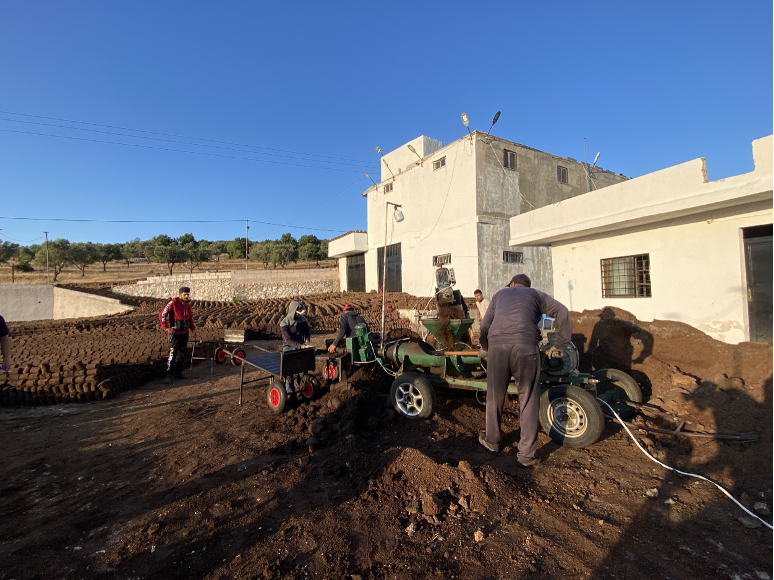
Photo by Trish Kahle of the re-use of olive “jiffet” as fuel in Jordan
Ala'a: As a historian, do you have examples of pre-modern energy systems that are relevant?
Trish: I’m a 20st century historian, so modernity is my home territory, but other ways of living with energy which may pre-date the twentieth century have also been a constituent if marginalized part of modernity. For example, in Jordan, I am thinking about olives as fuel, as calories as well as jiffet for heating of the village at the heart of the project. They don’t use gas for heating. They can’t afford to, so they still rely on jiffet. Tracing this practice reveals a complex system of gendered labor, a socio-energetic system of sharing and relating with energy that points to other ways of circulating energy, even though these are electrified villages and they are embroiled in cash economies and market cultures. Still, starting with jiffet and considering it in historical perspective offers other ways of imagining and thinking.
Dana Abi Ghanem: A historical perspective is also important to deepen our understanding of what energy practices emerge over time, underscoring the unfolding nature of the energy landscape, in contrast to the techno-economic paradigms that still dominate the field. For example, when exploring war and conflict in Lebanon and looking at the history of energy during the Lebanese civil war (1975-1990) we can observe how non-state actors intervened in electricity provision, and the relations that grew between them and those living in Beirut at the time. This historical perspective highlights how informal energy systems were not simply rule-bending or survival tactics but imbued with social and political meanings that were crucial for the locals and the political parties that participated in the conflict. Hence, meanings of energy justice in the region now cannot ignore social histories of energy infrastructures.
Zeina Abla: My work tries to connect our daily lived experience amid the multiple crises in Lebanon to global concepts. We at the Ebla Research Collective examined people’s everyday lives and how they encounter energy injustice through their daily practices, thereby situating the concept within the Lebanese context. I will refer to three studies: one study conducted in a Palestinian camp on the outskirts of Beirut, another examining building committees during Beirut’s electricity crisis, and a third exploring the risks of a large-scale renewable energy project in a remote area of Akkar.
All our work illustrates how electricity shortages and instability disproportionately affect women, who report heightened stress and daily hardship linked to unreliable supply. Our findings also reveal the burden of the high cost on households that pay two bills (one for the public grid and the other for a private generator). A 2021 survey by Human Rights Watch confirmed this burden, estimating that these bills consumed around 45% of the average household budgetbut could exceed 80% among the poorest groups. The burden of technically managing electricity in every home also creates fatigue. People articulated this by saying that they are, as citizens, assuming the responsibility and work of, “the electricity company, the municipality, the state and much more” as they juggle multiple inefficient power generating systems, not to mention the harm they face from air and noise pollution, and the environmental and infrastructural safety risks. In the Palestinian camps, people died from electricity-related accidents, such as exposed wires and generator fires.Another form of lived injustice is the dependent relationship with the generator owners, from which lower income households have difficulty escaping.
Our research also revealed that the introduction of renewable energy megaprojects often reinforces embedded clientelist relationships within local communities. In the case of Lebanon, it suggested that these projects sustain the country’s entrenched system of injustice through land conflicts, unfair returns, increasing rent-seeking, and sectarianism, particularly when local authorities did not negotiate on behalf of the local community and public rights. In such contexts, national political and economic elites capture internationally funded projects that appear to external funders to be favorable to the community under the guise of renewable energy developments.
As the study on Beirut’s building committees shows, the response to injustice often begins with collective efforts to cooperate; when these efforts fail, people turn to individual solutions. Most effective cooperative solutions relied on the lowest common denominator, participatory decision-making, leveraging social relations, trust, and quick, spontaneous response to all members’ needs. A similar pattern emerged in the Palestinian camp, where residents sought to establish local management structures to address the electricity crisis and the discrimination they experienced as Palestinians. Other research shows that cooperative models to address energy injustice have been more prevalent in Lebanon outside big cities.
It is undeniable that such lived experiences of energy injustice are a direct manifestation of the broader political economy that generates crises and reproduces everyday inequalities. The electricity sector reflects and reinforces these systemic dynamics, illustrating how deeply energy injustice is embedded within structures of political and economic power. However, any meaningful conceptualization of energy justice in Lebanon must move closer to the local and reflect the needs of those most affected, grounded in an understanding of their lived experiences, while simultaneously addressing the underlying political and economic injustices that sustain these conditions.
Hamza Hamouchene: To give concrete examples of how I understand energy injustice, I will focus on some examples from the Maghreb region. In Tunisia, there is an article in the new constitution stipulating national sovereignty over natural resources. Miskar, the largest and most productive gas field in Tunisia, was 100% owned by the British Gas Group until 2016 and then Shell until 2022. In that scheme, the BG Group and Shell sold gas to the Tunisian Electricity and Gas Company at global market prices and in hard currency, such that Tunisians were buying their gas as if it were imported. Additionally, 60% of Tunisia's electricity is currently produced from imported Algerian gas, and Algeria provides a further 11% of electricity to Tunisia, meaning the country is not self-sufficient in electricity production. Nonetheless, several proposed renewable energy projects are directed toward export, including green hydrogen projects. These projects use local resources, land, and water, without achieving either energy self-sufficiency or energy sovereignty. Carried out by foreign capital in alliance with local elites, they can be called “green neocolonialism,” where foreign agendas and foreign capital dominate with the participation of local capital.
In Morocco, Ouarzazate contains one of the world's largest concentrated solar power (CSP) plants. The solar farm can be seen as a “green grab,” as land was confiscated from local communities without a proper and transparent consultation process. It was also built on debt and with a privatization agenda through what is called public-private partnerships (PPPs) which are a euphemism for the privatization of profits and the socialization of losses. Another project in Morocco, the Midelt Solar Complex, witnessed protests by pastoral communities who called the project an outright “occupation.” Of course, the protests were suppressed. This is emblematic of what Marxist thinker David Harvey calls “accumulation by dispossession.” In the specific context of the green energy transitions, we can call such projects “decarbonization by dispossession.” All these projects are a form of spatial fix, where the historical responsibility for the climate crisis by the industrialized West is transferred across space to the Global South, creating “green sacrifice zones”for “sustainability.”
Moreover, through these projects, we see the construction and promotion of an environmental narrative, in a form of a renewed “green orientalism,” where the vast lands in our region are portrayed as empty, uninhabited desert, constituting a golden opportunity for Europe and Northern countries to acquire cheap green energy, while transferring social and environmental costs to our countries. Although all the examples I pointed to so far can be accurately described as green neocolonialism or green grabbing or perhaps decarbonization by dispossession, what happens in occupied land in our region from Western Sahara to the Golan Heights and Palestine can be surely called green colonialism. Palestinian scholars such as Samer Alatout, Muna Dajani, Manal Shqair, and others have documented such eco-colonial practices in Palestine and the Golan Heights and showed how Israel is greenwashing settler-colonialism, occupation, and apartheid by presenting itself as a green champion and environmental steward. Unfortunately, some of our dear Arab regimes legitimize such criminal endeavors by participating in normalization deals, including in the environmental sphere, something that has been described as eco-normalization. The proposed Green and Blue Prosperity project between Jordan, the UAE, and Israel is one such case.
Ala’a: When we visited Tunisia, there was a strong narrative around energy justice through the large electricity workers’ unions, do you have examples of this?
Hamza: The local partner with whom we, at the Transnational Institute, collaborate with is the Working Group for Energy Democracy in Tunisia, a collective of trade unionists and environmental activists that employs a distinct concept termed “energy democracy.” In their view, this concept has a broad scope and appeal. However, work on questions of democracy, justice and sovereignty when it comes to the energy transition within the trade union movement in the region is, in my opinion, somewhat weaker when compared to developments in other countries in Africa, Latin America, and Asia. These concepts are not as widely adopted, nor has there been a substantive discussion on climate change. Therefore, we need to promote this agenda more within trade union circles. Efforts toward this objective are underway through Public Service International (PSI) in Lebanon and Tunisia, a trade union federation concerned with public services as well as with our close global partner Trade Unions for Energy Democracy (TUED). In April 2025, I participated in a demonstration alongside activists from various associations and unions opposing green hydrogen projects, which employed an explicit anti-neocolonial discourse and demands
Muzna Al-Masri: Coming back to you Muna, can you give some examples of what energy injustice is in Palestine?
Muna: Energy injustice in Palestine is both material, as in issues of unequal access to electricity, and structural. Settler colonialism carves out a world of haves and have nots: Palestinians in different fragmented geographies therefore contend with issues of unreliable access to electricity and water. This is not because of a lack of capital or investment but rather enforced conditions of scarcity perpetuated by Israel as the settler colonial state and then normalized by the international aid community. For example, more than sixty percent of the occupied West Bank has to contend with an Israeli de facto embargo on the provision of basic services such as water and electricity, while the other forty percent also face restrictions. The South Hebron Hills region stands out for its abject conditions—lack of connection not due to remoteness but due to Israeli refusal of the right to basic infrastructure. This happens while the nearby illegal settlements enjoy abundance of land, water, and electricity. Energy injustice is further compounded by what Palestinians under siege in Gaza have been enduring for decades: intermittent electricity for a few hours per day, contingent upon Israeli imports and the availability of fuel—both controlled by Israel. Asmaa Abu Mezied has written about the energy poverty that Palestinians are forced to endure and how the international community and aid agencies reproduce a false narrative of energy poverty by designing and investing in solutions that propose more investments into green energy, promoted as justice-oriented solutions. What they do is depoliticize the imposed energy poverty by relying on technology and infrastructural development to remedy the situation, rather than considering the entrenched political reality of illegal siege, of Palestinians refused access to their resources, and denied sovereignty over those resources, whether water, solar, or gas. Today, the situation is so catastrophic and unimaginable because of the genocide. More than ninety percent of the population of Gaza are displaced, living in makeshift camps and tents, and electricity connections are scarce as Israel continues to illegally and deplorably deny the entry of fuel and reconstruction material. The question of energy justice is therefore much larger than the provision of services in a world where lives are being eradicated and disposed of. How do we link energy justice to wider struggles over sovereignty, and the right to resources, the right to have a say in how our own resources are used and exploited?
I try to unpack stories of places that don't make headlines. For example, the occupied Golan Heights (Jawlan) is Syrian land occupied by Israel since 1967. The Israeli regime has been exploiting its rich resources and depriving the remaining Syrian community of benefits since 1967. These communities live under precarious conditions without reliable electricity, especially in winter. While they are excluded from resource provision, the Jawlan has become a site for green energy transition projects Israel promotes as a Paris Agreement signatory. Israel advances its national contributions by doing this in occupied lands like the Golan Heights. But these green projects are also framed as bringing economic prosperity and jobs to a very small community. Since the announcement of the wind energy project and later when project began its work on the ground, the Jawlani community has protested and clashed with the occupation’s forces and the implementing company. These projects will destroy the last remaining agricultural lands for a community of just around 24,000 people, who rely so much on the land, not just as a site for economic activity, but also as the site of their identity and placemaking. Al Marsad, a human rights organization based in Majdal Shams, has produced a damning report that exposes the colonial and extractivist logic of the Israeli company. It has also mobilized the efforts of the community, academics, and legal experts to expose how the wind energy project is not only detrimental to the health and wellbeing of the occupied Golan Heights but also constitutes a destruction of the last stretch of lands that are the breathing lung of a community strangled by Israeli colonial settlements, explosive mines and a de facto border separating them from their Syrian homeland. Similar dynamics occur in the West Bank and the Naqab, where Palestinian Bedouin communities experience dispossession, expropriation, and marginalization under the guise of green energy transition.
Ultimately, energy justice is not only distributive; it’s not about how much energy we get or how connected we are but about who pulls the plug at the end of the day. This tells us much more, especially under settler colonialism and in other authoritarian contexts in our region. This genocide, for example, showed us just how much Gaza had become reliant on solar energy to electrify hospitals and places of refuge in public schools and community centers. They have been relying on it for so long because of the energy embargo that Israel has imposed. There are pathways where we can think of emancipatory infrastructure, but Palestine also shows how it can be hijacked or co-opted by multiple actors. This is not exceptional or unique to Palestine, but I think is replicated elsewhere as well.