[This article is the introduction to the Jadaliyya Iran Page's dossier, "Iran in Crisis: Seven Essays on the Obstacles to Freedom." Scroll to the bottom of this page to find all seven essays.]
“Free Iran” is increasingly being recoded as a right-wing crusade, especially in diaspora. This has added another layer to the multiple crises facing Iranian society. Across diasporic media ecosystems and international policy conversations, “Iran” is too often reduced to a narrow and familiar script. People are represented either as passive victims awaiting external rescue, or as heroic subjects whose sacrifice can be converted into justification for sanctions escalation, military strikes, or monarchist restorationist fantasies.
This external recoding draws strength from conditions inside Iran. Lethal repression and information blackouts make representation unusually consequential because Iranians are denied the infrastructures through which alternative politics can be articulated, debated and verified. Independent opposition parties are not permitted. Collective organizing is criminalized. Political and civil society activists, including union leaders and organizers, face imprisonment and censorship. Public communication is repeatedly severed, and narratives can be laundered, weaponised, and imposed.
This dossier starts from a basic question. How did we arrive at a moment in which imperialist powers that have waged war across the region and enabled Israel’s ongoing genocide in Gaza, can appear as plausible agents of “freedom for Iran?” How did the son of the deposed Iranian monarch, who long had negligible support inside Iran, come to appear as the only plausible alternative to a regime that many Iranians experience as hostile to their lives and future? The short essays collected here approach this question through historical materialist and decolonial analysis. Contributors trace how long-term neoliberal restructuring, sanctions-conditioned accumulation, ethnonational governance, ecological breakdown, and the systematic destruction of collective political capacities reshape what becomes thinkable as “politics” and what gets offered as a “solution.” In this account, reactionary capture is neither an accident nor a purely discursive shift. It reflects a material transformation of the political field, produced through the reorganization of accumulation and risk under sanctions, the securitization of dissent, and the erosion of institutions capable of translating collective demands into durable, structural change.
In contexts of prolonged crisis, people search for strategies that appear capable of ending unbearable conditions. The Iranian state has repeatedly blocked reform efforts, while cycles of protest and organizing by student, women, and civil rights activists have been met with mass arrests, torture, lethal violence, and exile. Independent unions are denied recognition, and bargaining channels have been systematically closed. Sanctions have deepened poverty and isolation, tightening the space for everyday survival. State economic policy has further intensified inequality through unrestrained inflation and rapid wage erosion. Daily life has become a struggle to make ends meet, while the costs of collective organizing are made devastatingly high. These pressures narrow the political field and reshape what can plausibly appear as a viable strategy.
There is an urgent need for anti-fascist, anti-capitalist feminist alternatives to the politics of despair as well as the politics of pragmatism, neither of which adequately respond to the popular desire to get rid of the Islamic Republic. We affirm this desire as legitimate and express our solidarity with Iranians who want to change their circumstances, including their government. Iranians should not be asked to sacrifice themselves in the name of “anti-imperialism” or die for an abstract principle of national sovereignty. When these values are emptied of justice and weaponized by the Islamic Republic, people will grasp for any exit from the status quo. Under these conditions, legitimate aspirations for freedom can become fodder for colonial and neocolonial conquest. The political task is to build forms of collective power that can pursue liberation without surrendering it to imperial violence or authoritarian control.
As the US and Israel threaten to launch another war on Iran, we are forced to reckon with the fragility of on-the-ground infrastructures that could sustain such a project. Under conditions of violent repression, displacement, and mediated visibility, efforts to build durable political capacities that can sustain solidarities across differences, distinguish between productive disagreement and betrayal, and protect collective organizing have been undermined repeatedly. We are also forced to reckon with the weakness of an internationalist alternative to imperial regime-change projects and alliances with a state that chose to massacre untold thousands rather than grant a single structural concession. This dossier takes these absences seriously as historical outcomes, and treats them as part of the conjuncture that reactionary forces exploit.
The main purpose of this dossier is to historicize and conceptualize the many obstacles to self-determination, which we understand to be a project of justice and democracy led by ordinary people in Iran. It approaches the current crises as the outcome of intertwined processes that have produced unsustainable economic, political, social and ecological conditions unevenly distributed across the geography of Iran. The contributions in this series develop this analysis across multiple scales. They trace how neoliberal restructuring and successive waves of sanctions reconfigured Iran’s political economy, and examine the crisis of social reproduction. They also examine how diaspora media and affective repertoires shape representation and international solidarity.
Several essays included in this dossier foreground political economy and examine the interplay between war, sanctions, and domestic policy. Kayhan Valadbaygi reconstructs three decades of policy shifts from post-revolutionary redistribution to neoliberal reform and the expansion of parastatal and security-linked economic power. He shows how sanctions amplified these trajectories by rewarding the institutions and networks able to profit under restriction and opacity, while shifting the costs through wage erosion, austerity, and deepening inequality.
Asma Abdi focuses on the crisis of social reproduction and traces how women and working class households bear its heaviest burdens. She shows how the erosion of food, shelter, care, and education infrastructures have become a central terrain of struggle, arguing against the separation between politics and economy as analytically misleading. Ida Nikou examines strikes and workplace protests and shows how they are shaped by securitized management and blocked negotiation. She argues that collective demands rarely translate into durable, enforceable outcomes, which helps explain why workplace conflict recurs and converges with wider street mobilizations.
Other contributors center the relationship between political economy, ecological destruction, state repression and ethnonational governance. Aghil Daghagheleh argues that center–periphery power dynamics and ethnicized governance have been constitutive of modern Iranian state formation and remain central to understanding authoritarian durability and uneven development. Allan Hassaniyan takes up these questions from the vantage point of Kurdistan and traces how repression, militarization, and extractive governance have shaped Kurdish political mobilization across Iran’s transformative epochs. By centering repertoires such as general strikes and civic resistance under intense surveillance, he shows how collective capacity is built and sustained under conditions that treat Kurdish political agency as a security threat.
Finally, this dossier returns to the struggle over representation that frames this introduction. It historicizes the rise of right-wing opposition forces in the diaspora and the criminalization of left and progressive alternatives in Iran. Mehrdad Emami examines the rise of monarchism and the regime-change industry in the diaspora, with attention to the media and lobbying infrastructures that have helped to install reactionary forces as hegemonic representatives of Iranian opposition politics. Sara Tafakori traces the political life of feminist autonomy as a central vocabulary of Iranian feminist mobilization. She shows how autonomy’s affective power makes it a potent resource for feminist claim-making while also making it vulnerable to neoliberal, nationalist, and imperial appropriation. Her contribution clarifies that left critique has to move beyond reflexive suspicion and rebuild solidaristic capacities that can hold disagreement without turning difference into disqualification.
Taken together, these essays argue that Iran’s current impasse reflects material transformations that have narrowed the political horizon while intensifying the struggle over representation. The dossier advances an anti-imperialist, anti-capitalist, feminist orientation as a method. In practice, this means starting from the conditions of everyday life, attending to the hierarchies and differences that shape survival strategies and uneven exposure to violence, and tracing how they are produced through political economy, governance, and coercion across multiple scales. It rejects imperial regime-change projects and it rejects rationalizations that excuse domestic repression as geopolitical necessity. The perspectives offered here center the autonomy of popular movements, and treat social reproduction, labor, and center–periphery relations as constitutive political-economic terrains. We offer this collaborative intellectual labor as a small act of hope against despair.
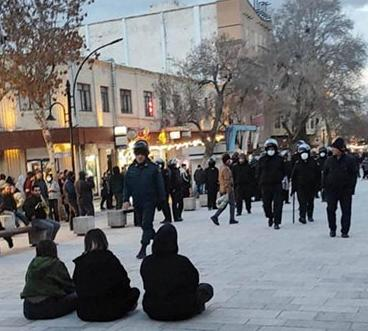
Women protest security forces. Hamadan, Iran. January 2026.
Articles
"From Revolution to Multi-Crisis: The Political Economy of Iran’s Present Conjuncture" by Kayhan Valadbaygi
"Gender, Crises of Social Reproduction, and Iran’s Neoliberal Policy Regime" by Asma Abdi
"The Politics of Non-Negotiability: Labor and the Making of Recurrent Uprisings in Iran" by Ida Nikou
"The Invisible Role of Ethnic Relations in Iran’s Current Crisis" by Aghil Daghagheleh
"Kurdish Political Mobilisation During Iran's Transformative Epochs" by Allan Hassaniyan
“Reactionary Politics in the Iranian Diaspora and the Crisis of International Solidarity” by Mehrdad Emami
“Autonomy's Travels: Feminist Vocabularies and the Politics of Appropriation in Iran” by Sara Tafakori
Contributors
Asma Abdi is an ESRC Postdoctoral Fellow at the University of Exeter. Her research and teaching sit at the intersection of global political economy, feminist theory, and de/postcolonial approaches. In particular, her work has examined the shifting gendered regimes of labor, social reproduction, and survival in Iran since the early 2010s, in the context of the country’s accelerated turn to neoliberalism and the intensification of the sanctions regime. Social reproduction, informal economy, and International political economy of war and sanctions constitute some of the key themes of her research. Asma’s work has appeared in feminist and politics journals and volumes, including International Feminist Journal of Politics and Social Politics.
Aghil Daghagheleh is an assistant professor of sociology at the University of Northern Colorado (UNC). He studies the politics of resistance among Indigenous and ethnic minorities in Iran, with a focus on Ahwazi Arabs.
Mehrdad Emami holds a PhD in sociology from Middle East Technical University in Ankara, Türkiye. His dissertation, “The Formation of the Subaltern and the Counter-Hegemony in the 2017–2022 Uprisings in Iran,” analyzes popular protest dynamics from a Gramscian perspective. He has translated books and articles from English and Turkish into Farsi on social movements, Marxism, ideology, and Turkish politics, and has also organized and led numerous workshops in Turkish on Iranian social movements.
Allan Hassaniyan is Senior Lecturer in Middle East Studies, Institute of Arab and Islamic Studies, University of Exeter.
Manijeh Moradian is assistant professor of Women’s, Gender and Sexuality Studies at Barnard College, Columbia University. Her book, This Flame Within: Iranian Revolutionaries in the United States (Duke University Press, 2022) won the 2024 Hamid Naficy Book Award for the best book in Iranian Diaspora Studies from the Association of Iranian Studies and the Center for Iranian Diaspora Studies. The book also received an Honorable Mention for the 2023 Middle East Studies Association Nikki Keddie Book Award. She has published widely including in American Quarterly, Journal of Asian American Studies, Radical History Review, Scholar & Feminist online, and Women’s Studies Quarterly. She is a founding member of the Raha Iranian Feminist Collective and a member of Feminists for Jina (feministsforjina.org).
Ida Nikou is a sociologist whose research focuses on labor, class, and political economy in Iran. She analyzes how sanctions, austerity, and financialization reorganize accumulation and shape class relations under authoritarian constraint. She received her PhD in Sociology from SUNY Stony Brook and teaches political economy and social theory.
Sara Tafakori is an Assistant Professor in Media and Communication at the University of Leeds. Her research brings feminist and postcolonial theory into dialogue with affect theory, media and cultural studies. With a particular focus on protest and digital culture in (post)colonial contact zones, she examines how mediated practices of dissent shape political spaces of appearance, alternative archives, and revolutionary imaginaries. Her work has appeared in Signs: Journal of Women in Culture and Society (awarded the 2021 Catharine Stimpson Prize), Review of International Studies, European Journal of Cultural Studies, and Feminist Media Studies. She is co-editor of the Brill Critical Emotion Studies book series and has held visiting fellowships at Princeton University, the LSE, SOAS and the Centre for Advanced Internet Studies at Ruhr University Bochum.
Kayhan Valadbaygi is a Fellow at the International Institute of Social History. His work explores the configurations of global capitalism and the international economic order in Iran and the broader Middle East. He is the author of Capitalism in Contemporary Iran: Capital Accumulation, State Formation, and Geopolitics(Manchester University Press, 2024), and co-editor of Mode of Production and the Historiography of Capitalism: Gender, Race and Eurocentrism (Bristol University Press, 2026).